Very basic on board electrics

meurig64

New Member
Joined
5 Aug 2013
Messages
7
Location
Fowey
Visit site
I have a 24' Woods Strider catamaran and would like to install some very basic on board electrics. Essentially I want a 12 volt battery dual powered by a solar panel and a wind generator. My electrical requirements would be as follows:
8 internal LED cabin lights (4inside each hull)
Port, Starboard, Anchor lights on the mast head and the same again either side and at the bow
1 x External Socket for my self steering device
2 x Internal sockets for USB phone/laptop charging
Depth and speed instrument
GPS
VHS radio

My needs are simple. I think I'll need a regulator to ensure that the battery receives a constant trickle from the solar panel and wind generator and doesn't discharge either. What I would be most interested in is what diameter cables do I need to handle the electrical flow to/from the battery and also the size cables to supply the rest of the requirements of my circuit?
Essentially I'm after a wiring diagram for the above to establish a safe, practical and flexible (should I need to make modest additions in the future) circuit.
 
Last edited:
I am sure you will get numerous 'perfectionist' replies.

At the other end of the spectrum, My Sadler29 is wired throughout with standard cheap 0.75mm twin core flex (2192Y) which is still perfectly satisfactory after nearly 30 years. For the connections from the battery to the switch/distribution panel I would use 4mm to allow for robustness and future expansion, though for your immediate needs 2.5mm should be adequate. Off course any engine starting requirements are separate.

It sounds like a basic PWM regulator will be adequate for your solar/wind chargers. Lots well under £10 on EBAY.
 
As Vic says. Wiring for some LEd light circuits can be quite light but any light wiring is more susceptible to corrosion and damage. So robust wire gives longest life.
The VHF radio takes most current on transmit but even this should be no problem with robust ordinary wire.18G. Get tin plated for preference.
The supply can be covered entirely by one fuse with just a master switch and switches for lights. The fuse needs to be rated for the highest current of demand but for lowest current for wiring so around 10 amps with wire that will carry 10 amps is simplest. Put the fuse near the battery. It can also protect wiring and regulator for charging. Try solar first as you might not need wind gen. good luck olewill
 
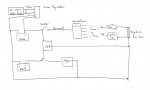
My set up is a bit like yours, rough sketch (hopefully) attached. I allowed 6.0mm cable from battery to switchboard as I added a fridge.
I also added a VSR, it detects when the solar regulator is charging and connects the two batteries together. It seems to work very well.

I used 1.5mm tinned cable for all the domestic loads and 1.0mm for the LED cabin lights and 6.0mm for the fridge.
Fuses for each domestic load are either 3A (lights etc), 6A for VHF and 15A for the fridge.

rough circuit.jpg

One thing I found, it's surprising how fast you power requirements can add up.

From what you mention, here are some guesstimates:
LED cabin lights: 1 Amp with them all on.
Nav Lights (Incandescent bulbs?) – say 2A
Self steer device - 500mA
USB socket (up to 1A) say 500mA
Instruments – 300mA
GPS - 300mA
VHS radio - 5 Amp (transmitting) 300mA standby.

So, say you have your nav lights on while transmitting on the radio, you could be pulling 7A through your cable.
It might be worth measuring your loads and then working out more closely what you need in the way of batteries and cable?

have fun.
 
There are some excellent books available on this subject which will answer any questions you may have. One basic book is Dag Pike "Boat Electrical Systems" which I think is still in print. There are others that are more comprehensive but this is a good first guide in plain english. Go to Amazon or other marine based bookstore for a selection.
 
Thanks Mike, will have a read. I've also been reading Boatowners illustrated wiring handbook by Charles Wing published by Adlard Coles Nautical and Electrics Afloat by Alastair Garrod also published by Adlard Coles. Both excellent.
 
I have half a dozen books about this which give lots of guidelines, and within reason I try to follow them. Much wiring that my father installed in 1964 using domestic flex still gives no problem, so I don't muck with it.

On the other hand, I have had a coax cable supplied specifically for marine use with moulded plastic plugs at each end corrode to destruction behind the plugs within 4 years.

Whatever you do, make your wiring tidy and accessible, and label it. I'm willing to bet that you'll add complexity over time and if you're anything like me you'll forget what you did.

And do use drip loops - so that any wire going downwards into and connector or device loops below and enters upwards meaning that condensation can't run down the wire into your gubbins. I have failed to do that - to my cost.
 
Lots of good advice. Follow it and you won't go far wrong.

A few tips:

Fuse each circuit separately and carry spare fuses. I'm in the process of planning a new switch/fuse panel and I'm allowing a few extra fuses for circuits I may want in the the future. When you've got leccy available, it's amazing how you find more uses for it. One thing you might want to consider is a couple of electric bilge pumps - they could save your boat one day!

I considered circuit breakers, but the only fuses I've seen blow in 10 years on Jissel, and far more years than I'm prepared to admit of driving old bangers, have been because of my own stupidity, so I decided that breakers weren't cost effective. I'm using car-type blade fuses in boxes that have an LED that lights when a fuse is blown.

Pretty much all the electrical problems I've had on both boats and bangers have been due to corrosion at connections, so leave some slack in the cables so you can remake them if necessary.

Finally, write it down! A simple circuit is easy to remember - today. In a couple of year's time, in the dark, trying to figure out why the nav lights have stopped working, you'll be very glad of that circuit diagram and all the labels on the wires. (You may want to get the diagram laminated, because it'll also be raining...) That's also when you'll be glad everything's on its own circuit, with its own switch and fuse.
 
There are some excellent books available on this subject which will answer any questions you may have. One basic book is Dag Pike "Boat Electrical Systems" which I think is still in print. There are others that are more comprehensive but this is a good first guide in plain english. Go to Amazon or other marine based bookstore for a selection.
+1

Got Pike's book for £0.99 including postage on Amazon!
 
Sorry to raise a somewhat contentious issue but given the cost etc and somewhat doubtful utility do you really need a windmill?

+1. A good one such as Rutland 914i will cost £700 ish if you fit yourself but if you Look at the power generation curves you'll be getting about 20AH a day in ten knots going up to more like 200AH in 20 knots. If you sail long distance in stronger apparent wins then it will provide all you need but if you sail and spend long time anchored in sheltered anchorages you may struggle.

You haven't mentioned engine charging is your boat powered by an outboard? Does it have battery charging?
 
Top