UV damage and webbing jackstays

but the webbing needs some slack to open the buckles slightly to get them onto (and later off) the U-bolts, so one at each end would result in a slack line which isn't good.
Actually there's a simple workaround to this: the forward buckles don't need to open at all once the basic length is fixed, just attach them to the U-bolts in the closed position with shackles.
 
Working At Height regulations in some jurisdictions require a 5000kg WLL on tethers and subsequent attachment points. It’s quite a high figure. However, quite achievable with webbing tape and fittings.
 
A related question perhaps: how taut or slack should webbing jacklines be?

Mine (never used in earnest!) have been about as tight as I can get them.

I am finally getting round to adding a centreline jackstay but I am pretty sure that the hatch garage isn’t strong enough so I want to make a pair in a /\ shape starting each side of the hatch and meeting at the mast.

Is that right?
 
A related question perhaps: how taut or slack should webbing jacklines be?
The least you can, in accordance with the boat geometry, tether lenghts, etc.
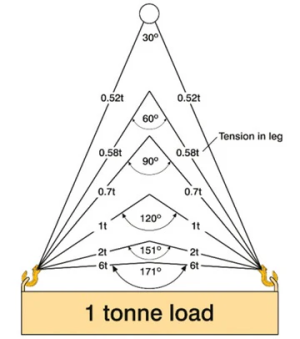
A transverse pull on a very tight line will generate a very high load, it will skyrocket with very tight lines (and theoretically become tending to infinite the higher the tension on the line, hence you break the webbing or the attachment points).
 
The least you can, in accordance with the boat geometry, tether lenghts, etc.
A transverse pull on a very tight line will generate a very high load, it will skyrocket with very tight lines (and theoretically become tending to infinite the higher the tension on the line, hence you break the webbing or the attachment points).
I'm never sure about this argument, surely if the question becomes relevant the line will very quickly *become* very taut anyway?
 
I'm never sure about this argument, surely if the question becomes relevant the line will very quickly *become* very taut anyway?
It's basic trigs, one divides against a number tending to zero. To figure it out, suppose the transverse load halfway along the line: with the two attachment points very close to each other, the load will be roughly distributed 50/50 on the two attachment points. Now keep on increasing the distance between the attachment points, the same halfway load will generate higher and higher loads on the attachment points and line. Or, take a rope between your hands with a 1kg weight in the middle, I bet you you can't pull the rope with your arms to make it almost horizontal, it will be impossible to make it perfectly horizontal :)
 
The least you can, in accordance with the boat geometry, tether lenghts, etc.
A transverse pull on a very tight line will generate a very high load, it will skyrocket with very tight lines (and theoretically become tending to infinite the higher the tension on the line, hence you break the webbing or the attachment points).

Surely everybody has seen this sort of diagram? The maths is exactly the same.

1776197548140.png
 
Just wondering, on small boats, say up to 28', could a series of mid ships strong points and a 2 hook harness do away with jackstays ?
On my very narrow in the beam 27 footer the mast is the single effective midships strong-point - lifeline around the base and clipped back onto itself if needs be.

BUT I would venture that the practice of clipping on is the essential mental safety, as much if not more than the actual physical security afforded.
 
On a tri, none of those things are a problem, neither is standing on the jackstay. You just don’t walk on that part, it’s 7ft from the edge of the boat, 7ft short of the bow and 5ft short of the stern. At sea, you’d normally crouch or crawl on the tramps unless going hand over hand on the coachroof. Then you’d walk upright on the tramp, the handholds are at hand height as you sink in to the tramp a bit. 6mm is obviously cheaper and lighter, so why not.
True. I run rope jacklines along the inner lacing.
2000kg is a 20g pull for the average wet guy on a lanyard. That’s going to sting a bit, as they say. Unless you’re exceptionally fat, I think 2000 kg is probably enough.
Not quite true.

The jackline is subject to a tight-rope force when you fall against the mid-point. The force on the jackline is easily 5x the fall impact force, and even Dyneema stretches some when rigged snug and then pulled to the side between two fixed points. The polyester tether also has some stretch, and the harness slides and the body deforms under impact. let's say 4x fall force.

Second, the 2000 kg figure is to allow a safety factor and an allowance for UV and wear. about 3:1 based on climbing gear practice for worst-case falls.

2000 kg rating is probably more like 2000/(4x3)=167 kg = 368 pounds, which is very realistic for a fall. The standard is what it is because that is what the math says. Jacklines have broken, but it is very rare, suggesting the standard is about right.
 
Top