Unbalanced LifePo4 batteries

mattonthesea

Well-Known Member
Joined
28 Nov 2009
Messages
1,522
Location
Bristol
ayearatsea.co.uk
Two 100Ah batteries in parallel with equal length connector leads just installed. Load connected - be to one and +ve to the other. Charged to 100% with shore power through B2B charge. All well. But only one of them seems to be discharging when fridge is turned on!

One of is 99% at 13.6V and 0A the other is 93% at 13.2V and -4.4A (I thought 13.2V is more like 70%?). This is from the Renogy Bluetooth app (DC Home).

Is this normal? Or, if not what could be the cause? The connectors are old but I gave them a good sanding to nearly shiny before installing.

Thanks

M
 
Two 100Ah batteries in parallel with equal length connector leads just installed. Load connected - be to one and +ve to the other. Charged to 100% with shore power through B2B charge. All well. But only one of them seems to be discharging when fridge is turned on!

One of is 99% at 13.6V and 0A the other is 93% at 13.2V and -4.4A (I thought 13.2V is more like 70%?). This is from the Renogy Bluetooth app (DC Home).

Is this normal? Or, if not what could be the cause? The connectors are old but I gave them a good sanding to nearly shiny before installing.

Thanks

M
What are the batteries? Do they have Bluetooth? You need to provide a lot more information
 
Do the batterys have any item between their parallel connection ... I assume you have a charge controller ?

Is it that there is a 'reverse flow protection' ... that may be blocking the second battery from supplying.

Just thinking out loud ... normally I would expect a load to be connected 'downstream' of the two batterys and any controller -
 
It's a good idea to charge both independently from each other with a lithium charger before fitting them in parallel. Are they "drop in replacements"? ... how much info can you get from the BMS? Are they Renogy batteries? ... like @geem said, need way more info on the batteries and their installation. Could be one BMS has decided not to allow discharge for some reason ... need more details.
 
It's a good idea to charge both independently from each other with a lithium charger before fitting them in parallel. Are they "drop in replacements"? ... how much info can you get from the BMS? Are they Renogy batteries? ... like @geem said, need way more info on the batteries and their installation. Could be one BMS has decided not to allow discharge for some reason ... need more details.
It could be a simple as 'discharge' is turned off in the BMS. Charge, discharge, balance are all on/off options on my BMS
 
Can you also name the batteries so those keen enough can look them up. Also do you have information on the voltage of individual cells? Pack (whole battery) voltage is less useful.
 
Check them with a multimeter - Renogy batteries are great but their BT and app are very poor - they are almost never right. I installed 6 200AH on a boat and spent ages trying to get each right before disconnecting each one, top levelling and putting back only to find the App still showed a difference . Ignore the BT SOC and use a multimeter or better still a proper battery monitor designed for LiFEPo

As a side bar I have installed hundreds of Renogy batteries and only ever personally recommend the Smart version with link cables and a separate monitor and never the BT versions. They all work correctly and are safe and use the same BMS but the BT and App combination is rubbish
 
Your Renorgy app is telling porkies or you have a bad connection between the two batteries because 2 batteries correctly wired in parallel must have the same voltage. A 0.4V difference would be impossible.
 
Check them with a multimeter - Renogy batteries are great but their BT and app are very poor - they are almost never right. I installed 6 200AH on a boat and spent ages trying to get each right before disconnecting each one, top levelling and putting back only to find the App still showed a difference . Ignore the BT SOC and use a multimeter or better still a proper battery monitor designed for LiFEPo

As a side bar I have installed hundreds of Renogy batteries and only ever personally recommend the Smart version with link cables and a separate monitor and never the BT versions. They all work correctly and are safe and use the same BMS but the BT and App combination is rubbish
Check them with a multimeter - Renogy batteries are great but their BT and app are very poor - they are almost never right. I installed 6 200AH on a boat and spent ages trying to get each right before disconnecting each one, top levelling and putting back only to find the App still showed a difference . Ignore the BT SOC and use a multimeter or better still a proper battery monitor designed for LiFEPo

As a side bar I have installed hundreds of Renogy batteries and only ever personally recommend the Smart version with link cables and a separate monitor and never the BT versions. They all work correctly and are safe and use the same BMS but the BT and App combination is rubbish
Check them with a multimeter - Renogy batteries are great but their BT and app are very poor - they are almost never right. I installed 6 200AH on a boat and spent ages trying to get each right before disconnecting each one, top levelling and putting back only to find the App still showed a difference . Ignore the BT SOC and use a multimeter or better still a proper battery monitor designed for LiFEPo
How do you top balance drop in batteries?
What does the Smart display provide that the App doesn't?
 
How do you top balance drop in batteries?
What does the Smart display provide that the App doesn't?
The BMS does it automatically but only if you run them down to shut off and then up to max again at a controlled rate

The Smart batteries have RJ45 connections to keep the bank linked and talking and software keeps them all equally charged as well as the individual cells. The accuracy of the software and comms this way seems to be perfect whilst the BT never is. I'm not sure why the difference but the "Smart" series with comms ports are about 10-15% more expensive than the BT versions that followed it even though the core cells are the same and the BMS is supposed to be the same and they just do a better job of reporting when you have a bank in parallel
 
The BMS does it automatically but only if you run them down to shut off and then up to max again at a controlled rate

The Smart batteries have RJ45 connections to keep the bank linked and talking and software keeps them all equally charged as well as the individual cells. The accuracy of the software and comms this way seems to be perfect whilst the BT never is. I'm not sure why the difference but the "Smart" series with comms ports are about 10-15% more expensive than the BT versions that followed it even though the core cells are the same and the BMS is supposed to be the same and they just do a better job of reporting when you have a bank in parallel
It looks like they use the Daly BMS? These use passive balancing. They burn off amps from the highest cells to match the charge of the lowest cell. They do with millivolts. If you get poor cell it is possible that the passive balancer can't keep up. The balancer is only effective at higher cell voltages. Often this is insufficient time spent at higher voltages tobalance the cells. This may only show up as the battery ages but worth people knowing what to look for in a good lithium drop in battery.
One of the best value decent BMS is currently the JK. This has 2A active balance. It takes up to 2A from the highest cell and sends it to the lowest cell.
Companies like Fogstar are using these in their drop in batteries. If you have to go drop in, this would be a far better choice of battery in my view.
 
It looks like they use the Daly BMS? These use passive balancing. They burn off amps from the highest cells to match the charge of the lowest cell. They do with millivolts. If you get poor cell it is possible that the passive balancer can't keep up. The balancer is only effective at higher cell voltages. Often this is insufficient time spent at higher voltages tobalance the cells. This may only show up as the battery ages but worth people knowing what to look for in a good lithium drop in battery.
One of the best value decent BMS is currently the JK. This has 2A active balance. It takes up to 2A from the highest cell and sends it to the lowest cell.
Companies like Fogstar are using these in their drop in batteries. If you have to go drop in, this would be a far better choice of battery in my view.
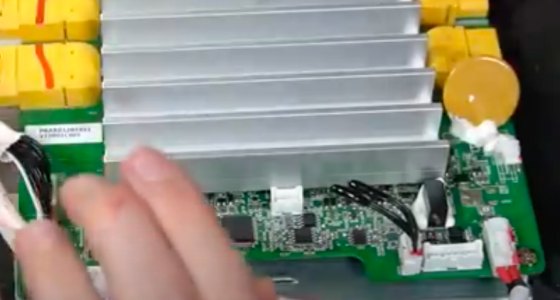
I can't say for sure but the BMS doesn't look like anything Daly make. In Will Prowse' tear down he comments he isn't sure who makes it (and he sells various BMS so would know) so it may well be proprietary. Built to handle 180 amps with multiple cell balance wires etc.

Might be worth watching his tear down to see if you recognise it..
Screenshot 2023-06-12 at 22.41.35.png
 
I can't say for sure but the BMS doesn't look like anything Daly make. In Will Prowse' tear down he comments he isn't sure who makes it (and he sells various BMS so would know) so it may well be proprietary. Built to handle 180 amps with multiple cell balance wires etc.

Might be worth watching his tear down to see if you recognise it..
View attachment 158075
Will Prowse pushes the Overkill BMS. This is actually a JK BMS that it's slightly modified with different external wiring. It is sold on the basis that you get excellent service back up if you need it.
Our JK BMS is 200A. On 24v this works perfectly for us as we are limited to the current the 3kw inverter can handle.
Building your own Lifepo4 battery is still better value than drop in batteries. Our 280Ah 24v battery cost £1200. Equivalent to 560Ah at 12v. That included the JK BMS, compression plates, threaded rods etc.
My insurance company have just accepted the install of my battery, though I did write up a technical article to explain it all. No additional premium.
 
OK so it looks like it might be a dodgy connection. They are now reading the same with all the cells on both batteries reading 3.3V.

I'm not sure what more information I need to supply. 12volt system. Sterling shore power 30a supply - not using at present. Sterling B2B plus mppv. Two 100aH Renogy Bluetooth batteries in parallel. No idea of BMS - they are internal! Renogy DC Home app is just a monitor. I can't get any other apps to find the battery data.

Anyway, I will check all the connections and voltages with multimeter and report back.

PS is there something I could apply to the battery connections to improve conductivity?

Thanks. M
 
OK so it looks like it might be a dodgy connection. They are now reading the same with all the cells on both batteries reading 3.3V.

I'm not sure what more information I need to supply. 12volt system. Sterling shore power 30a supply - not using at present. Sterling B2B plus mppv. Two 100aH Renogy Bluetooth batteries in parallel. No idea of BMS - they are internal! Renogy DC Home app is just a monitor. I can't get any other apps to find the battery data.

Anyway, I will check all the connections and voltages with multimeter and report back.

PS is there something I could apply to the battery connections to improve conductivity?

Thanks. M
Clean and tight should be enough.
Very Clean and very tight but not tight enough to break something.
 
OK so it looks like it might be a dodgy connection. They are now reading the same with all the cells on both batteries reading 3.3V.

I'm not sure what more information I need to supply. 12volt system. Sterling shore power 30a supply - not using at present. Sterling B2B plus mppv. Two 100aH Renogy Bluetooth batteries in parallel. No idea of BMS - they are internal! Renogy DC Home app is just a monitor. I can't get any other apps to find the battery data.

Anyway, I will check all the connections and voltages with multimeter and report back.

PS is there something I could apply to the battery connections to improve conductivity?

Thanks. M
How are you managing SOC? You don't have a smart shunt or similar in the system
 
Whoops, I meant B2B!
Can you set bulk, absorption and float on the B2B or doesn't just have a generic lithium setting?
Ditto the MPPT?
Monitoring SOC without a smart shunt may be problematic. Inbuilt BMS are notorious for inaccurate readings. You may find each battery gives you a significantly different value of SOC
 
Top