
ari
Well-Known Member
B
Remember, when heckling, you are supposed to make me look stupid, not the other way round :nonchalance:
The irony is strong in this one.


B
Remember, when heckling, you are supposed to make me look stupid, not the other way round :nonchalance:


Ari - can you factually support your argument with actuarial evidence from boat insurance Co,s
Like for like two identital boats ,except ones a twin Petrol ,other is a twin diesel , will there's be a premium difference ?
If so ARi why do think that might be ?
On that thought over say a 5-7 y ownership period would insurance cost difference ,if any ( i don,t know,but like No Regrets have pretty good gut feeling ) be anything to worry about --- i mean help the Op dicide ?
I think the excess fuel Bill issue ,we all understand .

This question is bit of a regular and having gone through the same dilemma many years ago would like to sum it all up.
It normally rears its ugly head on the transition from small speedboat/ cuddy type fishing boat with outboard, frequently on a trailer.
The idea is something a bit more stable,perhaps even a proper bog and galley and the ability to stay away a little longer and to sleep over night in some sort of comfort.
The boater will at this stage* still be clinging to the laughable illusion that a whizzy sports boat is going to enhance his sexual prowess/give him back his hair/knock ten years off his age,so sports boats it is then.
*Most do grow out of this stage but not all but all your mates know who you are
Confronted with small amount available after selling his speedboat and the ridiculous amounts of money demanded on 30 year old Targas or much newer built out of tinsle and egg cartons newer boats, he wanders the marinas in a desolate mood.
He would rather chew glass than be seen at the helm of an olde persons boat.
Scanning the brokers website he spots a really immaculate boat with amazingly low hours and its in his price range.....Hope springs eternal so off he trots.
The boat is immaculate, the buyer,who has only had the boat a short time, is really really keen to sell .......purely as he is upgrading.
All is going well until you lift the engine cover.....and there blinking in the light are a couple of engines in a stunning shade of RED.
The last sound you remember is the brokers voice telling you just how economical a pair of V8 /V6/inline 4 petrols can be.......
Virtually all of us with pockets a great deal smaller that our ambitions have gone down this path and just note that virtually everyone about to suggest to you that petrols are not really that bad has probably got a petrol boat.
That was me included until we saw the light.
This is actually a very good question - so I made some enquiries at lunchtime and found out.
The answer is yes, there may be a slight difference in premium between an otherwise identical petrol and diesel boat (so same age, same power, same speed etc - so to use rbcoomber's example, one Sunseeker Portofino 31 with twin 200hp petrols, the other Sunseeker 31 Portofino with twin 200hp diesels).
Assuming that the diesel boat has a higher insured value (ie it cost/is worth more - as is likely), the premium for the diesel boat would be slightly higher, because in a total loss, the payout would be higher.
But no, there is no premium loading for a petrol boat over a diesel (assuming everything else equal) as the reality is no measurable increase in risk.
He did say that if the diesel boat had a small four cylinder motor (for example) and the petrol was a big V8 then it could be possible that the increase in top speed pushed the faster boat into a higher risk band, but that was purely down to speed - would be the same if you were comparing a small petrol and a big diesel where the latter pushed the speed into a higher band.
So to answer the question, as far as boat insurance is concerned, the risk profile of petrol and diesel boats is identical.

This is actually a very good question - so I made some enquiries at lunchtime and found out.
The answer is yes, there may be a slight difference in premium between an otherwise identical petrol and diesel boat (so same age, same power, same speed etc - so to use rbcoomber's example, one Sunseeker Portofino 31 with twin 200hp petrols, the other Sunseeker 31 Portofino with twin 200hp diesels).
Assuming that the diesel boat has a higher insured value (ie it cost/is worth more - as is likely), the premium for the diesel boat would be slightly higher, because in a total loss, the payout would be higher.
But no, there is no premium loading for a petrol boat over a diesel (assuming everything else equal) as the reality is no measurable increase in risk.
He did say that if the diesel boat had a small four cylinder motor (for example) and the petrol was a big V8 then it could be possible that the increase in top speed pushed the faster boat into a higher risk band, but that was purely down to speed - would be the same if you were comparing a small petrol and a big diesel where the latter pushed the speed into a higher band.
So to answer the question, as far as boat insurance is concerned, the risk profile of petrol and diesel boats is identical.

It normally rears its ugly head on the transition from small speedboat/ cuddy type fishing boat with outboard, frequently on a trailer.
The idea is something a bit more stable,perhaps even a proper bog and galley and the ability to stay away a little longer and to sleep over night in some sort of comfort.
The boater will at this stage* still be clinging to the laughable illusion that a whizzy sports boat is going to enhance his sexual prowess/give him back his hair/knock ten years off his age,so sports boats it is then.
*Most do grow out of this stage but not all but all your mates know who you are
Confronted with small amount available after selling his speedboat and the ridiculous amounts of money demanded on 30 year old Targas or much newer built out of tinsle and egg cartons newer boats, he wanders the marinas in a desolate mood.
He would rather chew glass than be seen at the helm of an olde persons boat.
Scanning the brokers website he spots a really immaculate boat with amazingly low hours and its in his price range.....Hope springs eternal so off he trots.
The boat is immaculate, the buyer,who has only had the boat a short time, is really really keen to sell .......purely as he is upgrading.
All is going well until you lift the engine cover.....and there blinking in the light are a couple of engines in a stunning shade of RED.
The last sound you remember is the brokers voice telling you just how economical a pair of V8 /V6/inline 4 petrols can be.......
Are you stalking me?

That depends.....
For those who want a cheap twin petrol boat this may indicate what they are really worth.
http://www.ebay.co.uk/itm/Sealine-3...777839?hash=item3adb441eef:g:~TwAAOSwCU1Yqr-o

That to me looks bit overpriced for a project boat!
That to me looks bit overpriced for a project boat!

. . .
Even if you don't consider the not-unsubstantial risk of carrying Petrol on the boat and it's a no brainer.
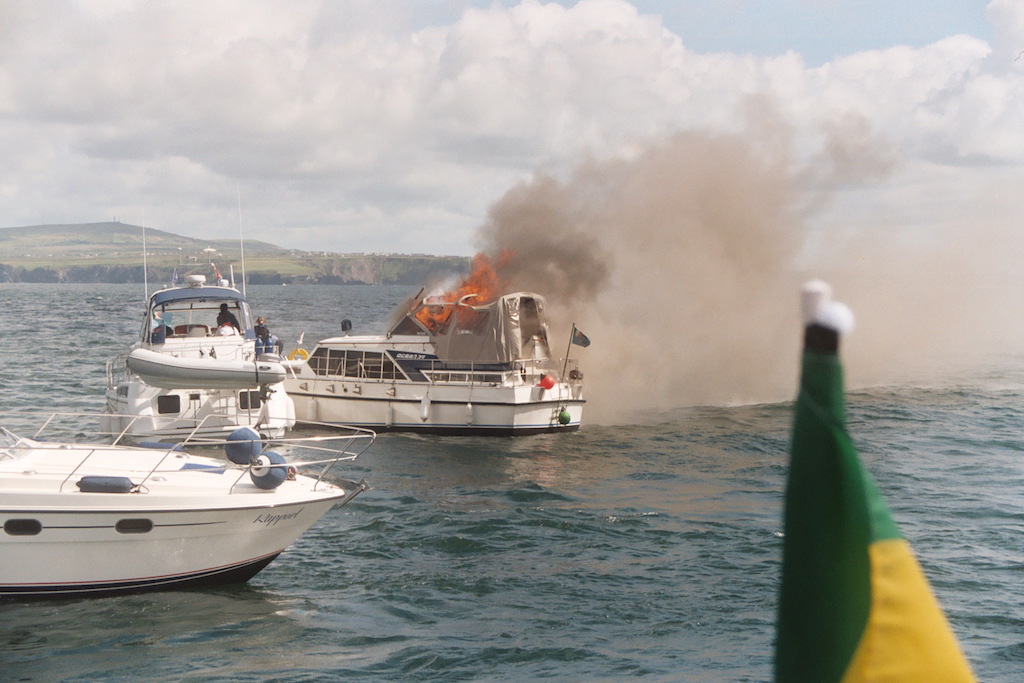

Aside from the risk of a fire on any type of boat, there is the separate risk of escaping a petrol boat on fire. The two crew of this vessel 12 years ago possibly may not have made it, except for the precious time slow burning and non-explosive diesel gave them before rescue arrived.
Love to see Ari on this one! I'll bet his pathetic little smirk would be slightly different :encouragement:
It's always lovely to have an adult and reasoned debate.
So we've had petrol boats on fire to prove petrol boats are 'a substantial risk', now we have a diesel boat on fire to, err, prove that petrol boats are 'a substantial risk'. Somehow.
So, to answer Oceanfroggie's point.
Would it have been worse had there been petrol on board? Yes.
But would it have been worse if the boat wasn't close inshore? Yes.
Would it have been worse if it hadn't been calm conditions? Yes.
Would it have been worse if there hadn't been other boats nearby? Yes.
Would it be worse if it were at night? Yes.
So does that prove that it's a 'substantial risk' to run a petrol boat? Well only if you agree that it's a 'substantial risk' to go offshore, a 'substantial risk' to go boating when there aren't other boats nearby, a 'substantial risk' to go out if sea conditions aren't calm or a 'substantial risk' to go boating at night?
You can point to any incident to try and 'prove' that the thing involved is a 'substantial risk' - as I mentioned earlier, 1,000 people a year die falling down stairs.
http://news.bbc.co.uk/1/hi/health/790609.stm
I still live in a house though, and I suspect so do most people on this thread that do won't be moving to a bungalow now that they know this.
Is your boat petrol by any chance?


