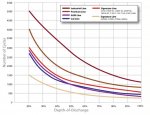
Trojan 31XHS life

I'm waiting to see how my T125s stand the test of time but, in common with most other users, they're abused in not receiving the charge regime Trojan specify. 14.82v bulk, 13.5 float & 16.2v equalize.

95% of our charging is via solar, occasionally topped up with battery charger run on generator or sometimes shore supply. Neither the solar regulator or mains charger are capable of giving the required charging voltages so, the batteries spend most of the time at float voltage which means they're constantly being undercharged.

Most chargers just have a fixed time for 14.4v bulk charge and then drop to float for as long as left switched on. Only way I can see to charge correctly is by having a variable voltage power supply where the user can choose the output voltage and time accordingly.

You have to remember the original, and probably still biggest, application for these is floor scrubbers in hospitals, offices etc., followed by golf and airport buggys. The typical use cycle is a heavy discharge and recharge daily hence the high voltages to keep them up to charge, and quickly. The strong high antimony content grids help withstand this rough treatment and the considerably increased self discharge rate is unimportant. The object is not long life in years but best number of cycles. The low(ish) float voltage will also be to reduce water loss when they are left over weekends, holidays etc.
The boat situation is different and you should be perfectly OK with the normal 14.4V or thereabouts recharge regime and it will give a longer life in years and less water loss.
The 16.2V figure is unusually high, but an equalisation at say 15.5V can be useful occasionally to bring them up to scratch or help restore after a deep discharge.
 
Apparently my mains charger will explode any sealed battery so a change to agm has a cost overhead so I'm stuck with open types.

I don't think that this is true, AGM's like other sealed batteries are valve regulated, so if you do push the voltage up so that they produce lot of gas the valve will blow. You'll probably knacker the battery, but it is very unlikely to blow up.

I can't see a battery which will blow-up getting CE (or any other) approval for sale, especially if bought by a reputable manufacture.

Yes all AGMs blow off gas at typically 2.5psi. You could explode the gas of course! Less dramatically you will dry the battery out quite quickly if you habitually go above (typically) 14.2V for long. AGMs start off with the separators only about 95% saturated, that's necessary for recombination and any water loss will soon reduce performance.
 

The batteries I referred to in post #12 were, if I remember correctly, were Trojan AGM (2@110 amp hr) on my Parker 275, which had 220 amp hrs of domestic, but very light loads, just lights and basic navigation aids.

The current batteries are Elecsol, however, the Southerly has much bigger loads, 5KVA inverter, 5KV bow thruster, electric winches, electric windlass and a full sweet of Raymarine Nav gear, including a powerful autopilot.

Last time I looked I couldn't see any AGMs sold by Trojan, I'd have brought Trojan AGMs again if I could have, and Elecsol no longer seem to be in business, which I think is a great shame, their technology, which has carbon fibre in the plates, seems to be quite good.

The "Topping Up" I was doing last night was from a bottle of Dalwhinnie Winter's Gold ..... very nice and smooth
:tranquillity:

The Trojan's I understand, but yours is about the first good report I've heard of Elecsol! Yes they are defunct and it was only ever about 2 men and a dog. I don't know who made the batteries for them. A number of manufacturers experimented with carbon fibre in the paste (the more normal is polyester fibres, it's for mechanical strength rather than electrical properties) but I never heard of anyone else using it.

Trojan "deep cycle" AGMs here http://www.trojanbattery.com/reliantagm/ don't know if sold in UK.
No idea how good they are. They have quite high CCA figures which suggest quite thin plates, which isn't conducive to good cycle life.
 
Definitely +1. Gladys had knackered 3x 75 AH Odysseys (left on a "non smart" charger by PO) when I bought her, which I replaced with 110 AH Squadrons (no longer available) which I badly mistreated in their first year by letting them down to 4V. That was 2006, and I replaced them with 110 AH AX31's from Battery Megastore last winter for £130 a battery. The original Engine battery was an identical Odyssey installed in 2002, which also got replaced last winter... AGM's are now available that are no longer stupid money (equivalent Odysseys are over £250) and in my experience are the way to go

This one? https://www.batterymegastore.co.uk/hankook-ax31-950.html
Hankook is one of several brands of AtlasBX in Korea. Here's their data sheet for it under their designation AGM M31-950. http://www.atlasbx.co.kr/en/product/marine01.jsp You'll note they describe it as dual purpose and give it a CCA of 950A. That pretty high figure, plus the fact that the grids are stamped (see http://www.atlasbx.co.kr/en/technology/automotive01.jsp ), indicates quite thin 2D plates. You can't regard it as a deep cycle battery equivalent to (e.g) a Trojan.
I'm not knocking it for what it is, I think AtlasBX are a decent substantial company, and in fact I have wet batteries that I think are from their factory. However you need to have realistic expectations. It will be interesting to see what life you get. The key thing is not to discharge them (much) :-)
Batt Mega exaggerate things wildly but as there is no legal definition of deep cycle, what can you do?

The main strength of the Odyssey is fantastic high rate performance. It makes no sense as a house battery. I worked on its predecessor and I shuddered when I heard Calder had chosen them fo his electric propulsion project.
 
Last edited:
As far as AGM's not blowing is concerned, I wish I had taken a picture of one of the Odysseys that I removed on the original domestic bank, it would roll around nicely on bottom or sides... I know the VRLA thing, but I would have thought that would have required more than 2.5psi to blow.

The Hankooks are the ones. I'm not a liveaboard, have solar on a swinging mooring, and for that kind of boat use they seem ideal... Time will tell.
 
As far as AGM's not blowing is concerned, I wish I had taken a picture of one of the Odysseys that I removed on the original domestic bank, it would roll around nicely on bottom or sides... I know the VRLA thing, but I would have thought that would have required more than 2.5psi to blow.

### They may have been hot as well.

The Hankooks are the ones. I'm not a liveaboard, have solar on a swinging mooring, and for that kind of boat use they seem ideal... Time will tell.

I wouldn't be surprised at anything up to 5 years from the Hankooks if very rarely discharged to any depth. Worth an effort to give a decent boost from a mains charger once or twice a year if you can, or after a significant discharge.
 
I wouldn't be surprised at anything up to 5 years from the Hankooks if very rarely discharged to any depth. Worth an effort to give a decent boost from a mains charger once or twice a year if you can, or after a significant discharge.

Well, I got 11 years from the abused Squadrons, I hope for the same or a bit more....
 
We had two 6v Trojan 105 batteries wired in series with everyday use long distance sailing for six and a half years, I had to replace them after 5 years. I suppose there are some options for four years they like to be used and charged everyday or 12 volt Trojans last less time or something else.
 
A bit more news...

(1) Trojan have kindly allowed me to upload thier battery curves so should be attached
(2) A T1275 apparently has twice the cyclic life of a 31XHS
(3) Their techies report that at temperatures above 25C the life is reduced 'at 10C above the life is halved'. Bad news for anyone in the Med...
(4) A T1275 in UK is £166 in Greece E345 !!! Anyone know how to ship two heavy batteries to Greece?

What fun we have...
 

Attachments

  • trojan battey curves.jpg
    trojan battey curves.jpg
    60.1 KB · Views: 1
A bit more news...

(1) Trojan have kindly allowed me to upload thier battery curves so should be attached
(2) A T1275 apparently has twice the cyclic life of a 31XHS
(3) Their techies report that at temperatures above 25C the life is reduced 'at 10C above the life is halved'. Bad news for anyone in the Med...
(4) A T1275 in UK is £166 in Greece E345 !!! Anyone know how to ship two heavy batteries to Greece?

What fun we have...

Thanks. That fits with the graph posted (by Sarabande?) a few weeks ago, which had curves for just the open lead-acid Trojans.
I'm not sure what a T1275 is, although obviously I recognise the T-105 because I have them.
I wouldn't worry unduly about the much-reduced life at 35C. What proportion of the year are average temperatures above even 30C in Greece, night included? 20%? Doubt it's much more than that. Also worth noting that the available capacity of lead-acids falls progressively below about 20C. I'd have thought that mean temperatures around the Med are on the whole quite kind to batteries. (Just don't go cruising in the Libyan desert in August.)

Those do sound scandalous prices in Greece. Ours T105s came from Istanbul at little more than the best UK prices.
 
A bit more news...


(3) Their techies report that at temperatures above 25C the life is reduced 'at 10C above the life is halved'. Bad news for anyone in the Med...

That is a standard provision for the life in years limited by corrosion. It's a general chemical rule that an extra 10 deg C doubles a reaction rate.
It should not have that effect on the cycle life as the main harm from cycling is mechanical from expansion and contraction in the charge/discharge cycle.
 
Top