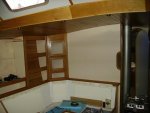
Tongue and groove as headlining

A simple lap joint is better (probably not the right name) like two overlapping 'L's. The new lining on my boat has been made this way. Don't use pine as it swells and splits from what I have seen.
 
Have used it for lining hull sides. Perhaps best attached to a frame with brass panel pins which allows it to expand and contract.
 
'Shiplap', perhaps?

Indeed it is, after a quick google the lap joint I am talking about is actually a V-Joint Shiplap, where the outer edges are chamfered slightly, thanks.
 
I have T & G teak as headlining. Excellent stuff. I preserve it with sadolin refreshing it every three or four years. Still as good as new after 20 years.
 
I know a couple of people who used pvc t&g panels as their headlining. Seemed quite a neat solution, easy to keep clean, cheap, worked well with the curve of the deckhead.
 
Been used on canal narrowboats for side and headlining for many, many years.

An excellent idea, but dont use cheapo stuff. It is usually fixed every two or three rows by nailing through the bottom groove, before entering the next tongued piece. Narrowboats can have an almost flat roof. If too many fastenings are used it can restrict the natural movement of the timber. Last time I used it I used S/S pins.

Be worth visiting a narrowboat builder to ask for advice-and perhaps as a source of good timber.
 
Last edited:
We built a bungalow in 1973 and lived in it until 2004, it was a diy job so time and skills were limited, the style was Scandanavian/ Irish Cottage with pitched ceilings; I opted to line all the ceilings with very light (7mm) t &g vee jointed sw matchboarding, the bathrooms except shower walls and splashbacks were the same stuff, we did not know of intumescent varnishes so all the surfaces were finished with yacht varnish. It needed to be very dry when fixed and the joints well wedged before nailing with sherardized pins. When we left after 30 years the light golden colour had darkened quite a bit but otherwise it was sound. It only really works if your rectangles are true, any deficiencies in shape are exagerrated by the joints. At the time I considered an open vee profile but decided it would look too 'sixties' though we did use it for the folding panels of the garage doors. It was open plan, rooms defined by changes in floor and ceiling level walls were painted concrete brick and nearly all the floors were maple but I never recall the acoustic horrors Dougal refers to.
I added a cantilevered bathroom to our current house and to keep weight down lined the walls with the same stuff this time it was opaque painted, New England style, has weathered well resisting steam, about 12 years now.
The critical thing is movement across the grain with changes in humidity, it needs to be dry and tight but if you overdo it and it then gets too damp it can explode away from the surface. If it worked in Antrim and Argyll it should be okay anywhere, the rest of the world is less humid.
 
Unless you are set on the idea of a wood look why not think about PVC panels that have the appearance of T&G boards and in fact join to each other with a T&G.
 
Kiss pics for Yobbo 003.jpg
This was an home made 'shiplap' profile in English oak, that allows secret nailing if required. We actually glued it all one strip at a time !
It's good for following a camber to the deck head that really emphasizes the curve. We also used it as the backing to the shelving down the side of the hull !
 
Last edited:
If the curve of the headlining is significant in places, you may have to cut back on the tongue or cut off the top wall of the groove otherwise it might be too tight a fit.
 
Top