Tightening Alternator Pulley?

Normally I would simply whip the nut on/off with an air driven impact wrench, it takes a matter of seconds. If you have not got easy access to one go to your nearest auto electrician, they are removing/fitting pulleys all the time to alternators - should not be a problem. Agree hex key there for a reason but impact wrench would I think be my tool of choice, professional mechanics use them to save time and remove awkward fastenings. I have seen car suspension units dismantled in minutes whilst us mere mortals are still looking for our first socket !
 
With my new layout, the pulley was right on the end of the shaft, which I'm not too keen about. If I can't fix the alternator I will have to buy a new one, which will probably have a shorter shaft. Either way, I'm considering one of these: http://r.ebay.com/opESjg

$_12.GIF


Only problem is, how do you tighten the nut?

Could be worth asking the supplier for advice?
 
I have been "away" and so haven't read all the thread. has anyone suggested taking the alternator off the motor and nipping (just enough) the new pulley in a vice to allow you to tighten the nut with a normal socket? I do it all the time and as long as it isn't a nasty pressed-steel pulley there is no distortion.
 
In Nigels case the engine rotates clockwise ITYWF. therefore it would require a LH thread on the alternator shaft to have a tightening effect.

Yes, clockwise as you look at the crank pulley. The alternator shaft has a normal RH thread (although the mechanism is bi-directional) but I think that is correct: if the pulley slips on the shaft it will tend to tighten the nut. I think. It was certainly a bugger to undo.

As an aside, some Greek chap who came to change my camshaft belts tried to convince me that the second alternator on the starboard side would spin in the other direction :)
 
As an aside, some Greek chap who came to change my camshaft belts tried to convince me that the second alternator on the starboard side would spin in the other direction :)

And you let him change your camshaft belts. You are braver then me.

BTW you could have used a pipe wrench (stilsons) to tighten your 24mm socket saving the need to weld a nut to the socket.
 
With my new layout, the pulley was right on the end of the shaft, which I'm not too keen about. If I can't fix the alternator I will have to buy a new one, which will probably have a shorter shaft. Either way, I'm considering one of these: http://r.ebay.com/opESjg

$_12.GIF


Only problem is, how do you tighten the nut?

Undid and retightened mine with an air powered impact hammer. If you havent got one your local tyre place will no doubt help for a few sovs.
 
How could such a simple problem be so difficult to resolve!!? In your days as a mechanic you would have used an air wrench as suggested. Has this problem been exacerbated by the nut being a nyloc type? Even one of those can be tightened by holding the pulley in a vice, pushing the shaft into it and applying sideways pressure on the body of (in this case the alternator) the component to jam the shaft in the pulley and fitting the nut. If it is not a nyloc nut but still tight on the thread, and the aforementioned method is no good, heat it up and spin it on with a drill driven socket (or quickly by hand) and then tighten to the required torque. I do hope you find a cost effective solution. Whatever you do don't apply lubricants, it will just make your job more difficult if you can't hold the shaft with an allen key.
 
How could such a simple problem be so difficult to resolve!!? ...

At home it would be simple job, but on the boat with limited resources it is better to have the correct tool. I did manage to remove the nut using a 24mm spanner (which I had to go and buy) and an Allen key wedged against a bit of wood in the engine well. But tightening the nut in a recessed pulley is a different matter.
 
I know how you feel! I stripped down my Jaguar top end a couple of weeks ago and the 4 overhead camshaft sprockets are not keyed to the end of the camshafts, it's just a taper. Just imagine the force on that taper with each cam opening 8 valves. I could not turn the cams by hand. Incredible! :(

Richard
 
Tapers ! do you know how much they cost? Ford Sigma engine cam sprockets have a face fit with one centre bolt, early ones were powder sinter pulleys, with latest being Plastic ! Never had one move during developement, or in production.
 
Tapers ! do you know how much they cost? Ford Sigma engine cam sprockets have a face fit with one centre bolt, early ones were powder sinter pulleys, with latest being Plastic ! Never had one move during developement, or in production.

My cams also have one centre bolt and I must admit that they have never moved but it still seems suprising to me that there is no woodruff key.

Jaguar call mine an "interference fit". Is that the same as a "taper fit" or is there some subtle difference?

Richard
 
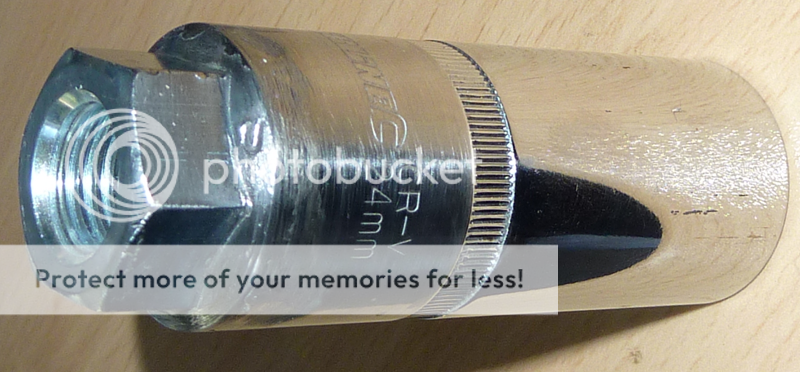
In the spirit of PRACTICAL Boat Owner, I've decided to buy a cheap 24mm socket and weld an M16 (24mm AF) nut on the end.

Da-Da! :)

Pass-Thru-24mm_zpsrv1ufnru.png~original


A flanged nut welded to a cheap socket.

Difficult to find a "good" side to photograph. Possibly the worst looking weld in the history of welding until I attacked it with a bench grinder.

I like the McPherson socket, what are they called?
 
Last edited:
Jaguar call mine an "interference fit". Is that the same as a "taper fit" or is there some subtle difference?

Richard


Taper is as it says, tapered, interference fit is parallel but with the shaft a wee bit too big for the hole, it is pressed in with a big press and most unlikely to come out. next up from interference fit is cold welded, it starts as interference, then the 2 components are turned against each other regardless of what friction says..... Or you can go high tech with expansion fit where the shaft is cooled (liquid nitrogen mostly), inserted in the hole and alowed to warm up.
 
Taper is as it says, tapered, interference fit is parallel but with the shaft a wee bit too big for the hole, it is pressed in with a big press and most unlikely to come out. next up from interference fit is cold welded, it starts as interference, then the 2 components are turned against each other regardless of what friction says..... Or you can go high tech with expansion fit where the shaft is cooled (liquid nitrogen mostly), inserted in the hole and alowed to warm up.

I would call it a shrink fit the same a a starter ring is fitted to a flywheel. Either heating the outer or cooling the inner.
 
Da-Da! :)

Pass-Thru-24mm_zpsrv1ufnru.png~original


A flanged nut welded to a cheap socket.

Difficult to find a "good" side to photograph. Possibly the worst looking weld in the history of welding until I attacked it with a bench grinder.

I like the McPherson socket, what are they called?

Was that really easier than grinding spanner flats on the socket?
I guess it's a bit easier to use with a ring spanner.
And it's always good to keep welding practice current.
 
Normally I would simply whip the nut on/off with an air driven impact wrench...

Having now read the instructions that come with the Balmar service kit, they do indeed suggest an impact wrench. I hadn't realised the distinction between a driver and a wrench, the latter being rotational only. Where can I get a cheap 230V model?
 
Top