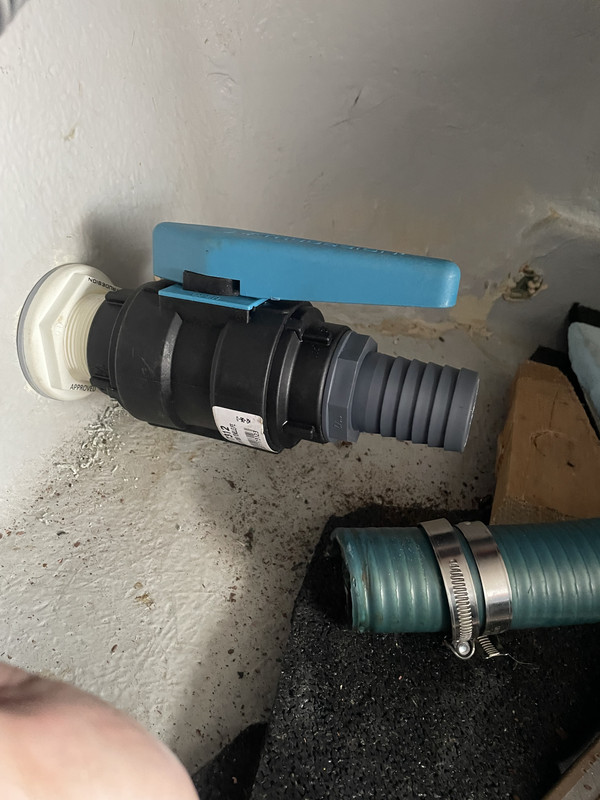
Thru hull fitting

My motivation for getting aluminum is the long life... I am tired of that end of year worrying about the anodes when it’s too cold to get in the water and look
Think about it unless it's bigger then the fact that it is not being used indicates that it is not as reactive as zinc, the zinc doesn't simply dissolve it's an electrochemical reaction. I haven't actually investigated it but it seems wrong that something that lasts twice as long is not protecting as effectively. That said most boats don't require that much anodic protection since people have been more careful about their electrical installations and don't now earth their through hulls.
 
Think about it unless it's bigger then the fact that it is not being used indicates that it is not as reactive as zinc, the zinc doesn't simply dissolve it's an electrochemical reaction. I haven't actually investigated it but it seems wrong that something that lasts twice as long is not protecting as effectively. That said most boats don't require that much anodic protection since people have been more careful about their electrical installations and don't now earth their through hulls.
And some people are installing plastic hull fittings
 
The rust !

What sort of anodes are in the Onan ?
Do you personally eye ball them @ replacement?
Can you or do you inspect them ? Ever ?

Genys if installed incorrectly can fizz away .Something to do with wrong Earth for the block , or the generated juice not correctly isolated , = you get acceleration of existing anode depletion and loose there protection .Other’s will hopefully fill in more detail .

You will have the install manual somewhere?
 
The rust !

What sort of anodes are in the Onan ?
Do you personally eye ball them @ replacement?
Can you or do you inspect them ? Ever ?

Genys if installed incorrectly can fizz away .Something to do with wrong Earth for the block , or the generated juice not correctly isolated , = you get acceleration of existing anode depletion and loose there protection .Other’s will hopefully fill in more detail .

You will have the install manual somewhere?
I’ve never seen the anodes except on the parts diagram...and I don’t shadow the technician I let them get on with it. I am just crossing my fingers and hoping there isn’t any expensive damage
 
My Sunseeker P57 also has an Onan generator and I've had various problems with corrosion and failure of parts in the raw water cooling and wet exhaust systems, so to see rust in your exhaust is not particularly surprising to me.

By way of background, my generator has been serviced by the local Onan agent and had the anodes changed in accordance with the official service schedule since new ... In the second year of ownership something failed in the wet exhaust causing a blockage in the hose which is buried at the back of the generator in an area that's not easily accessible. The hose split spraying hot salty water everywhere for some time before the flow sensors eventually picked up the increase in gas temperature and reduced flow of water. In the third year, the heat exchanger developed an internal blockage which lead to leaks from multiple places which resulted in surface corrosion, leading to its removal and complete refurbishment. Now in my fourth year, I'm on my third raw water pump and this one is already showing signs of leaks from the weep holes after only 10 hours in service. Whenever I discuss this with anyone not associated with Sunseeker or Onan, they just laugh and say the pumps (which are actually made by Sherwood) are known to be "fragile" and the litany of other corrosion related issues is not uncommon.

Be glad that you have a functioning exhaust ... mine has been shooting water from the dry gas outlet, and bubbles from the below water drain since new, and despite replacement of the muffler, gas-water separator and hoses continues to do so :)
 
My Sunseeker P57 also has an Onan generator and I've had various problems with corrosion and failure of parts in the raw water cooling and wet exhaust systems, so to see rust in your exhaust is not particularly surprising to me.

By way of background, my generator has been serviced by the local Onan agent and had the anodes changed in accordance with the official service schedule since new ... In the second year of ownership something failed in the wet exhaust causing a blockage in the hose which is buried at the back of the generator in an area that's not easily accessible. The hose split spraying hot salty water everywhere for some time before the flow sensors eventually picked up the increase in gas temperature and reduced flow of water. In the third year, the heat exchanger developed an internal blockage which lead to leaks from multiple places which resulted in surface corrosion, leading to its removal and complete refurbishment. Now in my fourth year, I'm on my third raw water pump and this one is already showing signs of leaks from the weep holes after only 10 hours in service. Whenever I discuss this with anyone not associated with Sunseeker or Onan, they just laugh and say the pumps (which are actually made by Sherwood) are known to be "fragile" and the litany of other corrosion related issues is not uncommon.

Be glad that you have a functioning exhaust ... mine has been shooting water from the dry gas outlet, and bubbles from the below water drain since new, and despite replacement of the muffler, gas-water separator and hoses continues to do so :)
Sounds ominous.Wondering if the exhaust manifold being on the far side , the blind side “ buried at the back “ hasn’t had its anode replaced due to inaccessibility? Saying this without sight .

As far as your gas water separation seemingly being reversed plumbed , simply re verse the pipage after the silent separator so the gas is above water and water below .It’s what I did with my Sunseeker to kill the trickle noise and somewhat the bubble noise .

@ Boba re rust .Get a pic of the geny back side , the inaccessible side with your camera phone + flash so we can see the manifold/ elbow , or anything else “ buried at the back “ .I want to see what’s “buried at the back “

Also the tell tale hole of the raw water pump .This should at the front when you remove a panel.

You need to find and inspect the geny anodes urgently.
I am guessing an inaccessible one hasn’t been changed .Something rusting away unprotected.


I do my own servicing btw and the geny is a air cooled MASE , 20 yrs+ old still kicking .
I replaced a weeping Johnson pump €160 , the whole thing back in 2015 .It’s belt is from a Citroen AX €4 from a auto spares shop .
Its got a SS exhaust manifold and only one easily accessible pencil anode on the air / water cooler .It’s uses seawater to cool the air which is fanned across the fins on the air cooled cylinder of the engine .

FWIW anyone thinking of getting a small geny . I think MASE still do air cooled little genys .Larger have conventional heat exchanger and closed circuit cooling for the engine block .No idea on relative prices compared to other players .
 
Sounds ominous.Wondering if the exhaust manifold being on the far side , the blind side “ buried at the back “ hasn’t had its anode replaced due to inaccessibility? Saying this without sight .

As far as your gas water separation seemingly being reversed plumbed , simply re verse the pipage after the silent separator so the gas is above water and water below .It’s what I did with my Sunseeker to kill the trickle noise and somewhat the bubble noise .

@ Boba re rust .Get a pic of the geny back side , the inaccessible side with your camera phone + flash so we can see the manifold/ elbow , or anything else “ buried at the back “ .I want to see what’s “buried at the back “

Also the tell tale hole of the raw water pump .This should at the front when you remove a panel.

You need to find and inspect the geny anodes urgently.
I am guessing an inaccessible one hasn’t been changed .Something rusting away unprotected.


I do my own servicing btw and the geny is a air cooled MASE , 20 yrs+ old still kicking .
I replaced a weeping Johnson pump €160 , the whole thing back in 2015 .It’s belt is from a Citroen AX €4 from a auto spares shop .
Its got a SS exhaust manifold and only one easily accessible pencil anode on the air / water cooler .It’s uses seawater to cool the air which is fanned across the fins on the air cooled cylinder of the engine .

FWIW anyone thinking of getting a small geny . I think MASE still do air cooled little genys .Larger have conventional heat exchanger and closed circuit cooling for the engine block .No idea on relative prices compared to other players .

Regarding your first point ... The Onan generator has a single zinc anode fitted to the heat exchanger. The recommended replacement cycle is every year/500 hours. It's easily accessible, easy to remove and inspect, and cheap to replace (about 30 Euros), so there's no excuse for not changing this every year and checking its condition on a more frequent basis.

Second point ... it's not a case of only water from the gas outlet, and only gas from water outlet. Both are mixed. I have a steady trickle of water mixed with the gas coming from what should be a dry gas outlet above the waterline, and every 60-90 seconds a stronger pulse of water. The water drain which exits below the water line has mostly water mixed with a steady stream of bubbles. The installation has been checked against the drawings and specifications supplied by Onan and Vetus, the manufacturer of the exhaust components. Everything is correctly dimensioned, components are correctly located relative to each other and to the waterline, correctly connected to each other and there are no obvious blockages or restrictions in flow anywhere. For some reason, the gas-water separator is being overwhelmed by the flow of water from the generator wet exhaust. The water level inside the separator gradually rises until the U-bend is blocked and then the gas pressure forces the water up and out of the dry exhaust outlet. Presumably either the flow of water in is too high, or the rate at which it drains out is too low, but at the moment everyone is scratching their heads for a solution.
 
9 pages in and Bouba is still trying to deal with the symptoms instead of looking for the cause.
relax!
he's not even started asking about what sika to use to seal the thruhull. That's going to hopefully be another 30+ posts :rolleyes:

291i btw is my suggestion, but plz ppl suggest something else, cannot finish that thread at only 200posts, it would be a shame...
 
relax!
he's not even started asking about what sika to use to seal the thruhull. That's going to hopefully be another 30+ posts :rolleyes:

291i btw is my suggestion, but plz ppl suggest something else, cannot finish that thread at only 200posts, it would be a shame...
Yes I have used 291i …I say used because the thru hull fitting is in already…just waiting for it to dry before I nip it up
 
9 pages in and Bouba is still trying to deal with the symptoms instead of looking for the cause.
Well I wasn’t expecting the mechanical Shan to contribute here…but your two cents is as welcome as anyone else’s…the mechanic is already scheduled to come for the generator service..so I thought I should leave it to him/her for an expert opinion
 
Top