Thoughts about throttle controls. Cable vs Servo

My thoughts..
Sea water and electrics have a bit of a history.

Routine visual checks on mechanical linkages are easy. Electronics? Less so. I have a Yamaha Malta. Stopped suddenly. It seems to be the ignition control modual, but checking not so easy.. I also have a Suzuki, that stopped. Points, so within my realm of quick fix.
Same for modern diesel with electronic injection. I have one in my car, but wonder about in a boat; Volvo problems?

Still, worth talking about, if keen. I just prefer KISS.
 
I have a ZF remote throttle on the boat, which drives a servo motor in the engine room, which controls throttle and gearbox controls on the engine. It works as badly as the regular cable control with no remote servo. i.e. sticky and imprecise. Another reason why I’m not impressed by this idea. If serious engineering manufacturers can’t make it great then what hope has a shade tree mechanic?
 
I have a ZF remote throttle on the boat, which drives a servo motor in the engine room, which controls throttle and gearbox controls on the engine. It works as badly as the regular cable control with no remote servo. i.e. sticky and imprecise. Another reason why I’m not impressed by this idea. If serious engineering manufacturers can’t make it great then what hope has a shade tree mechanic?

Shade tree mechanic ? Is that what you think of me ?

I have no idea how the ZF system is set up .. but I think you are being unfairly dismissive of the discussion ..

Lets look at general throttle linkage on a boat engine ... usually it has a small amount of 'play' in it - which can lead it to be a little unsettled .. if the 'servo motor' control moving it is based more on a stepped olenoid style - then I would not expect it to be steady .. in fact quite unsteady in fact.
Modern rotational servos as we use in models can be analogue or digital with incredible resolution and torque.
I would personally separate the throttle from gearbox in the control. I much prefer two lever control anyway ..

It is not uncommon for 'serious manufacturers' to not look outside the 'box' .. get stuck in ways that really do not provide the good result. Its when that lone guy decides to step outside - innovation and products are created.
I am not saying I am better than ZF in this - blimey - I'm not that daft !

When was the ZF system devised ? has it been revised / updated / improved since then ?

My idea has a high resolution controller ... a high resolution servo ... and a DC-DC regulator. The whole lot is small enough to sit inside that Morse lever case !!
 
Last edited:
I’d love to go electronic. We could put the controls somewhere sensible.

Understood.

This dicussion has been prompted by my MoBo suffering cable problem ... and prior to that failure of gearbox cable on another of my boats.

Both boats even in the time when cables were in good condition - had their 'quirks' ....

I'm just converting a 2.5m span gasoline powered Zlin Z50 Aerobatics madel to electric ... and while removing the engine control gear - the idea came to mind. Why could such gear not control the throttle on my boat ? It provided precision throttle setting ... despite vibration / fuel and exhaust .. never a fault.
 
Understood.

This dicussion has been prompted by my MoBo suffering cable problem ... and prior to that failure of gearbox cable on another of my boats.

Both boats even in the time when cables were in good condition - had their 'quirks' ....

I'm just converting a 2.5m span gasoline powered Zlin Z50 Aerobatics madel to electric ... and while removing the engine control gear - the idea came to mind. Why could such gear not control the throttle on my boat ? It provided precision throttle setting ... despite vibration / fuel and exhaust .. never a fault.
It’s certainly worth a thought experiment. As for being able to bodge if it fails, well, we are outboard powered. Pop off the lid and lean over the aft coaming a bit. The lever on the engine is comfortably within reach.
 
Being an RC addict .. I use servos from tiny 3gr up to large that control models .... with torque that really means they can operate many items - such as throttle or even gearboxes.

With damaged throttle control cable on my MoBo and previous to that - the gearbox cable shredding on my Motor Sailer .. thoughts of using large RC servo have crossed my mind. Throttle control would not take such a large servo .. but the operating arm would need to be long enough to get reasonable arc for sensible throttle setting.

We have non Radio controllers for testing servos ... basically a pot on a board ... so the control lever part could be easily made.

I presume that already there are wireless or electronic marine controls ... no doubt at 'marine prices' ...

For my setup - IF I was to do it ... I think I would leave the gearbox on Morse cable lever and put just throttle to servo control. That way the installation is simple ...

Its actually not likely I would do this - but interesting concept.
in 40 years and lots of different boats I have never has a Bowden cable fail but I have had repeated failures of Volvo electronic engine control panels. Easy to carry a spare cable if you are worried.
 
It’s certainly worth a thought experiment. As for being able to bodge if it fails, well, we are outboard powered. Pop off the lid and lean over the aft coaming a bit. The lever on the engine is comfortably within reach.

If it happened on the MoBo .. open up engine bay ... then disconnect cable after removing air filter box etc ... then a bit of string onto the throttle link ... I think the spring was removed - so maybe better to use a bit of stiff wire to give a push pull capability. Gearbox ? Forget it ... no way can I see anyway to cobble that on the 280 outdrive.

On the 25 (Perkins 4-107)and 38 (Yanmar 2GM20) sail boats ... it would need someone in the cabin accessing side of engines to do throttle. The 25 has already had me with stick do gearbox .. but the 38 ?? maybe.
 
It's not a new concept or idea, and has actually been proven quite well. Several decades ago I was working with the likes of Rexroth, Glendinning and ZF Mathers controls which do exactly as you describe.
In my 30+ years in the marine industry, i've seen failures in every type of system which has somewhat made me question the adage that things need to be mechanical in order to be reliable - I simply have enough experience to know that isn't strictly true. I've seen levers fall off or break, cables break (electrical and mechanical), power die and fuses blow - nothing is immune to failure.
A good and well designed servo system can work as well as a mechanical system, the 'new' failure nodes such as power loss and wiring need to be considered but are no worse in reality than if a morse cable breaks on a mechanical system.
Provided the connection to the throttle/shift lever can be quickly disconnected then a 'backup' could be fashioned if needed in an emergency.
I say if you want to do it and have the requisite experience, go for it. On our deck saloon, I would do it if I could.
 
I recently bought a boat with this setup. To be honest it works great. The RC servo is fine for throttle. The previous owner had a linear actuator pushing/pulling the gearshift cable.

I'm reworking it a bit at the moment and making a PCB to replace some of the spaghetti wiring.

Had a simple toggle switch to select the fly bridge position.
 
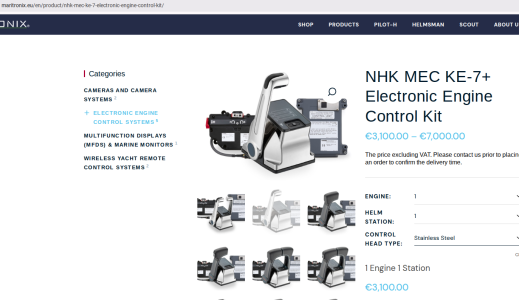
Just out of interest. Morse do make a kit for inboard engine which has an actuator and electrical control. But quite expensive.
1760792914354.png
 
Shade tree mechanic ? Is that what you think of me ?

I have no idea how the ZF system is set up .. but I think you are being unfairly dismissive of the discussion ..

Lets look at general throttle linkage on a boat engine ... usually it has a small amount of 'play' in it - which can lead it to be a little unsettled .. if the 'servo motor' control moving it is based more on a stepped olenoid style - then I would not expect it to be steady .. in fact quite unsteady in fact.
Modern rotational servos as we use in models can be analogue or digital with incredible resolution and torque.
I would personally separate the throttle from gearbox in the control. I much prefer two lever control anyway ..

It is not uncommon for 'serious manufacturers' to not look outside the 'box' .. get stuck in ways that really do not provide the good result. Its when that lone guy decides to step outside - innovation and products are created.
I am not saying I am better than ZF in this - blimey - I'm not that daft !

When was the ZF system devised ? has it been revised / updated / improved since then ?

My idea has a high resolution controller ... a high resolution servo ... and a DC-DC regulator. The whole lot is small enough to sit inside that Morse lever case !!
There actually usually isn’t an unsettled throttle problem because of the stiction that is built in to prevent just that, but which in so doing induces the problem of imprecise throttle setting. If you can fix the imprecision, do it with low cost, unbeatable reliability, simplicity and ease of installation then you may end up with a world beating system and make millions, so best of luck to you.
 
Being an RC addict .. I use servos from tiny 3gr up to large that control models .... with torque that really means they can operate many items - such as throttle or even gearboxes.

With damaged throttle control cable on my MoBo and previous to that - the gearbox cable shredding on my Motor Sailer .. thoughts of using large RC servo have crossed my mind. Throttle control would not take such a large servo .. but the operating arm would need to be long enough to get reasonable arc for sensible throttle setting.

We have non Radio controllers for testing servos ... basically a pot on a board ... so the control lever part could be easily made.

I presume that already there are wireless or electronic marine controls ... no doubt at 'marine prices' ...

For my setup - IF I was to do it ... I think I would leave the gearbox on Morse cable lever and put just throttle to servo control. That way the installation is simple ...

Its actually not likely I would do this - but interesting concept.
I think you should do it. Why not? It may not be common on boat engines but almost all internal combustion engined cars and all electric cars have accelerate-by-wire and when did you last hear of one of their systems failing? As long as you take into account the more corrosive/damp environment you should have no concerns about reliability/durability.
 
There actually usually isn’t an unsettled throttle problem because of the stiction that is built in to prevent just that, but which in so doing induces the problem of imprecise throttle setting. If you can fix the imprecision, do it with low cost, unbeatable reliability, simplicity and ease of installation then you may end up with a world beating system and make millions, so best of luck to you.

IF and its a big IF ... I was to do this ... I would actually pass on the details for anyone else to have a go.

I'm going to discuss with my close pal who is not only a better RC flyer than me - but also an electronics whizzo.
 
IF and its a big IF ... I was to do this ... I would actually pass on the details for anyone else to have a go.

I'm going to discuss with my close pal who is not only a better RC flyer than me - but also an electronics whizzo.
I'd certainly be interested. The Morse control on my Moody 31 is awkwardly placed - a consequence of tiller steering. As usual in such setups, it's low down on the side of the cockpit. So a remote control to operate the speed/forward/reverse would be really useful. I could imagine a servo operating on the existing control lever, but specifying such a thing and devising a suitable controller is beyond my abilities. A twist grip type controller on the tiller would be ideal.

It's the combination of length of stroke, speed and force that needs more understanding and knowledge of what's available than I can muster. Ideally the servo would still allow normal operation of the existing control, and be easy to disconnect (like the tiller pilot)
 
Hi AP ... interesting idea ... funny you should mention location of the control .... on my 38 - the Yanmar lever is set down low as well .. guy who installed didn't take note of the transom locker ... so neutral is actually about 10:30 when looking at the lever as a clock. If as I expected when I bought the boat - neutral was 12:00 o'clock - you are in astern ..
The control has had to be rotated those dgrees so that full astern can be given without hitting transom locker. (The boat had option for tiller or wheel - so it has the typical T shaped cutout in the benching. the control sits in the stbd cutout of the T .... )

As to operate gear selector ... that could be done with a servo - but it would need a high torque version ... not sure how much torque would be needed but not insignifcant.

My pal koded - why not mount one of my RC Transmitters on the console ... it could then do all : Trim tabs .. Throttle ... steering ... gears !!

But lets be real .. the easiest and less torque - is the throttle. To give an idea of a servo controller ... they can be as small as a box of matches or as large as a packet of ciggys. They carry no load - all they do is vary the signal pulse to the servo to determine arm position.

Use of the existing lever in my case would not be so easy as its a single lever - doing both throttle and gears.

Its crossed my mind to have a rotary throttle control on the conosle and leave existing gear lever ..
 
Top