Thought experiment about trip to the Elbe

2018, we sailed from Holland (Friesland) to the Baltic and back. Sailing up the outside you need to be aware that the Zeegatts between the Friesian Islands have strong tidal streams and in wind over tide situations can be rather formidable (polite version) and any harbour will be on the inside. For peace of mind I recommend the standing mast route up to Delfzeil. We ended up doing that after going from Harlingen to Terschelling, then over the Watt (draft 1.34m) to the Zeegatt between Terschelling and Ameland where we anchored for the night. By morning it was blowing some 40kts and when we went up to have a look-see the sea state in the passage was psychotic with white water. We chose the inshore route instead, via Lauwersoog, Groningen and on to Delfzeil. It makes good sense to enter the inland route at Ijmuiden which on it's own and after leaving Amsterdam, is pleasant enough. Inside from Ijmuiden to Delfzeil takes about 4days, 5 if the locks and bridges don't line up, shame to rush it, really.
From there we sailed to Norderney. Consult the Harbour master there for the best time of departure to make the flood tide into the Elbe. They are very helpful, though for us it meant leaving at two in the morning and navigating the channel out of Norderney was not all that easy or straight forward in the dark. Our arrival at the mouth of the Elbe, however, was spot on. Staying outside of the shipping lanes was no problem. Give yourself a break at Cuxhaven, its a fair stretch from Norderney.

Sadly, Latin will not get you very far in Germany, other than with the clergy, the Catholic brand and the North is traditionally Protestant, good thing that pretty much all the younger generations speak English.
The Dovetief channel from Norderney is lit partially but I agree that it is not easy in the dark as one can’t go straight from one light to the next. Fortunately, one would be leaving close to HW, giving about 2.5m over what is usually 2.5m at LW. Mostly, the channel is straightforward, though there is an area between Norderney and the watt going west near Juist that can be very confusing when headed west. If approaching Norderney outside, the Scluchter channel is usually straightforward and almost straight, though all these channels change a bit. For one brief period the Dovetief had 5m at LW and you will see fishing boats all over the shallow areas - not to be followed!

The beauty of the trip overall is that you always have the option of going outside or inside. For myself, I would always aim to shorten the trip by going outside but have the inside passage worked out as a reserve.

I had to to mug up my German when we did a regatta there in ‘06. I got as far as learning ‘Achtung”.
 
No, but English has enough in common with germanic languages to get you a long way. And you'd be surprised how much Latin there is in modern German! But you're quite right - many people have at least some English, and I have enough German for common politeness. Just a minor point; it's not unlikely that even a protestant member of the clergy could at least follow Latin or Greek - those two plus Hebrew are important for studying the Bible. I didn't study them for that reason (being a lay minister came later) but it's very handy that I did!

BTW, while I'm very interested in all the possible routes through the Dutch Canals, and warnings about the Frisian Islands, it would be my intention to go direct from UK to the Elbe - I presume I'd have to complete entry formalities somewhere like Brunsbuttel; the chances of doing it at the river Kruckau seem pretty slim! The point would be to visit relatives, not to go to the Baltic or other cruising grounds. If I were heading for Scandinavia, it would be Norway that would interest me; I have had many professional connections there - the main thing that would put me off is the extortionate cost of living there! My main interest in the Frisian islands would be to stay well away from them for the reasons you mention!
I doubt that Brunsbuttel would be at all convenient for clearing or even have the facilities, as you would have to pass through the lock into the NOK and back out again. For entry I think Cuxhaven would be the first and most convenient option en route and one that would not require any detour.

I speak fluent German and also had Latin at school and I am/was continuously surprised (at school) how inconveniently little Latin there was in modern German.
 
The locks at Brunsbuttel will usually open within half an hour or so but I have had to wait for two hours, and nowhere to tie up, so Cuxhaven makes much more sense. Cuxhaven is a large marina, so it is as well to go as far up the pontoon as possible, both for a shorter walk and to get away from the occasional swell near the entrance. They have a really excellent tally card system which can be got from the harbour office or an easily-understood machine at all hours, and this will refund unused money not used on electricity or showers. There are/were bicycles available for hire, at least I think for hire because the wonky old ones were free. A trip to the fishing harbour is interesting, as is a visit to the beach area for a bit of people-watching, nothing prurient intended. The current may be running at 3-4kn across the entrance, so overshooting it is not recommended. When navigating in the Elbe it is obligatory to cross the shipping lanes at roughly 90 degrees, although sailing boats tacking are allowed, so long as they take normal care.
 
On the language front, the Friesian dialect is said to be the closest language to English, which may help a bit.
It will help even more that both my nieces in Germany are amazing linguists! Both are fluent in English, German and Cantonese; I think both also speak Mandarin (although the script is the same, Cantonese and Mandarin are different languages). I think the younger also has Japanese, and I wouldn't be surprised if one or both of them speak other modern languages; it isn't something that comes up in conversation!
 
I have spent a lot of time sailing in the old East Germany and am amazed at the number of people who can't or won't speak English and this particularly applies to Harbour Masters. Unfortunately they don't speak Latin either.

As an aside I was amused when sailing down the Eider to be accused of speaking Haupt Deutsch in the town of Fredrikstadt as I used 'Guten Morgan' as a greeting instead of the local 'Moin Moin' (A very good day to you).
 
I have spent a lot of time sailing in the old East Germany and am amazed at the number of people who can't or won't speak English and this particularly applies to Harbour Masters. Unfortunately they don't speak Latin either.

As an aside I was amused when sailing down the Eider to be accused of speaking Haupt Deutsch in the town of Fredrikstadt as I used 'Guten Morgan' as a greeting instead of the local 'Moin Moin' (A very good day to you).
I had many German, Swiss and Austrian colleagues before I retired. They all complained of each others dialects! The Germans all regarded Schweizer-Deutsch and Austrian as extremely archaic and strange, and the north Germans had trouble understanding the south Germans.

It's not so long since the English for Dutch was Low German, and German was High German. The two languages are just a bit further along the same path as other German dialects.
 
I have spent a lot of time sailing in the old East Germany and am amazed at the number of people who can't or won't speak English and this particularly applies to Harbour Masters. Unfortunately they don't speak Latin either.
They were usually taught Russian at school as a second language.. good luck with that one....
 
Former East Germany is changing slowly. We first went there in 2000, when English was certainly not spoken, because of the Russian influence mentioned. Even ten years after the Wall came down there was still a strange atmosphere about the place and people in public places tended to have a haunted look, and there was little in the shops. We found buying food an especial problem, with small shops only selling tinned foods and UHT milk, and once sent a text in jest to our friends at home asking them to send food parcels. Things are very different now, with squillions of euros spent on the infrastructure and everyone now out and enjoying themselves.

I have never met any reluctance to speak English in Germany, though not everyone is capable. We sat with the same group of about eight for three days at our regatta and they decided to speak English exclusively for our benefit. I think that harbourmasters tended to be rather baffled to come across British sailors as we were so few, but in many cases tried to be as helpful as possible, often rounding us down to the next price band.

Moin moin is, so we were told, local to the Hamburg area. I don’t think anyone knows where it arose from, but it seems to carry an element of joking, though not as much as the “buon giorno, mon ami” that I heard between sailors in Heiligenhafen.
 
They were usually taught Russian at school as a second language.. good luck with that one....
It's surprising how much Greek there is in Russian, though the Slavonic bits are impenetrable! But the Cyrillic alphabet is closer to the Greek one than the Roman, and of course, there were strong historical links with the Byzantine Empire; the core Russian states were on a major trade route from Byzantium to the Scandinavian countries.
 
I spent a day in East Berlin in 1971 - a stop-over on a school train trip to Moscow and Leningrad. I can recall wide, empty streets, shops with nothing in them, and a general air of desolation despite the many modern buildings.
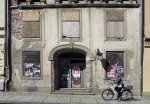
That would have been fascinating in a grim sort of way. When we first went to E Germany, cities such as Wismar and Greifswald were pretty decrepit and I had a fine time taking photos of classic buildings in disrepair. All round these towns the Commies had built tower blocks because they couldn't afford to renovate the towns, leaving the centres crumbling, and thus preserved. Sadly, the Germans don't share my love for decrepit old structures and by now almost all of it has been refurbished and given a fresh coat of paint. However, you can still a get a feel for what a mediaeval town was like, unlike the British cities which were basically knocked down and rebuilt.
 
That would have been fascinating in a grim sort of way. When we first went to E Germany, cities such as Wismar and Greifswald were pretty decrepit and I had a fine time taking photos of classic buildings in disrepair. All round these towns the Commies had built tower blocks because they couldn't afford to renovate the towns, leaving the centres crumbling, and thus preserved. Sadly, the Germans don't share my love for decrepit old structures and by now almost all of it has been refurbished and given a fresh coat of paint. However, you can still a get a feel for what a mediaeval town was like, unlike the British cities which were basically knocked down and rebuilt.
Sadly, in West Germany much that had not been destroyed during the war was sanitized to death after, not just towns, but villages as well, in a frantic drive to modernize and exorcise the ghosts of the past. If you want medieval/historic flair go to France where a lot of it has been preserved, though not intentionally, at first.
 
I don't know enough of France to make a comparison but my impression is that the Germans like old stuff, so long as it is cleaned up. I was once shown with pride the new marina development in Warnemunde by a German friend. Looking at the bleak new brickwork I remarked that it would look good when it had mellowed a bit, and was met with a look of blank disbelief. This is how I like my old buildings. It may be that seeing them in this state makes me feel better about myself.
show14 (2) copy.jpg
 
Sadly, in West Germany much that had not been destroyed during the war was sanitized to death after, not just towns, but villages as well, in a frantic drive to modernize and exorcise the ghosts of the past. If you want medieval/historic flair go to France where a lot of it has been preserved, though not intentionally, at first.
In East Berlin a) not much survived the war and b) the East Germans rebuilt it as a propaganda effort; look how modern and smart we are! Of course, as a school trip from the west, we were carefully only shown the good bits - for some reason they kept us away from the Berlin Wall, except for a distant view of Checkpoint Charlie and the Brandenburg Gate!

The REALLY weird place was Brest-Litovsk. The railway changes gauge there, so the rolling stock has to change - I think they changed the bogies on the carriages, but I don't know the technical details. We were allowed to wander off for an hour or two while they sorted it all out. I've seen livelier cemeteries! And a constant feeling of being watched....
 
Last edited:
I don't know enough of France to make a comparison but my impression is that the Germans like old stuff, so long as it is cleaned up. I was once shown with pride the new marina development in Warnemunde by a German friend. Looking at the bleak new brickwork I remarked that it would look good when it had mellowed a bit, and was met with a look of blank disbelief. This is how I like my old buildings. It may be that seeing them in this state makes me feel better about myself.
View attachment 121889
I think I understand where you are coming from. Much of what is considered perfectly acceptable, livable, even charming in France would be outright condemned as derelict in Germany. The need to restore historical buildings to "better than new" and keep the yard orderly seems to be a national affliction.
 
In East Berlin a) not much survived the war and b) the East Germans rebuilt it as a propaganda effort; look how modern and smart we are! Of course, as a school trip from the west, we were carefully only shown the good bits - for some reason they kept us away from the Berlin Wall, except for a distant view of Checkpoint Charlie and the Brandenburg Gate!
The small town I lived in in West Germany had been 94% destroyed. The rebuild was done with much the same sensitivity as East Berlin.
 
In East Berlin a) not much survived the war and b) the East Germans rebuilt it as a propaganda effort; look how modern and smart we are! Of course, as a school trip from the west, we were carefully only shown the good bits - for some reason they kept us away from the Berlin Wall, except for a distant view of Checkpoint Charlie and the Brandenburg Gate!

The REALLY weird place was Brest-Litovsk. The railway changes gauge there, so the rolling stock has to change - I think they changed the bogies on the carriages, but I don't know the technical details. We were allowed to wander off for an hour or two while they sorted it all out. I've seen livelier cemeteries! And a constant feeling of being watched....
The treaty of Brest-Litovsk was at least as harsh as that of Versailles and one reason why German complaints about their treatment received little sympathy.
 
They were usually taught Russian at school as a second language.. good luck with that one....
I spent some time in Rostock in 1999, and everyone under 10 spoke English, and all older people understood Russian. The school teachers struggled a bit with English, I was roped into being a conversationalist in English classes, because teacher knew no spoken English. As you find with French schoolchildren as well, the pupils were FAR better behaved than our rabble.
 
Top