The pro's and cons of steel boat building

Status
Not open for further replies.
But I am stuck with what I have, a cheap steel boat that gives us an outlet to enjoy the water.

When we are not de-rusting and painting.....................................

There you have it, do the big work getting back to good nick and keep on top of it or forever fight the corrosion and keep on with the 10 times work of grp.

Neglected for 3/4 of the year isn't going to end happily, yet another minus. :)
 
it's no mean feat getting a steel boat in a good state with nothing bolted through deck and the bilge easily accessible with the whole lot covered in many coats of epoxy. . Get the boat well sorted (which probably means changing lots of design mistakes if factory built) and maintenance should tail off drastically. Then little and often, not that big a deal when you life on the hook time rich. Right now I'm paying with high interest for neglected maintenance.... ;)

Not many people go that far though, see the design mistakes and not keeping on top of maintenance in marinas and anchorages all over.

Not many situations where it's worth the effort, but sometimes it comes into its own.

Not many people here can see past the usual forum rants of black and white good/bad either.

I spent a lot of time trying to make my steel boat as maintenance free as possible. Your 2 examples were the main ones but I still made mistakes.

The main 2 were not eliminating painted sharpish edges. Paint tends to flow away from sharpish edged leaving a thinner layer of paint. The paint can chip easer on sharp edges leasing to rust.

The second mainly on deck where flexing of the deck by standsons lead to cracking of the paint leading to rusting in the cracks.

The type of paint used and preparation is important. I used epoxy tar below the waterline and this is more flexible than the white I used on the topsides and being more flexible is less prone to crack or chip. This then allows rust to start up.

When I lived in the UK I did have a canal boat not a narrowboat and the hull of narrowboats are painted in a black tar type paint similar to epoxy tar, The topsides fo tend to suffer from mess paint cracking than a sail boat due to the simpler design (less intricate).

When you have rust its also very difficult to get rid of at all so it comes back.
 
Going back to the title of the thread.. This is quite possibly high up the list of pro reasons many steel boat cruisers arrived at the choice of hull material -
http://www.cruisersforum.com/forums/f90/norwegian-catamaran-sinks-outside-of-morocco-207213.html


Lots of things to hit out there and lots of things to hit you in anchorages/ports.

These guys didn't even hear the bang, whatever it was it's very likely steel would have survived unaided...>

(google translate)

Sounds like that is a catamaran and I don't think any home builders use steel for them, or prof builders.

There was/is a builder of GRP canal boats, who used chipboard moulds. treated them as disposable. Any thing that could be reused was a bonus.

Steel is an obvious material for a long rectangular cargo hull and the yards have plenty of work over-plating the rusted out ones and that is in fresh water. Also weight is not an issue and the bottom plate is usually quite thick for stability and strength (and rust!)
 
One interesting thing here in the UK, (and pleaae correct me if I am wrong) is 99'9% of narrowboats are steel. Granted they are in fresher water, and construction is simpler that a yacht, but even so it was a mystery to me why until I realised the bespoke nature of most of the new ones with length, superstructure etc. You would need an awful lot of huge moulds to make all the variations. So steel is used as it is the simplest way of getting the job done in a limited space, and more adaptable than moulding. Still makes me thin there must be a market for a grp narrowboat, maybe modular design that could have more added to the centre. Still the moulds would take up an awful lot of space
I seem to recall that many french canal boats are GRP (not exactly "narrow" though). GRP boats can be built without the use of a female mould. A timber frame can be constructed & covered with a core material. This can be covered on the outside in GRP. This is then faired off. The core & outer can be removed from the framing after bulkheads or stiffeners have been fitted to maintain the shape. The inner face covered in GRP. This gives a strong cored hull. It is a quick way to construct a one off hull.
 
I seem to recall that many french canal boats are GRP (not exactly "narrow" though). GRP boats can be built without the use of a female mould. A timber frame can be constructed & covered with a core material. This can be covered on the outside in GRP. This is then faired off. The core & outer can be removed from the framing after bulkheads or stiffeners have been fitted to maintain the shape. The inner face covered in GRP. This gives a strong cored hull. It is a quick way to construct a one off hull.

interesting shuttering method. Sounds like fairing the hull would be a lot of work, but yes it makes sense for one offs or short runs.
 
interesting shuttering method. Sounds like fairing the hull would be a lot of work, but yes it makes sense for one offs or short runs.

Hence the people using chipboard for a femail mould, it was covered in a PBO article. The first (Biggles?) was about 40 x 10 ft, then they made a 60x10 destined for the French canals.

Foam cored sandwich was a popular DIY for one offs, but, as you say, lotta fairing. Some friends have an ex Admirals Cup boat built that way, they completely restored it, including cutting out some areas of core and redoing. Only economic if you don't cost your time .

More recently, wooden strip with epoxy glass sheathing is a good option. Covey Island Boatworks built some Bristol Channel Pilot cutters at 40ft. Tom Cunliffe had one and one of our forumites has a 50ft (for sale..)

.
 
Hence the people using chipboard for a femail mould, it was covered in a PBO article. The first (Biggles?) was about 40 x 10 ft, then they made a 60x10 destined for the French canals.

Foam cored sandwich was a popular DIY for one offs, but, as you say, lotta fairing. Some friends have an ex Admirals Cup boat built that way, they completely restored it, including cutting out some areas of core and redoing. Only economic if you don't cost your time .

More recently, wooden strip with epoxy glass sheathing is a good option. Covey Island Boatworks built some Bristol Channel Pilot cutters at 40ft. Tom Cunliffe had one and one of our forumites has a 50ft (for sale..)

.

all the more reason to think that at the bottom end of the market boat building is a mugs game as a business. I am familiar with making up small moulds for one off parts for vehicles, but doing that for a large boat, that's a labour of love. But it would make sense if you knew what you wanted I suppose. But then, when one talks about building a boat, either steel or GRP, when one looks at the second hand market it hardly seems to make any sense to go through all that.
 
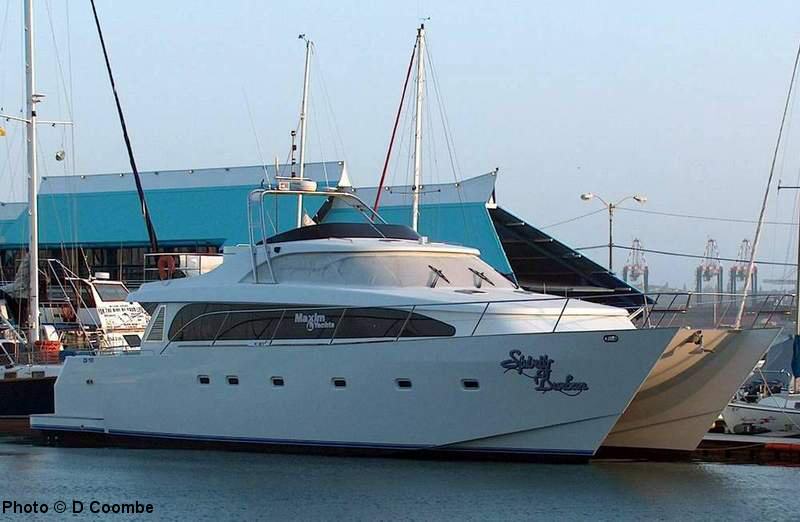
This boat below was built by a friend who laid up flat sheets of GRP and a table with gel coat first the glass fibre on top as in a mold. Where the flat sheets were to join a lap joint was incorporated. The hull and superstructure was made up with temporary fromes and the lap joints glued with epoxy. the inside was the laid up as in a normal mold to the required specification.

The only fairing needed was at the lap and other joints. Great for one off's

spirit_of_durban.JPG


This was built in the same way

24662-hak4.jpg
 
Last edited by a moderator:
all the more reason to think that at the bottom end of the market boat building is a mugs game as a business. I am familiar with making up small moulds for one off parts for vehicles, but doing that for a large boat, that's a labour of love. But it would make sense if you knew what you wanted I suppose. But then, when one talks about building a boat, either steel or GRP, when one looks at the second hand market it hardly seems to make any sense to go through all that.

Which brings us back to why most boats are GRP. The hull is made very quickly and mass production methods are used to fit out. The lower size end of the market hardly exists, except for character boats, as there are so many up for sale and people are conditioned by the mags into thinking 30ft is a starter boat.

This whole thread is really a bit passée, how many people are actually building steel boats now? BS seems to have done a few, but how recently? A few in SA and Dix has several. But not many in the global numbers.

Food on table, gotta go.
 
This boat below was built by a friend who laid up flat sheets of GRP and a table with gel coat first the glass fibre on top as in a mold. Where the flat sheets were to join a lap joint was incorporated. The hull and superstructure was made up with temporary fromes and the lap joints glued with epoxy. the inside was the laid up as in a normal mold to the required specification.

The only fairing needed was at the lap and other joints. Great for one off's

spirit_of_durban.JPG


This was built in the same way

24662-hak4.jpg

Brilliant. Very interesting to see actual examples, thanks Roger.
 
How about buckling failure of the mast itself?

That has been calculated a million times .No point in paying someone $175 an hour to do it yet again. Any boat of similar size and dimensions will have a standard sized mast for that type of boat. What works for them will work for you. Especially with so many being scraped. No sense in turning down a used mast for a fraction the cost of new . Save your money for cruising.
A friend got a mast off a big Beneteau for free. It had a small dent, which the rigger said would have no effect on strength. The owner said "Put a new one up, insurance is paying for it." It is bit heavy ,but as I have posted, that will make little difference in the real world, and give a good safety factor.
 
If the picture was of a beautifully polished bronze fastening in beautifully varnished red cedar , instead of rough welding slag ,you guys would be fawning over it. Ditto shiny plastic.
"So pretty, it must be strong! Gotta be stronger than an ugly weld"
Ya sure!
Some one posted a whisker stay tang
with a beautiful tig weld holding the tang to the base .It broke, proving that welds sometimes break!
It amounted to about a fraction of a millimeter of weld metal on both sides of 1/4 inch stainless. Zero penetration. But it was such a pretty weld ! How could something so pretty, not be strong?
A friend told me he considered 7024 welds weak, and didn't trust them.
A few days later, walking along the waterfront, I found out where he got the idea. A tang of one inch plate had broken off a crane boom, what looked like a 1/8th inch 7024 weld. It was a single pass down each side of a one inch plate, with about 3/16th ,roughly 5mm of weld, trying to hold 1 inch plate together , zero penetration. It should have had the plate edges beveled 45 degrees on both sides ,and the bevel completely filled with weld.
Yes, you can screw up ,which doesn't show in a photo of the slag on top of a weld.The weld in the photo had the edge of the plate beveled for full penetration.
I built the first 36 just down the road from a welding shop. The owner came by , and said "Brent's welds are as strong as any, not as pretty as some ,but just as strong."
They were tested, in 16 days of pounding in big surf, on the west coast of Baja, and pulled off thru 12 ft surf .No serious damage. None of my boat welds has ever broken.

When I start boat for someone, I let them weld the lugs for the comealongs, for pulling the hull together .Most have never welded in their lives .Their welds are often extremely rough. When we are done with them, I give them a sledgehammer and tell them to break the lugs off. They bang them back and forth many times, the sweat pouring down their faces, before they break. They invariably break well above the weld, very rarely on the weld. Then I ask them "Do you still believe the negative "Sky is falling" bull, from welders, trying to put themselves on a pedestal, by making welding sound far more finicky and difficult than it is?"
"No" is the answer.
One kid I trained , who went on to become professional welder, said ;
"When it comes to bull, trying to promote their importance, most welders are incredibly full of crap!"
 
Last edited:
If the picture was of a beautifully polished bronze fastening in beautifully varnished red cedar , instead of rough welding slag ,you guys would be fawning over it.
"So pretty, it must be strong!"
Ya sure!
Some one posted a whisker stay tang
with a beautiful tig weld holding the tang to the base .It broke, proving that welds sometimes break!
It amounted to about a fraction of a millimeter of weld metal on both sides of 1/4 inch stainless. Zero penetration. But it was such a pretty weld ! How could something so pretty, not be strong?
A friend told me he considered 7024 weld weak, and didn't trust them.

a ri

And if your Uncle had tits he would be your Auntie!

Methinks he protesteth too much.....................................

Brent, I built a three bike motorcycle trailer from steel box section and channel in 1975.

With a stick welder. My recollection-it was a long time ago-is that none of the welds had slag deposits like your welds. There was slag, but not like the welds shown. IIRC, no grinding was required, it chipped off with a chisel end hammer and the welds were sand blasted before painting.

It is still giving good service, used frequently by a friend who purchased it from me in 2003.

No welds have broken and by comparison to the crap you present they are works of art. I have towed it, two bikes up, at over 100 MPH on European autobahns.

I was taught, during a proper 5 year indentured apprenticeship, that if a job is worth doing, its worth doing well.

It is a pity you dont have the same ethos.

IIRC Solent Clown is a steel and welding expert, far ahead of me. He is not impressed with your welding either.

If YOU are happy with the work you do, fine. But dont expect others with higher standards to applaud crap.

And, IMHO, your welding and ideas about strength show that your understanding of structural integrity is not all it could be.

And it is certainly not what it SHOULD be........................................
 
Last edited:
There you have it, do the big work getting back to good nick and keep on top of it or forever fight the corrosion and keep on with the 10 times work of grp.

Neglected for 3/4 of the year isn't going to end happily, yet another minus. :)

A few hours a year lets you ignore the boat maintenance for the rest of the year. That works for me.
If it gets too much, then sandblasting and a good buildup of epoxy lets you eliminate maintenance for ten years or more. No plastic boat problems, like deck leaks under stanchions, around chainplates , cleats and hand rails, zero thru hull problems, no rotted balsa cores, bulkheads and decks pulling away from the hull, no chainplates on rotten bulkheads , the list goes on, and on, and on.
 
rotrax And said:
Your suggestion that I am wrong in suggesting there is a need to bevel the edges of thick plate for full penetration, and that I am wrong to suggest that the weld metal should exceed the thickness of the metal you are welding, along with your suggestion that you can look at the slag on top of a weld to determine the strength of a weld, or determine the strength of weld by looking at an online picture , clearly shows that at you don't know your ass from a hole in the ground ,when it comes to welding.
How many of your welds have survived 16 days of pounding on a Baja lee shore, in up to 12 ft surf, or equivalent.No driving around Europe is not the equivalent! Nowhere near it!
 
I spent a lot of time trying to make my steel boat as maintenance free as possible. Your 2 examples were the main ones but I still made mistakes.

The main 2 were not eliminating painted sharpish edges. Paint tends to flow away from sharpish edged leaving a thinner layer of paint. The paint can chip easer on sharp edges leasing to rust.

____________________________________________________________________________
A bead of stainless weld along sharpish we corners can drastically reduce maintenance. Putting my stainless cabin top handrails at the corner, instead of slightly inboard , also helps a lot. It also acts as a toe rail ,not leaving a place to step, and have your foot slide off.
Having owned steel boats gives one a good idea of where to use stainless to minimize maintenance. Get your advice from those who have.
____________________________________________________________________________

The second mainly on deck where flexing of the deck by standsons lead to cracking of the paint leading to rusting in the cracks.
__________________________________________________________________________
That is one reason I weld my stanchions to the pipe bulwark cap. Another is to eliminate the toe busters they would be on deck, and to maximize deck space. Going for solid pipe top lifelines drastically reduces load on the bottoms of stanchions ,and movement there. About an hour or twos work to do it.
Pre bend the top pipe, before welding it down.
___________________________________________________________________
_____________________________________________________________________________

The type of paint used and preparation is important. I used epoxy tar below the waterline and this is more flexible than the white I used on the topsides and being more flexible is less prone to crack or chip. This then allows rust to start up.
____________________________________________________________________________-
Some don't like epoxy tar because it bleeds thru colour coats., If you put colour coats directly on wet epoxy tar you, get a good bond between the two. The tar will bleed thru. Don't worry, give it another coat .That too will bleed thru. Leave it for a month to harden, then you can put whatever colour you want on, including white, and it wont bleed thru.
_________________________________________________________________________ I lived in the UK I did have a canal boat not a narrowboat and the hull of narrowboats are painted in a black tar type paint similar to epoxy tar, The topsides fo tend to suffer from mess paint cracking than a sail boat due to the simpler design (less intricate).

When you have rust its also very difficult to get rid of at all so it comes back.

A small compressor and a $20 siphon sand blaster gives you a gray metal surface, and is all you need for touch up maintenance. Skip the rust converters. Epoxy tar , 5 coats on a sand blasted surface, lasts for many years without coming back to haunt you.


Boy, what a relief , to be discussing steel boats, rather than continuous plastic boat hecklers.

After 34 years, my current steel boat requires a fraction the maintenance of my last one, due to what I learned from the last one. That is why good design and steel boat advice can only come from those who have owned and maintained a steel boat over a long time.
No, plastic experience is no substitute ,certainly not having only drawn pictures of plastic boats !
 
Last edited:
Sounds like that is a catamaran and I don't think any home builders use steel for them, or prof builders.

There was/is a builder of GRP canal boats, who used chipboard moulds. treated them as disposable. Any thing that could be reused was a bonus.

Steel is an obvious material for a long rectangular cargo hull and the yards have plenty of work over-plating the rusted out ones and that is in fresh water. Also weight is not an issue and the bottom plate is usually quite thick for stability and strength (and rust!)

Bob Perry gave the cost of a mold for a 37 footer at $300K
In 83 a friend built a mold for a 26 ft Bristol Chanel cutter. Then he priced the materials for a hull and deck, and was quoted $12K . Then he watched me build a 31 ft steel hull and deck for $3500. He abandoned the plastic cutter, and built himself a 31.
The price for materials gap is probably bigger than ever. The last quote we got for materials for a 36 ft steel hull and decks was around $9K CDN.
Anyone want to give us a quote for materials for a 36 ft plastic hull and decks, for a comparison?
 
Brent, get yourself back down the dole office, buy some food to put in your sisters cupboard, and stop talking so very much nonsense. Just because you are lounging around your sibling's flat with nothing better to do you come on here spouting so much nonsense. If you were so successful;, and spending so much time at sea you wouldn't be claiming benefits - How is that an independent lifestyle???? There are some interesting bits on this thread, then there is you, like a rash of ringworm on a dogs butt. Not wanted, hard to get rid of, and generally unpleasant.
You give bad advice, write bare faced lies, and illustrate your utter incompetence with some of the few pictures you post. You have no place on a forum like this where people come to share knowledge and experience.
I will get you a materials cost for a 36ft grp yacht. A proper one from a real factory, not an occasional build in a field, and a deluded hermit hiding in his sisters flat.
In the real world where people have jobs instead of sponging off their sisters and the state, the economics are different, TIME IS MONEY when you have a job, instead of bumming off the government. So a lot of people buy a boat insted of cobbling one together. Your estimate of hull build cost is only a small part of the cost of a boat anyway.
If the costs were so low, we would all be building them - except that at the smaller end of the market the weight penalty is so high, and they rust, and oh yes, nobody wants to buy an old one so resale values are nowhere.
I can understand why you have one, not having the money to buy charts or a plotter on your dole handout means you have to risk hitting reefs all the time .
SEEK GAINFUL EMPLOYMENT buy a decent welder, do a course, then come back to us with something real.
 
Anyone want to give us a quote for materials for a 36 ft plastic hull and decks, for a comparison?

East Coast Fibreglass Supplies will sell Lloyd's approved polyester resin at £2000 per tonne and CSM at £2200 per tonne. Which just goes to show that the cost of the hull materials is a pretty trivial part of the cost of a boat. The sheet winches alone on mine cost more than the hull materials.

You really can't compare some rough old thing bodged together in a field and fitted out with second hand junk to a proper boat designed by a qualified naval architect. The latter will probably be capable of more than drifting downwind until it hits a reef, for a start.
 
Status
Not open for further replies.

Other threads that may be of interest

Top