The "pros" and "cons" of an electric galley vs gas galley?

coopec

N/A
Joined
23 Nov 2013
Messages
5,211
Visit site
There's no doubt previous threads on the the “pros” and “cons” of electric galley vs gas cooking but as there have been advances in solar technology, cheap inverters and cheap induction hobs I believe another thread can be justified.
An electric galley may only be feasible on larger yachts (35ft+ ?) since you'd need power from solar panels and/or diesel generator but when I read

"While electric is certainly more energy-efficient than gas, induction is still the clear winner for efficiency. Stovetop or cooktop electric cooking allows only 65-70% of heat to reach food as opposed to induction's 90%. This results in your kitchen staying cooler with induction than it does with electric cooking".30 Nov 2017 (Gas is only about 35% efficient)

Yesterday I brought to boil 1 liter of water in a 1200W jug in 3 minutes. (I hope my maths are OK here (not allowing for losses))
1200W at 240V = 5 amps or
5 X 240/12 = 100amps at 12V
Therefore in 3 minutes I used 100amps/20 = 5Ah

Surely that is not a lot when my battery bank will be 560Ah?

I have a convection microwave installed as well and that seems to be the way to go

"The microwave is generally the most efficient way to heat up and cook food - it's always quicker and its smaller size (as opposed to the oven) means that the heat is more focused on whatever's being cooked"

My single hob 2000W induction hob only cost around $A50. This is what Kenomac (on another forum) had to say:

"We’ve been using induction cooktops for six years, the reaction from those newly introduced seems universal....WOW!
We use nearly all solar for power generation via a 2500w inverter. Here’s some figures from last night generated for another thread:

Cook three fried eggs medium setting for five minutes: 2Ah
One fried steak on high for 5 minutes: 4Ah (would have been the same for two steaks)
Off subject: Nespresso machine used for 1 cup of coffee: .4Ah"


Does anyone have any thoughts for/against?


Induction cookers on yachts: Why it’s finally feasible to ditch the gas
 
Your fridge is going to consume to a predictable schedule. Will you have a freezer? decent size to allow you lamb or beef over an extended period, say a couple of months and the freed will be needed to store the tuna and the dolphin fish. Is you house bank going to be lithium - if not then your usable battery power is (I believe) half of 560ah. If you are m making passage - your autopilot will be a bit consumer - factor these fixed consumers and then see what you have left.

Jonathan
 
I forgot to add - where is your fresh water going to come from? If you are joining the current century than you will want some form of de-salination and it is a huge consumer.

For some items you must have electricity for others there are options, you can run the desalination off the engine, you can use wind /water for your autopilot but your freezer/fridge is likely to need electricity as will your instruments and communication devices. The advantage of gas - if you are 'off piste' for a long period means that you have options, you can carry a spare gas bottle. If you are in Tasmania over winter, or even Sydney, a reliance purely on solar looks very brave (Sydney today is overcast, its warm but no sun - so from say 5pm yesterday till 8am tomorrow minimal solar - so your battery bank needs to provide for everything on your yacht - and you might be on passage - for 40 hours. Now if you have a Watt n Sea you can make power - more than you need (hydro gens are much better than wind, but even a wind gen might be better than solar on a cloudy day. You mention use of 'more efficient' solar - they are no better than older solar when the boom and mast create big shadows. Up north in Oz - what you will crave is shelter (from the sun) or the inside of the yacht is like a sauna - a damning contradiction (but its why you need the deep freeze for the fish you catch :) ).

To obtain useful comment you really need to define how you are using the yacht, day trips, independent for 3 months; you need to define what sources you have to generate power and list the consumers. Maybe also mention where you intend to sail - and what the climate is like there.

What ever conclusion your audit defines - assume that it is optimistic.

There are plenty of people here who have made ocean passages and/or who live full time on their yacht. Hopefully they can quantify their lifestyle and resources.

Jonathan
 
Your fridge is going to consume to a predictable schedule. Will you have a freezer? decent size to allow you lamb or beef over an extended period, say a couple of months and the freed will be needed to store the tuna and the dolphin fish. Is you house bank going to be lithium - if not then your usable battery power is (I believe) half of 560ah. If you are m making passage - your autopilot will be a bit consumer - factor these fixed consumers and then see what you have left.

Jonathan

I won't argue with that.

I read TDF-Texas's comment


"This only works if you have lithium batteries as lead acid batteries are affected by Peukert’s law.
"A common mistake is made when it is assumed that a 200 AH lead acid battery will provide 200 amps for 1 Hour. It won’t. In fact, a battery of this type may only provide about 40 minutes of continuous 200 amp service at best.
This is due to a well known characteristic associated with lead acid batteries. Specifically the capacity will decrease as the rate of discharge increases.
In other words the relationship between battery capacity (how much energy is available) and the rate of discharge is not a linear one.

The phenomenon being described here is known as Peukert’s law."

Amp hours used: 1,200 watt electric kettle, on for 3 minutes? - Escape Trailer Owners Community
 
There's no doubt previous threads on the the “pros” and “cons” of electric galley vs gas cooking but as there have been advances in solar technology, cheap inverters and cheap induction hobs I believe another thread can be justified.
An electric galley may only be feasible on larger yachts (35ft+ ?) since you'd need power from solar panels and/or diesel generator but when I read

"While electric is certainly more energy-efficient than gas, induction is still the clear winner for efficiency. Stovetop or cooktop electric cooking allows only 65-70% of heat to reach food as opposed to induction's 90%. This results in your kitchen staying cooler with induction than it does with electric cooking".30 Nov 2017 (Gas is only about 35% efficient)

Yesterday I brought to boil 1 liter of water in a 1200W jug in 3 minutes. (I hope my maths are OK here (not allowing for losses))
1200W at 240V = 5 amps or
5 X 240/12 = 100amps at 12V
Therefore in 3 minutes I used 100amps/20 = 5Ah

Surely that is not a lot when my battery bank will be 560Ah?

I have a convection microwave installed as well and that seems to be the way to go

"The microwave is generally the most efficient way to heat up and cook food - it's always quicker and its smaller size (as opposed to the oven) means that the heat is more focused on whatever's being cooked"

My single hob 2000W induction hob only cost around $A50. This is what Kenomac (on another forum) had to say:

"We’ve been using induction cooktops for six years, the reaction from those newly introduced seems universal....WOW!
We use nearly all solar for power generation via a 2500w inverter. Here’s some figures from last night generated for another thread:

Cook three fried eggs medium setting for five minutes: 2Ah
One fried steak on high for 5 minutes: 4Ah (would have been the same for two steaks)
Off subject: Nespresso machine used for 1 cup of coffee: .4Ah"


Does anyone have any thoughts for/against?


Induction cookers on yachts: Why it’s finally feasible to ditch the gas

Forget the gas explosion risk and go partly electric. My classic lifeboat rebuild will have an 800w microwave, cos microwaving is by far the most efficient way of cooking using electricity, although it does help if you have a 240/110v generator, rather than using the main donkey and invertor. That option is bad for an idling donkey and less efficient.

As a backup, I also have a classic single burner alcohol stove and a much beloved good old paraffin primus single burner. Alcohol is great for cooking, BUT you can't find it in the Pacific islands or a few other remote areas.

It's possible to convert a normal propane gas cooker to Hydrogen, BUT it's real difficult to find the correct burners as there are very few companies making them. H2 bottles are more expensive than propane ones, but it is a very safe way of cooking and ultra clean. It's also possible to make water at the same time!
 
I have a 3.5kw suitcase gen set but maybe if I bought again I'd go smaller. At 32kg I can just carry it on land but on a rocking boat I wouldn't like to try my luck. I think I'm going to have to install it permanently in an enclosure down near the push-pit. (I also have a 120A alternator on the Perkins.

Yes and I have a two burner alcohol stove for back-up too.

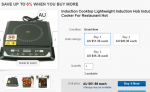
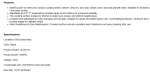
The single induction hob is not expensive at all (but you'd need an inverter too if running off the batteries)Screenshot 2021-09-18 at 12-46-12 Induction Cooktop Lightweight Induction Hob Induction Cooker...pngScreenshot 2021-09-18 at 12-47-03 Induction Cooktop Lightweight Induction Hob Induction Cooker...png
 
Just a thought: When discussing and calculating solar energy, the actual hours of sunshine has a huge impact.
I certainly saw a lot more sunshine down under than up here.

The issue is you need to look at worst case scenario - which means having a few days with insufficient solar and maybe weather confining you to whatever anchorage you are in. We, in Oz, do have glorious weather (our complaint is usually drought and the drought exacerbating bush fires) - but we do have had weather. You can of course run the engine. But if you have a fall back for most systems, non electric cooking that will help as if you have a freezer or fridge full of provisions you must prioritise the power to these units - or it becomes crayfish bait very quickly - and if you are successful with catching the crays - they soon pall in attraction

But gearing up a galley for two independent systems will need some thought - and compromises.

Josephine likes gas because of the instant heat - you don't see many Chinese restaurants using electric :). Having said that - microwave is the way to steam a fish, see post above from TNLI - but we only use ours if we have shore power - otherwise its gas an a steamer.

To us Josepheline is a second home - we live for prolonged periods on board - and we are kitted out allowing us to live at the same standard as on land (except I cannot sit on the kitchen steps and watch the toast - we use an electric toaster :) ). Its not camping! Others live differently ( notice here on YBW the proximity of pubs is regularly mentioned - where we go there are neither pubs nor people - it would not do if we were all the same.

Jonathan
 
Our boat was built as all electric cooking. My experience of it was not good. Having to run the diesel generator every time we wanted a cup of tea seemed crazy. Even with 1000Ah of battery capacity.
We had an induction cooker but nothing was gimballed so at sea it was impossible to cook.
We converted the galley to gas cooking using a three burner hob, grill and oven. Cooking at sea is now easy. Gas is cheap.
In the future we will install lithium. We will then install a built in induction hob alongside the gas cooker for use in harbour. We won't remove the gas cooker.
 
The microwave is generally the most efficient way to heat up and cook food
There’s more to cooking than raising the temperature of food. Efficiency is nice but I’d rather have tasty meals. Gas hobs on boats have effectively zero impact on global gas usage. Granted it can be hard to source but in my opinion worth it.
 
There’s more to cooking than raising the temperature of food. Efficiency is nice but I’d rather have tasty meals. Gas hobs on boats have effectively zero impact on global gas usage. Granted it can be hard to source but in my opinion worth it.
Next thing someone will be telling me not to try and heat up a tin can, or boil an egg in a microwave. Oddly enough there are some meals I do entirely with a microwave to avoid firing up the primus or alcohol burners.

Another poster did mention a 2 burner alcohol stove, and it's good news that a born again Origo 3000 is back in production in Germany. It's called the Spritzcooker 3000. I did think about buying one, or the 1500 single burner version, BUT found a French alcohol burner (It's a real good classic from Napoleons days), for only 20 quid, plus a fiver for gold paint, as it was a tad on the rusty side!

Gas hobs might not impact the global greenhouse effect, but gas explosions sure do, as does the need to install all that gas sniffing, auto shut off and bomb proof vented and drained gas bomb locker. I've been a tad too close to both petrol vapour and Propane gas explosions on boats, so I'm not going to use either methods of trying to kill myself or my passengers.
 
I have a 3.5kw suitcase gen set but maybe if I bought again I'd go smaller. At 32kg I can just carry it on land but on a rocking boat I wouldn't like to try my luck. I think I'm going to have to install it permanently in an enclosure down near the push-pit. (I also have a 120A alternator on the Perkins.

Yes and I have a two burner alcohol stove for back-up too.

The single induction hob is not expensive at all (but you'd need an inverter too if running off the batteries)View attachment 122690View attachment 122691
Nice unit, and not as expensive as I thought. Alas I've alreadt purchased a single ring unit for use when the generator is on.
 
There's a huge difference between going all electric, and simply adding electric options.

This year I added a 271Ah home-made lithium system, with a big inverter and 520w solar. As we've worked our way south over the past few weeks, we encountered gas shortages so started cooking with electricity.
It's been a revelation. We've cooked entirely off solar power (my lithium has no other charging sources) every day for a month, except for one day when we had had three days of rain. This was in Galicia, so sunnier than the UK but I presume a bit less than Oz.
We use a little 2x800w hob (Vango Sizzle) which sits perfectly on top of our gas hob. I had to bend the pan clamps a little too accommodate it.
We also have a Remoska electric oven, and a proper toaster. We absolutely love it.
 
What do you mean by a suitcase generator ??

Hope you are not trying to blow up your boat with anything that drinks petrol, or does not have on overboard exhaust system.
 
Just a thought: When discussing and calculating solar energy, the actual hours of sunshine has a huge impact.
I certainly saw a lot more sunshine down under than up here.
A cloudy day results in half of a summertime sunny day, and not tilting the panels can reduce the final number for Amphours even further.
Wild guess but in summer you get about one third of a figure on the panels label!
 
We were approaching an anchorage and passed a yacht with anchor chain deployed, anchor light on and the interior cabin light on. The yacht was a b it far from the anchorage. We anchored in the anchorage and in the middle of dinner, lamb shanks, there was an aggressive hammering on the hull. The man hammering wanted to know where his yacht was - we were anchored where he had left his pride and joy. Cutting a long story short we retuned him to his drifting yacht, he retrieved his anchor - we both re-anchored - went to bed.

The following day we receive a curt thanks - his windlass had part auto retrieved ??, the anchor had tripped - yacht drifted off.

The following night his yacht caught fire, sank, he was rescued and was in the local hospital suffering from smoke inhalllation.

Gas and petrol are dangerous - so is electricity (in the wrong hands). All are safe if handled with caution and respect.

Jonathan
 
We would find the option of a microwave very usefull but don’t have room or the required power, same with induction hob. SWMBO keeps looking at them but also notes that we would need to change all pans and pots as well.
youtube Sophisticated Lady converted last year to induction but also kept the gas as backup, this is what I think we would do. Speed and easy of microwave and induction are real benifits but the lack of gimbal on a monohull would cause an issue.
 
We have a microwave and it's rarely used. Use it when we're in the yard for a month doing annual maintenance and if occasionally visiting a marina but dragging the Honda genny out just to use it on mooring or anchor soon became a chore and I'm not adding more solar and batteries and larger inverter just to power higher 220v loads. Good idea for marina dwellers though.
 
I'm not very good at posting images but this should work if you click on it. Mini induction hob sits perfectly on our existing cooker. Managed a very rolly Biscay crossing without dropping any pans.

Click
 
Top