The "pros" and "cons" of an electric galley vs gas galley?

Also worth noting that heavy discharge reduces the battery's theoretical capacity. At 120A discharge, his 560Ah bank only has an effective capacity of 215Ah and will be 50% discharged in less than an hour. Using a kettle for a few minutes won't be a big problem, but sustained heavy discharge will.

Did you read comment #4? :unsure:
 
I posted some accurate figures for working out how much equipment uses when connected to an inverter, if you don't want to use those figures (which are well established, well proven figures), but would rather use incorrect data, feel free to do so. Once again, you attempt to turn a perfectly reasonable post, providing you with some useful information, into an argument.

Did i mention LPG ?

I'm trying to get ideas at this stage so I'm not looking at anything in fine theoretical detail. But thank you(y)
 
Did you read comment #4? :unsure:

Yes I did. It was another example of snatching incorrect facts from the internet by a quick Google.

You suggested that a 200Ah battery would provide 200A for about 40 minutes. It won't. A typical battery with an average Peukert value of 1.2 would be 50% discharged in only 10 minutes.
 
Yes I did. It was another example of snatching incorrect facts from the internet by a quick Google.

You suggested that a 200Ah battery would provide 200A for about 40 minutes. It won't. A typical battery with an average Peukert value of 1.2 would be 50% discharged in only 10 minutes.
As I said to Paul I am not looking at anything in theoretical detail. Maybe I should be looking at lithium batteries down the track? :unsure: Whatever I do I must look at the whole system and not a specific part. (I'm sure you'd agree with that?)
 
I'm trying to get ideas at this stage so I'm not looking at anything in fine theoretical detail. But thank you(y)

It's not "fine theoretical data, it

The information in post #4 is wildly inaccurate.=, unless you want to destroy your batteries.

"A common mistake is made when it is assumed that a 200 AH lead acid battery will provide 200 amps for 1 Hour. It won’t. In fact, a battery of this type may only provide about 40 minutes of continuous 200 amp service at best.

I see PVB has beat me to it.

If you base any of your calculations and assessments of your needs you will have a system that just doesn't do what you want it to do. You need to start by using correct figures.

You need to know how much power you require.

You need to install enough battery capacity to have that power available for a given time, with no power generation.

You need enough power generation to replenish that power.

I'm not saying that you should use LPG or that you cannot achieve an all electric galley, i'm simply saying, you need the correct equipment, which can only be planned for by using correct data.
 
It's not "fine theoretical data, it

The information in post #4 is wildly inaccurate.=, unless you want to destroy your batteries.


I see PVB has beat me to it.

If you base any of your calculations and assessments of your needs you will have a system that just doesn't do what you want it to do. You need to start by using correct figures.

You need to know how much power you require.

You need to install enough battery capacity to have that power available for a given time, with no power generation.

You need enough power generation to replenish that power.

I'm not saying that you should use LPG or that you cannot achieve an all electric galley, i'm simply saying, you need the correct equipment, which can only be planned for by using correct data.
Yes I agree I must do an "audit' of what my power requirements are going to be and then work out how the power requirement can be met. I'll try to do that but the figures will be a bit woolly at this stage. (But I must start somewhere).

The first thing I want to do is get the yacht in to the water then I'll think about an autohelm, watermaker etc etc. Of course when working out the electrical system I'll have to keep those loads in mind.

Whatever I do the yacht is going to go into the water with lead/acid batteries. From what others are saying about lithium batteries I know I must find out more.

Thanks.
 
Personally I am quite happy with gas for cooking. Simple, efficient and a gas cylinder lasts many weeks, with spare ready to use.
We also have a single ring portable induction hob - rarely used, but useful for places like Norway where Camping Gas is "unobtanium". If specing a new build I would want both.

What would be a 100% no no would be both (a) a suitcase generator, and (b) any requirement to fire up a noisy generator for cooking(nasty in a quiet anchorage, dangerous with a suitcase generator at sea).

Any new build offshore boat should have a properly installed fuel cell or diesel generator, in sound proof "equipment room". Perhaps the latter with electric saildrive to be serial hybrid. But not a suitcase generator (unless boat under 30 foot and no other options).

All IMHO
 
That sounds like a very good system. I'll have to work out how I can increase the solar panel area but there is no way I can get to anything like 720W. The Duetto only holds about ten liters (enough for two showers they claim) so I'd have to build a separate insulated storage tank (not hard)
From what the other guys are saying I'll have to look at l ion batteries but it would not be a priority at this stage.

Thanks for that
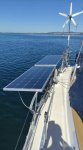
You don't need space on the boat to locate solar. You can use space outside the boat. This is 360w of solarreceived_4300113560038376.jpeg
 
It's not "fine theoretical data, it

The information in post #4 is wildly inaccurate.=, unless you want to destroy your batteries.


I see PVB has beat me to it.

If you base any of your calculations and assessments of your needs you will have a system that just doesn't do what you want it to do. You need to start by using correct figures.

You need to know how much power you require.

You need to install enough battery capacity to have that power available for a given time, with no power generation.

You need enough power generation to replenish that power.

I'm not saying that you should use LPG or that you cannot achieve an all electric galley, i'm simply saying, you need the correct equipment, which can only be planned for by using correct data.

Having a 3.5kW inverter generator would probably give me enough flexibility for a start. I really wouldn't want to run a genset for one hour each morning but apparently a lot of yachties do.

"you need the correct equipment, which can only be planned for by using correct data". I'm sure you are correct but I haven't got the correct data at this stage: that's the problem!

Thanks
 
You don't need space on the boat to locate solar. You can use space outside the boat. This is 360w of solarView attachment 122735

I think that's a great idea as my yacht is ketch rigged and I really wonder how shaded the panels will be if mounted on deck.

I don't want to mount the panels on the pushpit as that is where the life-raft will be mounted and probably near where the genset will be mounted on deck.
 
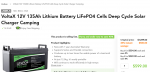
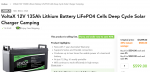
My yacht electrical system is 24V. If I go for X4 Lithium 135Ah batteries are these the type to go for?

Or maybe X8 of the 3.2V Lithium batteries?


Screenshot 2021-09-19 at 18-51-27 VoltaX 12V 135Ah Lithium Battery LiFePO4 Cells Deep Cycle So...png


Screenshot 2021-09-19 at 19-01-29 Lithium Iron Phosphate LiFePo4 3 2V 206AH Rechargeable Batte...png
 

Attachments

  • Screenshot 2021-09-19 at 18-51-27 VoltaX 12V 135Ah Lithium Battery LiFePO4 Cells Deep Cycle So...png
    Screenshot 2021-09-19 at 18-51-27 VoltaX 12V 135Ah Lithium Battery LiFePO4 Cells Deep Cycle So...png
    123 KB · Views: 4
Last edited:
So even with a cat she can’t use the induction hob at sea, as things just slide off? Possibly solvable with custom gimbals and pan racks, but the slidy surface a challenge. (Incidentally, the induction hob looks very similar to the portable one we got for £40 and carry for occasional use on shore power.)
Somewhat over does the challenges of getting gas. With spare cylinders and a set of adapters, hundreds of thousands of cruisers have cooked successfully with gas all round the world.
And again, a cat has unique advantages in terms of masses of deck / Bimini space for solar
 
I've heard that a silicone mat between the hob and pan works for that. It's heat resistant and allows the pan to get hot from induction still.
 
So even with a cat she can’t use the induction hob at sea, as things just slide off? Possibly solvable with custom gimbals and pan racks, but the slidy surface a challenge. (Incidentally, the induction hob looks very similar to the portable one we got for £40 and carry for occasional use on shore power.)
Somewhat over does the challenges of getting gas. With spare cylinders and a set of adapters, hundreds of thousands of cruisers have cooked successfully with gas all round the world.
And again, a cat has unique advantages in terms of masses of deck / Bimini space for solar

I have to laugh at the cats that sail around Florida and the Carribean: they have domestic fridges and freezers - no shortage of power!

I was going to say that I'm certain I could gimbal an induction hob but I've just done a google and many people have done it already.

25 Nov 2020 — The OceanChef is thought to be the first gimballing electric cooker with induction hobs designed for the marine market. (Yachting World)

fitting gimbal to induction hob - Google Search
 
I have to laugh at the cats that sail around Florida and the Carribean: they have domestic fridges and freezers - no shortage of power!

I was going to say that I'm certain I could gimbal an induction hob but I've just done a google and many people have done it already.

25 Nov 2020 — The OceanChef is thought to be the first gimballing electric cooker with induction hobs designed for the marine market. (Yachting World)

fitting gimbal to induction hob - Google Search
Fridges and freezers are potentially miserly compared to electric cooking. Our single ring induction hob can pull up to 2000w. Fine if you are just boiling a pan but if you want to cook a proper meal and use the oven expect to need a very large battery bank and 2500wof solar to replenish that bank. This is what catamaran friends of ours have. Their lithium installation with all the bells n whistles cost them over $10k US. At that cost.I really don't see the advantage.
If I was going to go lithium I would be building the bank myself and hope to spend a lot less money
 
Another interesting thread for me as we consider our next boat (which will, by desire be a bit of a renovation project) and I am starting to think about lithium and/or the possibility of going electric cooking.

I've come to the conclusion that whilst I could happily ditch gas, I am not ready to ditch fossil fuels just yet, and have come to the realisation that in order to go electric with the right amount of peace of mind, finding multiple ways to replenish power and heat water are desirable.

So thanks to all the contributors so far, it's been useful to help me crystalise a few things. As we will be UK boating for many more years yet (no world cruises on our horizon, unfortunately), I think we will go with a diesel fired water heater for cabin heating (radiators/matrix blowers) and twin coil calorifier for separate feed from engine, backed up with an electric immersion. I'll also have solar, upgrade the alternator on the engine and have a suitcase genny as backup. As we won't be far from marina's or civilisation for long, this will give us the flexibility and peace of mind to go full electric in the galley, and have a few creature comforts that we forgo right now as we try to use gas for cooking.

My hope is that I can find a suitable cooker, induction tops are readily available.

Thanks again :)
 
My yacht electrical system is 24V. If I go for X4 Lithium 135Ah batteries are these the type to go for?

Or maybe X8 of the 3.2V Lithium batteries?


View attachment 122740


View attachment 122739

Cheap LFP batteries are the Wild West. If you know what you are doing and put in plenty of research you may find a successful way through it but plenty get burnt. Even if you chose high quality LFP drop-ins or separate prismatic cells like Winstons from an authorised dealer for a DIY project it still wouldn't be possible to answer a question on suitability since any judgement would need to be on a complete system, not just the battery.

This article is a good starting point. LiFePO4 Batteries On Boats - Marine How To and there are a few threads now on this forum discussing aspects of LFP for marine use.
 
Last edited:
Fridges and freezers are potentially miserly compared to electric cooking. Our single ring induction hob can pull up to 2000w. Fine if you are just boiling a pan but if you want to cook a proper meal and use the oven expect to need a very large battery bank and 2500wof solar to replenish that bank. This is what catamaran friends of ours have. Their lithium installation with all the bells n whistles cost them over $10k US. At that cost.I really don't see the advantage.
If I was going to go lithium I would be building the bank myself and hope to spend a lot less money

Other people on this forum have done that and it really interests me. (I notice there are plenty of DIY videos).
But it is not something I can do in the near future as I'm flat out trying to get my yacht in the water
 
Whilst I no bias, gas or electric, living aboard full time, gas for cooking, I use around 10kg a year ..
Yes, I'd fit microwave etc if I had the leccy
 
Top