The Ford to Cummins Conversion Thread

Looked in ryders yard yesterday, theres an old S reg 45 beavertail, thats been there for ages so maybe worth a phone call, everything else is the newer common rail stuff.


Lynall
 
Fantastic, thanks. That sounds like a simple, doable and enjoyable little project. Imagine if I over-oiled and this happened within the confines of a my boat... http://www.youtube.com/watch?v=d_8Fc9qAZcw

From look of set up looks like a big Sigma pump on there which nutters in U.S. use on 12 valve B series for tractor pulling where they regularly screw 1,000 hp out of the poor little motor........

One of my last jobs before I retired was involved the MOD FV 107 Life Extension Program http://en.wikipedia.org/wiki/FV107_Scimitar.

We were up against the Perkins Phaser and Steyr to replace the Jaguar XK gasoline engine. Engines were run on the evil MOD 500 hour endurance dyno test which consists of all sorts of daft tricks like suddenly running stone cold coolant through a motor grinding away pulling peak torque. At about 200 hours into the first test the internals of the Steyr decided to exit to atmosphere, the Cummins and Perkins completed the test with zero faults. As the Steyr was what the project team really wanted as it was easy to install in place of the Jaguar another 500 hour test was run. All three engines completed the second test, however Perkins showed signs piston scuffing and minor defects indicating distress were found on Steyr internals. Third 500hr test was scheduled, this time the Steyr got to 250 hours before vomiting its internals all over the dyno room the Cummins and Perkins completed the test and were found to be perfect on tear down.

Visited MOD Bovington Camp recently to take a look at updating my training package, near 15 years on these little tanks are going through yet another upgrade, what is changing?? Everything except the engine which has been rock solid in Iraq and Afghanistan.
 
Visited MOD Bovington Camp recently to take a look at updating my training package, near 15 years on these little tanks are going through yet another upgrade, what is changing?? Everything except the engine which has been rock solid in Iraq and Afghanistan.

I drove one of those in Germany once when they still had Jag engines. Got it some in some deep mud, revved the hell out of it, then the engine died a death. Deathtraps without speed and reliability...
 
Removing The Old Engines

If I’m doing/done something wrong, or you’ve got any suggestions - please - let’s hear ‘em!

I’ve divided the engine removal into five sections:
1. Removing the gearboxes
2. Undoing the engine mounts
3. Clearing away all wires, pipes and controls
4. Making sure the engines can clear the cabin floor
5. Making sure the engines can clear the cabin roof

The engines are mid-mounted, beneath the saloon. I thought about removing them through the cabin side door, but the yard’s perimeter fence prevents fork-lift access, and there’s what looks like a hole already cut in the cabin roof.

Barcelona.jpg


Profile.jpg


Removing the gearboxes was an easier task than I thought it would be.

First, off came the gearbox oil to gearbox oil cooler pipes.

Gearbox1.jpg


Then I let the gearbox oil drain off. There was more oil than I imagined – it came out slowly but surely…

Gearbox2.jpg


Next I removed the gearbox oil cooler raw water pipes, followed by the jubilee clips holding the gearbox oil cooler.

Gearbox3.jpg


The arm holding the gearbox gear selector cable followed. A word of caution – it may have been better to remove the gear selection cable from the gear selection arm on the gearbox first, as doing it my way put unnecessary stress on the cable.

Gearbox4.jpg


Gearbox5.jpg


Out comes the split pin on the gear selection arm.

Gearbox6.jpg


Then, off comes the gearbox oil pressure tube.

Gearbox7.jpg


Gearbox8.jpg


Two jubilee clips later and the sump pump is off (are these really necessary when large-capacity pumps do the job so much more quickly?).

Gearbox9.jpg


With the gearbox free of encumbrances, I can now undo all the gearbox adapter plate to flywheel bolts. The ones underneath weren’t easy to get to, but liberal use of WD-40 made them come undone without protest.

Gearbox10.jpg


A piece of board underneath gave support as I wiggled.

Gearbox11.jpg


And she’s off!

Gearbox12.jpg


Just three bolts held the drive plates against the flywheel. It must rely on surface friction as well, but I was surprised at this.

Gearbox13.jpg


To be continued…
 
I cannot accept just three bolts holding flex plate to flywheel??

Not sure how close together your engines are but just remembered STORM (Straight O Ring Metric) block has drillings on both side of the pan rail therefore you can have handed dip sticks, must be a bonus.

Finally, remind me to never eat aboard Fitzroy
 
I cannot accept just three bolts holding flex plate to flywheel??

This is exactly how it was - both sides - when I got the 'boxes off - not the best photo but you can see the three bolts...
Gearbox14.jpg


Not sure how close together your engines are but just remembered STORM (Straight O Ring Metric) block has drillings on both side of the pan rail therefore you can have handed dip sticks, must be a bonus.

Access between the engines is fine (a couple of feet), but getting to the other sides can a pain in the 4rse. This will save having a dip stick trailing over the top of one of the engines. With the Dorsets, there is a little three-inch hole in the cabin floor just to access one of the dipsticks!

Finally, remind me to never eat aboard Fitzroy

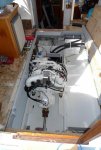
Basically, seven years of filth and grot - coated liberally with WD40 now and then, and made more vivid by a decent camera with a polarising lens.

All will change when the new engines go in. I'm going to flow-coat or paint every surface in the engine compartment in pristine white. And with the smaller engines, I'll be able to reach under and behind the engines more easily to keep her clean.
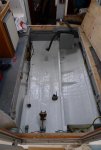
Edit - ooohhh, you meant the saucepan?! Needs must. The other half's curry sauces more toxic and corrosive than any gearbox oil ever could be...
 
Last edited:
I thought about removing them through the cabin side door, but the yard’s perimeter fence prevents fork-lift access, and there’s what looks like a hole already cut in the cabin roof.

Had a similar situation myself a few years ago. Have you considered a Hi-ab with the arm coming over the fence and through the cabin door. Worked for me.
 
Like this you mean. Danboline.
View attachment 34754

Beautiful. Yes - exactly like that.

Not sure if the grey stuff already down there is Danboline or flow-coat - I suspect a mixture of both badly applied over the years. But it's all going to go somehow or other. There's been a lot of oil and antifreeze sitting down there - I just hope it clears up okay.
 
Undoing the engine mounts...

On to the engine mounts. As with the rest of the engine, these had been WD40’d to within an inch of their lives. Nevertheless, I was surprised how easily most of them came undone bearing in mind they might not have been undone in 40 years. I loosened all of them then hand-tightened them all up. Not sure if the mounts will be reused, as it’s difficult to assess them and their rubberiness (if any) with the engines still in place. I hope the mild steel engine beds can be removed – it’d be great to have them sand-blasted and powder coated, but I’ll need to be very sure about engine mount positions otherwise I’ll be drilling into the powdercoating.

EngineMounts1.jpg


EngineMounts2.jpg


EngineMounts3.jpg
 
There's been a lot of oil and antifreeze sitting down there - I just hope it clears up okay.
My engine bay was pretty similar to yours originally. I used a couple of cans of Gunk engine degreaser and a wire brush which got the worst of it off. Then a thorough sand and two coats of Danboline.
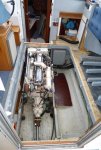
Re the engine mounts, I had mine grit blasted but I painted them myself with two pack polyurethane. Even though I drilled them afterwards for the new mounts they've had lasted 4 years with no signs of corrosion yet.
 
Top