Terrible news from Clipper

I think what a lot of us are beginning to get at is, one may be very experienced, probably pretty fit too, but the foredeck of a big fast boat in the Southern Ocean while trying to tame a huge heavy sail is a task which would make the SBS cringe - or it would / should if they knew what is involved.

People like Sir Francis Chichester - a small but very strong and fit man - handled huge hanked headsails, but I doubt they pushed anything like as hard as say the Clipper boats - and now lots more people and boats are doing it, the law of averages is catching up, and people are getting killed - I think it's that simple, particularly when labour saving devices like headsail rollers are deliberately avoided; I'm extremely well aware of the potential snags with rollers, no golden solution, but most of us here would I think go for them in this situation.

Re tethers and strong points, as alluded to they can only be so strong, there's only so much shock load a body can take; I am not sure about the harness lines used on the Clipper, but one thing I came across as photographer at BAe was that the pilot's parachute straps on ejection seats have rows of progressively weaker stitching, the weaker end taking the load first, so that the stiches break and lines lengthen slightly, easing the shock of the parachute deploying after ejection.

Is anything like this used on marine harness lines ? I don't think mine have this feature, and yes I have looked.
 
..... pilot's parachute straps on ejection seats have rows of progressively weaker stitching, the weaker end taking the load first, so that the stiches break and lines lengthen slightly, easing the shock of the parachute deploying after ejection. ..... .

Industrial working at height harness tethers fail like this. You have to take into account the eventual length of an activated tether for the work at height; it could result in actually hitting the deck. In some designs it is stitching, in others it is like a controlled fraying of the tether as the stands elongate. Single use devices i.e. only one fall and then they are junk.

There is a school of thought and design that tape jack stays will absorb the impact load on the body unlike wire rope jackstays.
 
Last edited by a moderator:
BlowingOld Boots, thanks; I've never liked wire jackstays becayse they can roll under one's boot and cause a slip, and webbing jackstays - which I still prefer for lateral give etc as you mention - are vulnerable to U/V and salt crystals.

I'm lucky on my boat that a standard line attached to a hard point beside the mast foot allows reaching the cockpit and the stemhead without unclipping; I have a three-way harness line to work myself along on my and other boats too, I suppose one could do without jackstays on larger boats as I do on my 22 and just work along, but of course sod's law will always catch one during an unclipped moment...
 
...There is a school of thought and design that tape jack stays will absorb the impact load on the body unlike wire rope jackstays.

Not just a school of thought, but engineering fact. All jackstays stretch, the amount depending on both the material and the length. For example, polyester is nearly non-stretch on a 25-foot boat, but it will deflect far to the side on a 70-foot boat. Thus, a longer boat needs different jackstay materials if they are to perform in the same way. This can be no one-size-fits-all.

But that does not mean they need to be steel cable. Dyneema webbing isn't hard to find. BTW, if the material has less stretch (steel or Dyneema) it also needs to be stronger, because the forces go up. The standard was based on experience with polyester. Fortunately, worse case falls are really, really rare.

There are also industrial tethers used in Europe (Petzel) that rely on climbing rope to absorb the impact, and thus are not single use. I am not aware of a marine-adapted version, but it would sure be simple. One downside is that rope can roll underfoot, depending on the size and length of the rope. That said, I've slipped on Plastimo webbing tethers worse than rope.

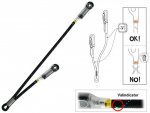
The overload indicators are a very simple solution. A non-stretch contrasting thread is included. When the tether stretches past a certain point, the thread disappears inside the cover.

product_petzl_progress_how_to_use_1_1.jpg

https://www.petzl.com/US/en/Professional/Lanyards-and-energy-absorbers/PROGRESS
 
Last edited:
Thinwater
Just for clarity are you saying that the photo of the deformed Gibb and Spinlock clips was caused while the 'jackstay' was deep within the 'crook' of the clip and not as shown while the fabric of the 'jackstay' was around the end of the hook?
 
Thinwater
Just for clarity are you saying that the photo of the deformed Gibb and Spinlock clips was caused while the 'jackstay' was deep within the 'crook' of the clip and not as shown while the fabric of the 'jackstay' was around the end of the hook?

Good question,

surely must have been around the end.

I'm beginning to wonder, if people insist on regular foredeck work in conditions like this, is if some sort of ' impact absorption harness line ' and the MOB ending up in their own Jonbuoy style device clattering alongside until the boat is slowed and they are recovered, is what is required ?

This would be jolly expensive on kit if it happened regularly, but I suppose good for Alton Towers type thrills ( with a huge lot more at stake not least for the rest of the crew ) and I suppose it would look good ( ? ) on Youtube, might even recruit the next season's punters if that's what they think they want ! :rolleyes:
 
BlowingOld Boots, thanks; I've never liked wire jackstays becayse they can roll under one's boot and cause a slip, and webbing jackstays - which I still prefer for lateral give etc as you mention - are vulnerable to U/V and salt crystals.

I'm lucky on my boat that a standard line attached to a hard point beside the mast foot allows reaching the cockpit and the stemhead without unclipping;
I have been using 1 /4 inch stainless 1x9 wire for decades and have had no problem with the foot rolling on it.
Mine runs from the cockpit to the foredeck ,so no detatchement needed,
 
No point clipping on to anything if your chest harness is that loose. You would slip out of it.

I have a line running down from my mast with a clip on it. Clipped onto that, I can reef easily, and if I fall, I can't travel far enough to hit anything, given the limited length of that tether.
 
Last edited:
Thinwater
Just for clarity are you saying that the photo of the deformed Gibb and Spinlock clips was caused while the 'jackstay' was deep within the 'crook' of the clip and not as shown while the fabric of the 'jackstay' was around the end of the hook?

If the load is in the basket (crook, as you say), the gate is fully latched, and the carabiner is NOT loaded from the side, the Spinlock carabiner tests very strong, well over 2 tons. Same with the Gibb (the test results were nearly identical).

If the load is from the side (even fully latched) or on the nose (there are several very valid theories floating around, none fully proven that I am aware of, since apparently no one saw exactly how it was hooked) the hook can begin to distort at about 300 pounds. At that point, even if the webbing did not start near the nose, it can easily slide to the nose and become caught on the pin groove in the nose. Then, as the force builds, the carbabiner will stretch out as you see.

This is a subtle failure to diagnose, and there is more than one way it could have begun. However, it seems probable that it ended with the nose hooked on something; that is the only way to duplicate the distortion.
 
...polyester is nearly non-stretch on a 25-foot boat, but it will deflect far to the side on a 70-foot boat. Thus, a longer boat needs different jackstay materials if they are to perform in the same way. This can be no one-size-fits-all...

There are also industrial tethers used in Europe (Petzel) that rely on climbing rope to absorb the impact, and thus are not single use....

Simple solution is to have intermediate anchors, avoiding a 70ft span.

I believe climbing ropes are rated for a specified number of falls. So not single-use, but not indefinite either.
 
For decent protection they shouldn't be underfoot, inboard and waist height would be much better.


So how do you get from side to side on the foredeck then, and it'd have to angle down to the headsail tack ? The previously mentioned stainless bar would seem a better bet.

Aft of the mast it would also be tricky organising a waist high jackstay, due to kicker, preventers and mainsheet, and with the boom potentially whizzing around clipping on and off would seem a bit hazardous.

The nearest I get to that is having a wichard eye each side of the mast foot, so they are inboard and out of treading areas.
 
Simple solution is to have intermediate anchors, avoiding a 70ft span.

I believe climbing ropes are rated for a specified number of falls. So not single-use, but not indefinite either.

Climbing ropes are typically rated for about 10 (UIAA 5 minimum) vertical falls of 4.8 meters on 2.5 meters of rope. This means the fall starts 2.3 meters above the rigid anchor point and then falls past it. the rope is over a 5 mm radius edge and is secured with knots. This fall is far more violent than anything experienced on a boat. It is 70% more violent than current tether designs are built for, and I doubt any modern tether could survive one UIAA fall (data welcome). In reality, climbing ropes in gyms are used for thousands of moderate falls and hundreds of fairly violent falls (like the one this thread started with) before they are retired.

In effect, on a boat, the life of climbing rope is limited by UV and chafe, not falls, and should greatly exceed the useful life of current tethers.
 
Last edited:
I do believe we should be grateful to our friend from the scenic small town of Deale, Maryland for his focused and single-minded investigation of this concerning problem, not least as it has implications for most of us.

A friend posted the following to me, from The Cruising Club of America, and in turn I pass it on..

A Caution when Fitting Safety Harnesses

To be safe, all harnesses, whether integral with a PFD or not, should fit properly. This may be an issue if you are smaller than average, as noted below.

Regarding the fit of a sailing harness, the core instructions are: the attachment point of a harness must be “above the lowest point of the rib cage” (from ISO 12401)

US Sailing has expanded on the ISO rule to note that many inflatable PFDs with a built-in harness are designed for people 5’6” in height or greater. If you are below that height there may be a risk of broken ribs or back injury if sudden tension is applied to the harness.

It is strongly recommended that each person who is below the 5’6” height test their harness to insure that it is high enough. If not, that person should switch to a PFD with built-in harness unit that has a better fit, adjustable features, or an independent adjustable harness.

https://ber.cruisingclub.org/pdfs/sas_safety_moment_harness_height.pdf
 
I do believe we should be grateful to our friend from the scenic small town of Deale, Maryland for his focused and single-minded investigation of this concerning problem, not least as it has implications for most of us.

A friend posted the following to me, from The Cruising Club of America, and in turn I pass it on..


https://ber.cruisingclub.org/pdfs/sas_safety_moment_harness_height.pdf

Excellent information, often overlooked. However, I could not find the US Sailing reference regarding harnesses for 5'6" and shorter. Could you guide me?
 
Humm well sorry to be a pest, but, whilst waiting in a Hosp waiting room (where else can one wait ?) to day I picked a Yachting Mag, and browsed through it; well the only Racing Yacht pic that I found clearly showing safety netting along the side rails was in an advert for Hemple Paints, all the other pics of Yachts racing, mostly on across Ocean Races, along did not appear to have netting fitted, so am I to understand that netting is not usually fitted, despite some claims to the contrary ?

NB the camera does not lie, eh !
 
Netting - or line in a zigzag pattern between the toerail and guardwires, usually from the pulpit to the forward stanchion, was a standard item on racing yachts of the 70's but is less popular now, I'm not into racing but use separate headsails so I do have this on my boat, as she's had for the last 39 seasons.

I'm guessing slicker sail handling gear and techniques and - maybe a hint of fashion - are the reason it's less popular on the average racing boat now, but it's great for keeping sails and people from disappearing over the side; boats with children or pets aboard often have netting all the way round, which can be a bit of a pain for berthing lines but obviously it's worth it for the safety.

BTW I'm a photographer, please keep telling people ' the camera does not lie ' as it makes me laugh. :)
 
Last edited:
The previous MAIB report on a Clipper mishap recommended they completely envelope the stanchions/lifelines with net. This is now the case on all Clipper yachts. it is laced along the top lifeline and they seem to have drilled the wood toerail and laced to it as well. The netting is a quite wide mesh and on the yachts has suffered some, very minor, damage - but it looks as if it will easily hold a man, or sails on the foredeck. I am not aware that the same requirement is imposed on racing yachts. They also have substantial stanchions, pulpit and pushpit, or more substantial than you see on most production yachts, there did not appear to be any damage, bent stanchions (though I did not look at every yacht, some were still at sea).

As long as you fall inside the deck of a Clipper yacht I could not see how you could be swept through the lifelines, though could conceivably be lifted, from a prone position, over the top by an errant, large wave.

Clipper jackstays, where possible, are doubled up, an inner jackstay and parallel, an outer jackstay, inboard but under the stanchions. The problem occurs, on any yacht, at the bow where both jackstays converge and there is really no way of having a jackstay inboard and no real possibility of having a chest high jackstay. The bow is where a lot of the work is demanded, unhanking and hanking on sails. Further aft they have inner jackstays and you could attach to a variety of places at the mast (including the mast). The issue then develops that the item to which you fix the hook might result in the hook being levered on something else, horn cleat - for which hooks are not tested (?).

Jonathan
 
Last edited:
Top