Taking wind gen up and down

He said he regretted the inability to add a wind gen but it was impossible to fit without reducing some of the sailing characteristics - the working component, the generator itself, was too heavy and to be useful needed to be high up.
Exactly, not worth the drawbacks.

This yacht relied on solar, which contradicts your view that small cruising boats need to fit a wind generator.

This was the example you picked and highlighted in post #23 to show that wind is necessary on small cruising boats, but the boat you chose to feature turns out not to have fitted a wind generator :(.
 
Last edited:
And when sailing down wind they just spin on the vertical axis unless you tether them.
The ideal is to have a wind and water gen combined - like the Dougen (which may have other downsides). The LVM aero4aquagen converted to a hydro generator and when set up would produce copious amounts of power, over about 7 or 8 knots it would produce as many amps as boat speed - and did so through the night (when power usage is high). I had to modify our impeller to, even, smaller blades as the impeller would leap out of waves when making over 10 knots.

It was not worth converting from wind to water for short passages but well worthwhile for longer runs, say over 12 hours.

Not mentioned but another option is a Watt and Sea Hydrogenerators - though they are not much use when at anchor :( and last time I looked were a bit pricey.

Jonathan

Unlike some who like to try to score points and be provocative.

In addition to supply the 6mm rode I also had their Spade anchor regavanised, covered in this thread.

Apologies - pasting the link had some issues I could not solve.


Thank you 2.jpeg
 
Last edited:
The duogen produces nearly twice as much power in water mode. It can be switched between water mode and wind mode in less than 5 mins.
Even with these features, I would not want another one. I don't think you realise how much solar has improved.
We see less and less wind turbines on boats. Every boat seems to have solar, either on and arch or mounted on thr guardrails.
 
If you live aboard a, say 40' plus yacht to suggest because solar is so cheap you don't need an alternative source of power as you can smother your yacht with cheap solar. Why does the owner of a small yacht not have the aspiration to live in the same lap of luxury as 'you'.

My conclusion of the 'cheap solar' grouping is they prirmariily have larger yachts

Solar needs space, why should the owner of a small yacht need to slum it because he is on a small yacht when he could augment his power requirements another way.

Wind is not a panacea. But a hydro generator (and more time sailing) might help.

So instead of leaving the small yacht to camp, as in the 50's, think positive - this is Practical Boat Owner - how can a small yacht owner deploy these cheap solar panels effectively on a small yacht. Other than cheap Chinese panels are there other sources of 'cheap' power,

Small windgens seems to have found a niche, Sky Wind being but one - any of the denigrators of wind tried some of these newer suppliers....?

Now it could be that the only way to enjoy these cheap solar panels you need a 40' plus yacht - which seems a high entrance fee to cheap power.

Jonathan
 
The duogen produces nearly twice as much power in water mode. It can be switched between water mode and wind mode in less than 5 mins.
Even with these features, I would not want another one. I don't think you realise how much solar has improved.
We see less and less wind turbines on boats. Every boat seems to have solar, either on and arch or mounted on thr guardrails.
We had the same experience hydro produces more power than you can store - so maybe an answer is hydro (that converts to wind) and bigger batteries.

You are in the Caribbean - what is your survey of PBO members (in Scotland, or in sunny England). on more typically sized yachts (who want the extra amps to encourage their partners to enjoy the week on the water).

Jonathan
 
If you have a 50" yacht, cheap solar IS a panacea. If you spend time in the Caribbean (or the Whitsundays and maybe the Med) and have a large yacht then cheap solar IS a panacea.

What hope do the rest, many PBO members, have?

Hands up those who want more cheap power, knowing that you need bigger batteries to store the power, need extra controllers that add the the costs - but need some hard core, numerical data and advice on how to achieve that lift of comfort (in a 30' yacht). Keep the partner and 2 impressionable youngsters to add to the mix.

Tell us how to increase power farming on a small yacht. How to use these cheap solars to best advantage - don't waste you time denigrating - think positive.

Jonathan
 
Last edited:
We had the same experience hydro produces more power than you can store - so maybe an answer is hydro (that converts to wind) and bigger batteries.

You are in the Caribbean - what is your survey of PBO members (in Scotland, or in sunny England). on more typically sized yachts (who want the extra amps to encourage their partners to enjoy the week on the water).

Jonathan
That's not correct. We are in the Canaries, having sailed from the UK this summer. The long summer days in the UK provide ample solar performance, if you have modern 25% efficient solar and enough of it.
We were never short of power with lithium batteries that will enhance the performance of your solar.
 
If you have a 50" yacht, cheap solar IS a panacea. If you spend time in the Caribbean (or the Whitsundays and maybe the Med) and have a large yacht then cheap solar IS a panacea.

What hope do the rest, many PBO members, have?

Tell us how to increase power farming on a small yacht. How to use these cheap solars to best advantage - don't waste you time denigrating - think positive.

Jonathan
We don't have a 50ft yacht but we do have a 44ft yacht with 1300w of solar. In the UK where you don't need a watermaker as water is good and plentiful in every harbour we could reduce our solar. We need about 500Wh per day to run the watermaker. That's about 300w of solar on reasonably sunny day.
So that would leave us with 1000w of solar. That is 4x250w bifacial solar panels on our boat. Other boats can fit that on an arch. Not so easy on our ketch so ours are on the guardrails. The benefit of guardrail mounting is we get about 25% more output if we tilt the panels. This mainly works on one side of the boat as often the other side is shaded.
We have an all electric galley. No gas on the boat. We spent a month in the UK before we headed to Madeira. We never needed to run the generator. We haven't plugged into shore power since we were in a shed last winter.
Solar is more efficient than it used to be.
 
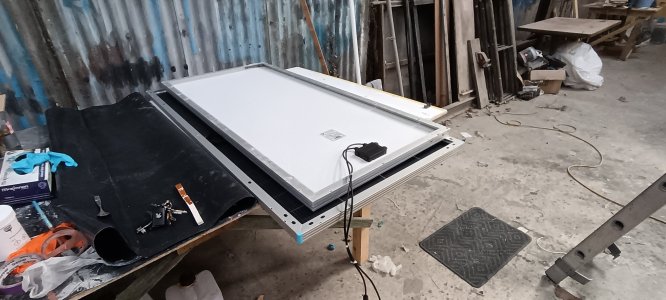
Here is a photo of my old 180w P type (17% efficient cells) solar panel on top of my new 250w bifacial N type (25% efficient cells).
As you can see the difference in size is not huge. You also need to consider that the bifacial aspect of solar cells on the rear, comes for free. ii is not calculated in the 250w rating.
If you have the bifacial panel pointing at the sun, you will likely see circa 5% additional harvesting off the rear. If you have the panels vertical to collect early morning sun, they will do this very effectively on the front or the rear. With panels mounted on guardrails on both sides of the boat, you can have the front of one panel in full sun and the rear of another. We can see 30A at 12v going into the batteries some mornings when the horizontal panels will be producing less than 1A. Our peak instantaneous solar output has hit 100A at 12v on occasion.IMG_20250602_092321.jpg
 
For comparison purposes, if you take a P type solar panel with 17% efficiency of 1m2 and compare the output in the same sunlight to a 25% efficient 1m2 N type panel you will see 170w output on the P type and 250w on the N type. This doesn't assume bifacial on the N type that would likely add another 5%. Without the bifacial aspect, this is a 47% increase in performance. If we add in some bifacial performance, we are in the territory of 50% increase in performance with new modern efficient panels.
If you have older panels with relatively low performance it is worth considering an upgrade as you could increase the solar output by 50% for no additional panel area. If you add in the degradation that happens in older P type panels over time the actual increase in performance could be more. N type solar panels have a different coating on the cells so they don't degrade over time like P type panels.
If you then add lithium batteries that don't need hours of absorption, you solar harvesting will also improve dramatically. We saw about 25% increase when we switched to lithium.
Why would you need an expensive wind turbine that produces very little power in the real world compared to solar
 
Thank you Geem - that's the data that supports your argument.

Now translate that from a 44' yacht to, say, a 35' yacht based in the UK. The owners are a cruising couple, or want to be, and have exactly the same power needs as you - I'm guessing somewhere near a more typical PBO forum member. (not suggesting that you and better half are 'average' - you are exceptional :)

They have a clean slate, or they might do as you suggest (dump what they bought when they took ownership) and buy new, state of the art (and cheaper than the ones they will dump). Not forgetting controllers, inverters, DC/DC chargers

What should they buy and how are they going to accomodate it on a smaller yacht (and if this is to big an ask - what might they need to sacrifice. Some pictures of you guard rail panels, installed, might be an eye opener.

Jonathan
 
They may not have the same power needs. We have 3kw inverter and run an all electric galley. My point is that you don't need a wind turbine. Solar will run a small boat easily.
We heat water for showers with an immersion heater, do all the cooking electrically. Boil an electric kettle for tea and coffee. Not many 35ft boat would do this by they could easily do away with the wind turbine that would likely shade the solar anyway
 
Last edited:
Thank you Geem - that's the data that supports your argument.

Now translate that from a 44' yacht to, say, a 35' yacht based in the UK. The owners are a cruising couple, or want to be, and have exactly the same power needs as you - I'm guessing somewhere near a more typical PBO forum member. (not suggesting that you and better half are 'average' - you are exceptional :)

They have a clean slate, or they might do as you suggest (dump what they bought when they took ownership) and buy new, state of the art (and cheaper than the ones they will dump). Not forgetting controllers, inverters, DC/DC chargers

What should they buy and how are they going to accomodate it on a smaller yacht (and if this is to big an ask - what might they need to sacrifice. Some pictures of you guard rail panels, installed, might be an eye opener.

Jonathan
We are just like that cruising couple. We abandoned our wind generator. Well, actually it abandoned us, by dramatically disintegrating in a gale, causing some damage to the boat.
We now have 180w of panels permanently installed on the coach roof, with a further two x 50w panels, rigged when at anchor, by slinging them over the mizzen boom. Our electrical requirements are fairly modest. We cook using gas. We don't have or need a water maker. We have all the other normal navigation and domestic equipment, including a fridge. We sail on the West Coast of Scotland, in the six months of "Summer". Particularly in the mid Summer months, the days are long. The further north you go, the longer is the daylight.
Given reasonable weather, we find that the arrangement of panels that we have, gives us all that we need. We are definitely not camping.
Previously, with the wind generator mounted high up on the mizzen mast, any running noise that it made, was transmitted straight down into our aft cabin. It maybe wasn't loud, but it was there. PV panels have no moving parts, and are absolutely silent. They are also a fraction of the price of wind generators. I am a convert.
 
If you have a 50" yacht, cheap solar IS a panacea. If you spend time in the Caribbean (or the Whitsundays and maybe the Med) and have a large yacht then cheap solar IS a panacea.

What hope do the rest, many PBO members, have?

Hands up those who want more cheap power, knowing that you need bigger batteries to store the power, need extra controllers that add the the costs - but need some hard core, numerical data and advice on how to achieve that lift of comfort (in a 30' yacht). Keep the partner and 2 impressionable youngsters to add to the mix.

Tell us how to increase power farming on a small yacht. How to use these cheap solars to best advantage - don't waste you time denigrating - think positive.

Jonathan
The extra weight and windage aloft needs to be taken into consideration, which will be disproportionately higher (literally) in a small boat.
Many smaller yachts also tend to be older designs, and often have added weigh and windage aloft from furling genoa which the designer never envisaged back in the day.
Adding a wind great generator on a heavy metal pole will have a material adverse impact on a small boat, whereas solar is generally much lighter (until get in to the large metal stern gantries which also have stability impacts). The arrays of “solar sails” that can be hoisted at anchor might be an ideal solution for small boats.

PS Solar seems to generally work well in Scotland due to the long summer days - but clearly not so effective in winter or when overcast.
 
We are just like that cruising couple. We abandoned our wind generator. Well, actually it abandoned us, by dramatically disintegrating in a gale, causing some damage to the boat.
We now have 180w of panels permanently installed on the coach roof, with a further two x 50w panels, rigged when at anchor, by slinging them over the mizzen boom. Our electrical requirements are fairly modest. We cook using gas. We don't have or need a water maker. We have all the other normal navigation and domestic equipment, including a fridge. We sail on the West Coast of Scotland, in the six months of "Summer". Particularly in the mid Summer months, the days are long. The further north you go, the longer is the daylight.
Given reasonable weather, we find that the arrangement of panels that we have, gives us all that we need. We are definitely not camping.
Previously, with the wind generator mounted high up on the mizzen mast, any running noise that it made, was transmitted straight down into our aft cabin. It maybe wasn't loud, but it was there. PV panels have no moving parts, and are absolutely silent. They are also a fraction of the price of wind generators. I am a convert.
I think it helps having experienced both wind turbines and solar at the same time. We had energy meters on both so we could directly compare.
The most we ever saw out of the Duogen was 1kWh in a 24hrs. (We had to tolerate the noise as it span and vibrated the back of the boat. Earplugs were the only answer.)
This was in exceptional conditions for wind turbine performance. We were anchored in 20kts of wind blowing 3000nm across the Atlantic with only a reef between us and the constant wind. This anchorage type is incredibly rare where both the direction and and wind speed hardly varied. Wind turbines lose so much generating potential by constantly hunting side to side and never facing constantly into the breeze. Most anchorages or moorings have some form of obstruction nearby that vastly reduces the energy hitting the turbine blades.
By comparison our cheap 180w solar panels vastly outperformed the wind turbine every day. Our four panels gave us 720w of solar for £500 US purchased in Bonaire from a Chinese electrical shop 9 years ago. We used to average about 3kWh per day. The current price of a D400 wind turbine is £1800. Our four new replacement panels that are slightly larger cost £640 and they are rated at 1000w combined. Installing a wind turbine just isn't money well spent, if you can find the space for solar
 
I have 80w of solar on my contessa -keeps me fully powered up Solent sailing all year round charging phones and the like.

My catamaran has about kW of solar (cheap domestic panels mainly) and runs a 3kw inverter and all electric propulsion - apart from the sails obviously. Also Solent use for trips with the family (of four). Never run out of power. It has an old wind gen on the stern the previous owner fitted and the shunt shows it does more or less sod all beyond make a humming noise. The 80 flexi panel on the contessa produces lots more even in winter. I wouldn't bother with a turbine, solar is so good these days and if you have an arch a 450w domestic panel is only 60 quid new.
 
Our four new replacement panels that are slightly larger cost £640 and they are rated at 1000w combined. Installing a wind turbine just isn't money well spent, if you can find the space for solar

The panels cost stg640, how much does an arch cost to mount them (if you go for an arch - what does an arch do for sailing ability, see post 55 - especially on a yacht under 44'

That's the killer.

If you can find the space - so what do you do if you cannot find the space?

If you have a 44' yacht, preferably bigger there is no argument - go exclusively for solar. Hands up the people with 44' + yachts.

My guess is that the majority of owners (it would be interesting to know) slot in around the 30' - 35' size. Buying the panels is not an issue, as mentioned, they are cheap (though you need to add in the cost of 'a' ? controller) - finding somewhere on a 35' yacht is the issue. Additionally to take advantage of the better panels you really need to factor in changing to Lithium (most yachts are still lead?)


Jonathan
 
It seems the dream for a family of 4 to live off grid, or have 2 weeks holiday off grid, and enjoy the benefits of today's technology, desalinator, induction hob, etc etc has nothing to do with the cost of solar - it could be free - but unless you have a 44' yacht - you cannot fit the solar (and have a yacht that you can still sensibly sail).

Jonathan
 
It seems the dream for a family of 4 to live off grid, or have 2 weeks holiday off grid, and enjoy the benefits of today's technology, desalinator, induction hob, etc etc has nothing to do with the cost of solar - it could be free - but unless you have a 44' yacht - you cannot fit the solar (and have a yacht that you can still sensibly sail).

Jonathan
But surely the average family having a two week cruise, can manage fine without a "desalinator, induction hob etc etc".
 
Top