
Spreader bracket

Sea Change

Well-Known Member
Joined
13 Feb 2014
Messages
2,532
Visit site
I'm taking a good look over my rig and I don't much like the look of my lower spreader brackets.
It's a Francespar mast from the late 80s, twin spreader.
The upper spreaders are all good but the lowers have these ugly spreader brackets. In comparison to the uppers, there's a second stainless plate welded on underneath. I wouldn't be surprised if it was a previous repair.
I think I'd be happier if I got new brackets made. I know most of the force on an inline spreader is in compression and the brackets aren't doing a huge amount, but we have an ocean to cross and while we have the mast down I want to get everything right.

From previous experience of getting custom metal parts fabricated, I don't think this needs to be too expensive.

Does anybody recognise these brackets? Is the double layer original, or a later bodge?spreader base.jpg
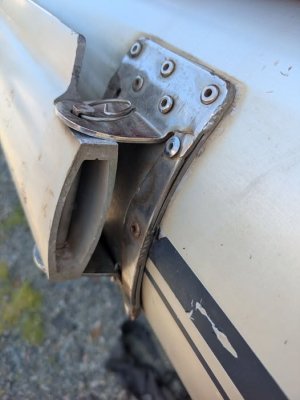
 
There's an extra rivet there that isn't on the other corners we can see. The other side has a matching weld, which makes me think it's been repaired before and the repair is failing.

It's down - if you can get it'd done I'd replace.
 
Will you sleep easy when you hit heavy weather offshore, knowing that fitting maybe/is cracked or weakened? The sea has a nasty way of finding out that sort of weakness.
No, I won't.
Which is why I'm asking about how to get replacements.
Fortunately I'm now in touch with a local guy who may be able to fabricate new ones. Or at the least, help me knock up CAD files to send off to have the cutting done elsewhere, and then we can bend them on site.
 
A spar of that age, I would suggest a s/s fabricator is the way to go. The chances of getting original fittings is pretty remote and not worth the effort tracking them down. I had a triatic spreader made to match the damaged original, at very reasonable cost here in Chichester Harbour on S Coast. Dont forget to get a good insulating layer between the fitting and the alloy spar when you come to fitting the new part. Electrolysis can play havoc with the spar in just a few months, but Granny may be collecting eggs....

In answer to your second question is it original or bodged, I would say from the rough weld joining the two plates, that its a bodge. But if so, the original is a pretty poor design and its unsurprising that stress cracks have appeared where they have. There's very little metal holding the flange to the base to stop it lifting or flexing as it very obviously has. Is the one opposite the same pattern? If so I would suggest replacing both, as the other may be similarly overstressed and develping the same cracks even though they may not visible yet. I would make the plate wider too, to give more strength where this has failed. Stainless is funny stuff, and can fail very quickly with little warning when it is under stress.
 
Last edited:
A spar of that age, I would suggest a s/s fabricator is the way to go. The chances of getting original fittings is pretty remote and not worth the effort tracking them down. I had a triatic spreader made to match the damaged original, at very reasonable cost here in Chichester Harbour on S Coast. Dont forget to get a good insulating layer between the fitting and the alloy spar when you come to fitting the new part. Electrolysis can play havoc with the spar in just a few months, but Granny may be collecting eggs....

In answer to your second question is it original or bodged, I would say from the rough weld joining the two plates, that its a bodge. But if so, the original is a pretty poor design and its unsurprising that stress cracks have appeared where they have. There's very little metal holding the flange to the base to stop it lifting or flexing as it very obviously has. Is the one opposite the same pattern? If so I would suggest replacing both, as the other may be similarly overstressed and develping the same cracks even though they may not visible yet. I would make the plate wider too, to give more strength where this has failed. Stainless is funny stuff, and can fail very quickly with little warning when it is under stress.
I'm in touch with another owner of the same model, and he's sent me pictures such prove that this bracket is indeed a bodged one.
By the way it's not actually cracked. What you can see in the photo is the edge of a blob of weld. It's likely a stress raiser and I don't trust it. You can see that the original plate did crack under the weld.

Interesting idea about making the new ones bigger. Would avoid reusing the old rivet holes, and would give a lot more meat to the area that previously cracked.

The local fabricator is highly regarded, although his facilities are limited. Going round there this morning, will update with progress...
 
Looks a bodge and the fact you are on the chat asking,to me at least..seems to be a bit like the old reefing addage..if you are thinking about it you already should of!
 
My only thought re not using the original holes is to avoid perforating the mast too much and creating a postage stamp weakness by perforating the mast wall too often. I would make the fitting longer to give more strength to the point where it failed, but use the original vertical plane fastening holes. Maybe Im being finicky because it will be supported by the fitting, but you dont want to build in weakness. When I find something has failed I'm a belt and braces type, and tend to want to overengineer the repair, specially in something critical like the rig!
 
Looks a bodge and the fact you are on the chat asking,to me at least..seems to be a bit like the old reefing addage..if you are thinking about it you already should of!
Uh, I've literally already drilled out the rivets. This was never a question of 'if', it's a question of 'how'.
 
So, update.
The fabricator has persuaded me that, with weld being just as strong as original metal, it's far easier, faster, and cheaper to repair. I let him go ahead and he's returned the brackets to me, repaired and buffed up and looking really very good. No signs of overheating the metal anywhere so I think it's a good job. I will make it part of my regular rig inspection.

Moving on... I think I really have to stump up for monel rivets for this, don't I? They are criminally expensive. Literally ten times the price of stainless.
I actually have good access to the inside of the mast, making through-bolting an option.

But I think I already know the answer.

My poor bank balance...
 
Monel is the way to go. Also use Tef Gel to prevent corrosion. You can apply it between the stainless and alloy mast.

On my replacement foot blocks, the stainless base was isolated from the alloy turning block using a plastic backing pad and Tef Gel on the bolts passing through to the stainless.

It is a good product.
 
Top