Sydney to Hobart Yacht Race

William_H

Well-Known Member
Joined
28 Jul 2003
Messages
14,520
Location
West Australia
Visit site
A lot of us are glued to the tele on Boxing day to watch the start of this race. Hoping for a bingle.!00 yachts in 2 starts. Not so spectacular this year except for one port starboard encounter where the 100 fter had to do a crash tack. He was not ready so after tacking the massive cant keel was canted the wrong way. You would not think such a big yacht could heel so far over. (looked like about 20 degrees from flat) anyway with hydraulics they got it sorted.
News this morning talks of 2 incidents seemingly the same but different yachts of crew dieing from hit by boom. Obviously not one of the bigger boats as boom is so high on them. I wonder when it will become normal to wear helmets?
Some footage shows amazing scenes to m of crew running around the bigger boats. No harness no LJ. Yes I know they are big boats but pretty wild ocean. Boats are frequently doing 20 knots. I hope my friends in UK can find some amusement here Rolex Sydney Hobart Yacht Race 2024 ol'will
 
It is always very sad when sailors lose their lives, and it gives any authority license to meddle and impose additional regulations.

RIP
 
I don’t think that helmets will help a lot except for glancing blows - what amazes me is that we all know that almost all deaths come from going overboard or being hit by the boom, yet even in races for experienced people it still happens. The kill zone will be part of pretty much every safety briefing.
 
My sympathy for those affected.

There will always be times when a helmet just isn't enough, but far more when a helmet will make the difference between swearing a bit and a concussion, or a concussion and a fatality. It would make total sense to me to put on a helmet when the lifejackets must be worn signal is flying, if the boom is low enough to hit the crew - and that would be most boats if the crew is on the side deck when a crash gybe happens.
 
We participate in an activity that has some risk. While the death of anybody doing that activate is sad at least we know they were doing something that they loved.
 
Threads like these are healthy - there is no lack of respect.

If we followed your desires we would not know that one of the deaths was caused by the main sheet, not the boom. We now have two totally independent causes of death, not only the boom. Your attitude would deny us knowing that a mainsheet can cause death.

The more we know the more we can take steps to remove danger. Wearing a helmet is now common place on foiling multihulls, helmets are part of safety gear for the mast man and anyone going to help a MOB in the water on Clipper yachts - there is no reason why they could not be mandated, in the same way LJs and lifelines are mandated. People wear helmets skiing, kids wear helmets playing rugby - no-one thinks the use of helmets is wimpy. Helmets are not THE answer - but they would make an interim 'stop gap' and if they saved one life - are worth the effort.

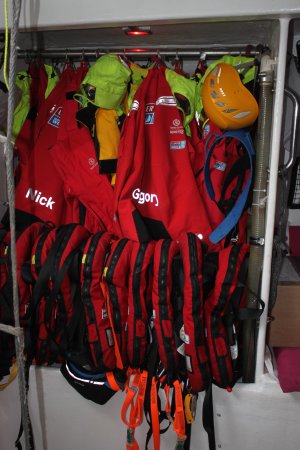
A man died on a Clipper yacht, this is a picture, below, of the safety gear on a Clipper yacht on the stopover after the man died (there is no lack of respect). The tethers have the same clip that failed. Practical Sailor conducted a test on the clip used on the tether and found that in certain applications the clip would fail, easily.

One of 'our' magazines did the work, a member of YBW conducted the investigation (not the manufacturer of the clip, not Clipper). There was a debate on jack stays, hard points, clips, tethers in a number of forum, including YBW - there was no lack of respect. As a result of the work we now have a much greater understanding of tethers, hard points, clips, jack stays etc etc

And as an aside we now know that if an MOB is unable to help himself and a crew member need be in the water - then you should wear a helmet (how many yachts have a helmet on board?).

IMG_6717.JPG

A failure was that the manufacturer of the clip did not conduct a rigorous assessment of the clip. Clipper, the organisation, assumed the 'reputable' manufacturer had conducted rigorous testing. This absence was quietly buried. Its because we have people who think outside the box, conduct tests (at their own expense) that the clip was, eventually, withdrawn.

The clip, the focus of the investigations, was widely discussed and anyone reading the discussions could decide whether they wished to risk their own life and that of their crew by continuing to use that clip. If we did not air these issues and engender debate the threads would die and never be read - we need to disseminate information, make it easily read.

There is no lack of respect.

There will be two inquests, which will take months, but we need to know, in the interim, why a man was killed by a mainsheet (booms are more obvious a cause of death). If interim measures, like helmets, can make a difference we should be part of the debate.


But there was another incident on the race. A man went overboard and was later safely recovered. There has been no debate, that I am aware of, of how he went overboard - or rather how he went overboard and was not tethered. To me... He should have been wearing a harness, the jackstays are mandatory, he should have been clipped on - but no debate, no discussion. To me there is a lack of respect that a man could have died - but we are not interested (because he was recovered quickly).

Debate is healthy.

Jonathan

Edit

I did note one comment of the race that the crew of a yacht, or some of the yachts, were prancing about the deck with no visible LJs, harnesses nor tethers.

I think on these yachts in the close confines of The Harbour with helicopters and (too many) 'spectator', or chase, boats in attendance there was no need for harness, LJs - more debateable. The TV crews stay on board until the vessels are well outside The Heads and then exit the yachts, by jumping off the stern and being picked up by a chase boat - so within these 'limits' no harm done - though I still wonder about LJs (which the TV crew do wear).

But these yachts are making over 20 knots and a man in the water soon disappears (and beacons fail) - so I'm a bit twitchy about the practices and wonder when do skippers demand tethers etc and further demand they are used.

I had a girl overboard in big seas - it took us time to recover her - I still shudder at what might have happened - I was lucky.
 
Last edited:
I don’t think that helmets will help a lot except for glancing blows
I have no idea what you can possibly base that opinion on - all energy absorbed by the helmet is energy not having to be absorbed by the skull. This is proven to make a huge difference in cycling, skiing, skateboarding, etc, etc - why would sailing be an exception?
 
I would like to correct the original post in reference to my friends on this forum finding "amusement". Perhaps not the best word when so much is related to tragedies. Sorry about that. The whole event however is to me quite amazing with 100 yachts starting.
It is hard to get accurate details from TV news however it would seem that one of the victims was hit by the main sheet and thrown into a winch.Hitting his head.
The MOB rescue was quite amazing. He (the skipper) was apparently washed over board at 3.30AM and was dragged under by the tether such that he had to cut or release it. He activated PLB and authrities were on to the problem immediately. A helicopter was launched. But the crew of his own boat were able to turn around and go back 1.3NM to pick him up. He was in the water for 40m mins. I guess if the news story is correct the moral is a tether should so short as to hold you on the deck. Over the side at 15 knots boat speed is hopeless. ol'will
 
Thanks Will, I think your timing was unfortunate - when you posted I think news of the deaths was being suppressed until the relatives had been advised.

I had not realised he was the skipper and that he had cut his tether. He was very, very lucky.

I had read, and forgotten, that one of the casualties had hit his head on a winch - a helmet would have been a lifesaver. This, death, is one of those freak accidents that you would never anticipate.

Jonathan
 
Thanks Will, I think your timing was unfortunate - when you posted I think news of the deaths was being suppressed until the relatives had been advised.

I had not realised he was the skipper and that he had cut his tether. He was very, very lucky.

I had read, and forgotten, that one of the casualties had hit his head on a winch - a helmet would have been a lifesaver. This, death, is one of those freak accidents that you would never anticipate.

Jonathan
Very sad. For both crews who lost a friend. Even worse for their families.
Having little or no information. I have no clue or comment on what happened or why it happened.
Helmets some times compulsory sometimes a free choice in life for some activities.
I don't know of any helmets designed and fit for purpose for sailing. I have worn hard hats for work. I own helmets for Motorcycle, Skiing and Cycling. I don't do climbing. Helmets are specific for each purpose. I have never considered wearing one when I go out sailing.
I will agree. Accidents are usually unexpected. Looking back with hindsight. Most if not all could have been prevented with foresight.
Freak Accidents. Rarely just happen. Things involved beyond our control.
Booms or sheets on sailing vessels don't fit the category of things beyond our control. The hazards are well known. To most sailors. Anticipating the possibility of being hit by a loose boom or sheet not beyond reasonable foresight.
Looking forward expecting high hazards tasks may result in an accident. Hopefully appropriate action can be taken ahead of time to prevent the accidents from happening.
While these events were tragic and life altering for both families and friends. Hopefully lessons can be learned which will help to prevent future accidents.
The News reports indicate both these boats came from well known sailing clubs.
Yacht racing isn't an interest of mine. Despite this, even I have heard of this race and understand it is one of the world's premier sailing races.
Hopefully the clubs and organisations involved these kind of races. Will figure out how to reduce the probability of this happening again.
 
The interesting comment about the skipper of one of the boats who had to cut his tether.

There was a discussion some time ago and it was proposed that a front attachment would tend to cause the MOB head to be pulled under the water but if the tether is connected at the center of the MOB back the head tends to be lifted out of the water with the OB mouth upwards.

A cycling helmet would prevent or reduce and head damage if head was hit and injured
 
The interesting comment about the skipper of one of the boats who had to cut his tether.

There was a discussion some time ago and it was proposed that a front attachment would tend to cause the MOB head to be pulled under the water but if the tether is connected at the center of the MOB back the head tends to be lifted out of the water with the OB mouth upwards.

A cycling helmet would prevent or reduce and head damage if head was hit and injured
Backtow lifejackets are available, which avoid the issue of being dragged face forward - I have one (though clearly not ending in the water is plan a)
Also the Americas Cup and SailGP boats have sailing specific helmets
 
Backtow lifejackets are available, which avoid the issue of being dragged face forward - I have one (though clearly not ending in the water is plan a)
Also the Americas Cup and SailGP boats have sailing specific helmets
Many helmets have a brim (or they stick out a bit, at the front, to keep some of the sun off). These are not the best for sailing as when you want to see the top of the mast you have to tip your head right back and this is tiring. There are lots of different helmets (which might be cheaper than sailing specific versions) climbing, cycling, skiing, kayaking, tree lopping, high rise window cleaning - some might be better suited to sailing than others. I don't know what application the one in the image was intended for - but it seems to be 'skull' shaped and does not protrude at the front.

Given the number of activities for which helmets are commonly used its surprising that sailing has never had a similar focus.

Jonathan
 
Many helmets have a brim (or they stick out a bit, at the front, to keep some of the sun off). These are not the best for sailing as when you want to see the top of the mast you have to tip your head right back and this is tiring. There are lots of different helmets (which might be cheaper than sailing specific versions) climbing, cycling, skiing, kayaking, tree lopping, high rise window cleaning - some might be better suited to sailing than others. I don't know what application the one in the image was intended for - but it seems to be 'skull' shaped and does not protrude at the front.

Given the number of activities for which helmets are commonly used its surprising that sailing has never had a similar focus.

Jonathan
Kids sailing schools / courses have generally been using helmets in the UK for years.
 
Kids sailing schools / courses have generally been using helmets in the UK for years.
Yes but I think there is a bit of a difference between getting a tap from a Mirror boom and getting smacked on the back of your head by the end of a boom on a 40 foot boat running down hill that has just crash gybed(sp) in 20 knots apparent. I can't think of anything that will protect you in that situation.
 
I have no idea what you can possibly base that opinion on - all energy absorbed by the helmet is energy not having to be absorbed by the skull. This is proven to make a huge difference in cycling, skiing, skateboarding, etc, etc - why would sailing be an exception?
Because all those other issues are with the momentum of your body hitting a hard surface - often with a glancing blow. The momentum of a fully loaded boom is orders of magnitude higher and is coming directly in at right angles to your head unless you are very lucky.
 
Yes but I think there is a bit of a difference between getting a tap from a Mirror boom and getting smacked on the back of your head by the end of a boom on a 40 foot boat running down hill that has just crash gybed(sp) in 20 knots apparent. I can't think of anything that will protect you in that situation.
But you are taking my comment about helmets being commonplace in junior kids sailing out of context - this was in reply to a post suggesting “it’s surprising that sailing has never had a similar focus”.
As has already been stated earlier, there are helmets designed and used at the top end of the racing - eg Sail GP - designed for maximum protection. If a helmet can now avoid most head injuries in F1 crashes, there is no doubt that a well designed helmet could hugely increase likelihood of a safe outcome even in the 40 foot boat example you quote. Like bike and motorcycle helmets, they may not give 100% prevention of fatalities, but could reduce by 80% or so.
The issue with helmets for sail racing - or more positively the good thing - is that whilst tragic these accidents are still quite rare in terms of participants and miles sailed, hence many might choose not to wear them.
For cruising sailors, one important starting point is choosing a boat where the mainsheet is ahead of the hatchway, avoiding the mainsheet issue which seems to account for a substantial proportion of the fatalities.
 
But you are taking my comment about helmets being commonplace in junior kids sailing out of context - this was in reply to a post suggesting “it’s surprising that sailing has never had a similar focus”.
As has already been stated earlier, there are helmets designed and used at the top end of the racing - eg Sail GP - designed for maximum protection. If a helmet can now avoid most head injuries in F1 crashes, there is no doubt that a well designed helmet could hugely increase likelihood of a safe outcome even in the 40 foot boat example you quote. Like bike and motorcycle helmets, they may not give 100% prevention of fatalities, but could reduce by 80% or so.
The issue with helmets for sail racing - or more positively the good thing - is that whilst tragic these accidents are still quite rare in terms of participants and miles sailed, hence many might choose not to wear them.
For cruising sailors, one important starting point is choosing a boat where the mainsheet is ahead of the hatchway, avoiding the mainsheet issue which seems to account for a substantial proportion of the fatalities.
I agree that on most larger 40ft etc boats the boom is above the head of a person inn the cockpit. However often the main sheet is in the middle and very harmful. A main sheet either at the stern or ahead of hatch seems to be a safer option. ol'will
 
Top