Switching between IALA regions. Anyone messed it up?

fredrussell

Well-Known Member
Joined
24 Mar 2015
Messages
4,149
Visit site
So you’ve crossed the Atlantic and are looking forward to landfall. How does one reverse in one’s head a lifetime’s worth of ‘green = starboard’. I’m convinced if it were me I would run aground within the first day. I suppose the obvious comparison is driving on the right when abroad - but at least in that situation there will usually be loads of other drivers to copy. In a boat you’re often the only one in an area.

Whilst I’m on the subject, given that the Americas were mostly colonised by Europeans, what’s with the IALA system anyway?
 
Whilst I’m on the subject, given that the Americas were mostly colonised by Europeans, what’s with the IALA system anyway?
AIUI, back when Britannia ruled the waves and waived the rules, A red buoy should be kept to port as you go home. Leaving the US was heading home, so keep the red buoy to port.

As for driving on the right, I normally adapt pretty well, but there was that time when, late at night with no one around, I turned from a minor road left onto a dual carriageway in Belgium, and drove a couple of miles down the wrong carriageway before I twigged. o_O
 
I just remember it. It is like driving on the right hand side out side the UK, the consequences of not doing it can be fatal. That focuses the mind. You could also write in chinagraph pen in an obvious place beside the steering area.
 
3 yachts I sail occasionally don't have a plotter at all. :)
How quaint. My point was that most of us aren’t really using buoyage the way it used to be used these days. Even if I did decide to dabble in the arcane art of traditional pilotage, my notes would include what buoys I’d see and where so the difference between A and B is and always has been largely irrelevant. Although it’s possible that someone might arrive somewhere with no charts and no idea what’s where it would be unusual to rely Solely on buoys to safely enter harbour.
 
So you’ve crossed the Atlantic and are looking forward to landfall. How does one reverse in one’s head a lifetime’s worth of ‘green = starboard’. I’m convinced if it were me I would run aground within the first day. I suppose the obvious comparison is driving on the right when abroad - but at least in that situation there will usually be loads of other drivers to copy. In a boat you’re often the only one in an area.

It's just a colour change, forget about them and try and follow the shapes (can/cone) if there are any :) You may have to push buoys sideways sometimes.
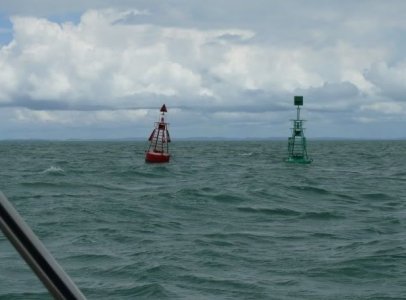
Test your reflexes: you just came up on deck, what is the General Direction of buoyage here? :)

iala.jpg
 
It's just a colour change, forget about them and try and follow the shapes (can/cone) if there are any :) You may have to push buoys sideways sometimes.
Test your reflexes: you just came up on deck, what is the General Direction of buoyage here? :)

View attachment 191061
I’m guessing that something horrible lies, submerged, between the two buoys? Although I’m not sure why an Isolated Danger mark wouldn’t have been used.
There’s a military wreck, on the Medway (in Kethole Reach), marked by this red and green can method. Where others have Isolated Danger marks. @tillergirl or @Cantata may understand the rationale……
 
Last edited:
The story I was told was that in the war of independence, the Yanks repainted all their buoys in the opposite colours, to confuse the Brits.

I have no idea whether it's true but it explains why the shapes remain the right way round.

I have to say it caught me out for a moment in Martinique. In my head I had reverted to everything being 'normal' because I was 'in Europe'. But a quick glance at what all the other boats were doing put me back on the right track.
 
How quaint. My point was that most of us aren’t really using buoyage the way it used to be used these days. Even if I did decide to dabble in the arcane art of traditional pilotage, my notes would include what buoys I’d see and where so the difference between A and B is and always has been largely irrelevant. Although it’s possible that someone might arrive somewhere with no charts and no idea what’s where it would be unusual to rely Solely on buoys to safely enter harbour.
I think you overestimate how many leisure craft use plotters, invaluable as they may be. There are many ways to safely navigate without them.....

Do you recall when starboard hand markers were black with a white light and green buoys marked wrecks? :)

I was young then......
 
I think you overestimate how many leisure craft use plotters
That post was talking about traditional navigation, so no not really. How often do you turn up to a new location completely chartless and relying entirely on recognising buoys to determine where to sail your boat? Wherever I get my chart from, I use that to work out what buoy will be where. The advantage with a plotter/app/watch/etc. is that it draws your boat on the chart in real time, but that doesn't change the fact that you almost always look at the chart to know where to go. When doing "proper pilotage" RYA course style, you'd write these down beforehand and take to the cockpit. I'm not sure at what point in this process there's scope for IALA to confuse me. I expect a green buoy, I see a green buoy, I go to the side of that green buoy I decided I needed to be.

Perhaps some skippers are lolling about with no plan and no chart just haphazardly spotting marks and making decisions there and then on their next action. That's not how I was taught, and not how my boat navigates. I'm not even sure how you'd know you have to use a channel in the first place without consulting some kind of chart.
 
That post was talking about traditional navigation, so no not really. How often do you turn up to a new location completely chartless and relying entirely on recognising buoys to determine where to sail your boat? Wherever I get my chart from, I use that to work out what buoy will be where. The advantage with a plotter/app/watch/etc. is that it draws your boat on the chart in real time, but that doesn't change the fact that you almost always look at the chart to know where to go. When doing "proper pilotage" RYA course style, you'd write these down beforehand and take to the cockpit. I'm not sure at what point in this process there's scope for IALA to confuse me. I expect a green buoy, I see a green buoy, I go to the side of that green buoy I decided I needed to be.

Perhaps some skippers are lolling about with no plan and no chart just haphazardly spotting marks and making decisions there and then on their next action. That's not how I was taught, and not how my boat navigates. I'm not even sure how you'd know you have to use a channel in the first place without consulting some kind of chart.
The question was about how B region can cause confusion in ones mind because you are seeing something opposite to what you've grown used to in a an A region.

It's never the first time you enter a B region that causes a problem for the average navigator. It's when complacency sets in.....well that applies everywhere.

Simple to remember red right returning.....
 
The question was about how B region can cause confusion in ones mind because you are seeing something opposite to what you've grown used to in a an A region.

It's never the first time you enter a B region that causes a problem for the average navigator. It's when complacency sets in.....well that applies everywhere.

Simple to remember red right returning.....
As I said though, I'm not sure how confusion might arise if you're looking at the chart since it has pictures of the buoys, and when making passage notes you'd write down what you expect to see. I've literally never been in a situation where I made a steering decision in real time based on the colour of a buoy so I don't need a way to remember it simple or not.

You're describing a situation where you're on a boat, have no idea where you are and no chart to confirm and you see a buoy. That's not realistic
 
As I said though, I'm not sure how confusion might arise if you're looking at the chart since it has pictures of the buoys, and when making passage notes you'd write down what you expect to see. I've literally never been in a situation where I made a steering decision in real time based on the colour of a buoy so I don't need a way to remember it simple or not.

You're describing a situation where you're on a boat, have no idea where you are and no chart to confirm and you see a buoy. That's not realistic
Good for you. If only everyone else was that wonderful! :)

Seriously, do take into account that most people wont have your experience or skill with a plotter.

Have you navigated in a B region? I'm sure you are aware in your pilotage that channels are marked with port and starboard markers, regardless if you use them. It does make you pause now and then for a moment when an ingrained visual prompt is reversed. I'm sure it's the same for B sailors coming to an A region.
 
most people wont have your experience or skill with a plotter.
Again though, I'm not talking about plotters. That was literally one comment at the start of the thread.
I'm sure you are aware in your pilotage that channels are marked with port and starboard markers, regardless if you use them. It does make you pause now and then for a moment when an ingrained visual prompt is reversed. I'm sure it's the same for B sailors coming to an A region.
Indeed, and when taking notes you'd write down where the greens and reds are to be expected. If my notes say green buoy to starboard and I see a green buoy to starboard I don't see where the panic is. I also don't panic when entering Portsmouth harbour and my notes say to follow the port side of the channel and red buoys, nor when leaving and the notes say to be to starboard of the red 4 Bar buoy.

Now you mention it I do see a lot of people who perhaps did panic and go to port of 4 Bar on the way out, so perhaps colours are an issue for a lot of people after all. Or maybe they just didn't look at the chart!

Yes I have been to other regions. No it didn't bother me in the slightest.
 
Again though, I'm not talking about plotters. That was literally one comment at the start of the thread.

Indeed, and when taking notes you'd write down where the greens and reds are to be expected. If my notes say green buoy to starboard and I see a green buoy to starboard I don't see where the panic is. I also don't panic when entering Portsmouth harbour and my notes say to follow the port side of the channel and red buoys, nor when leaving and the notes say to be to starboard of the red 4 Bar buoy.

Now you mention it I do see a lot of people who perhaps did panic and go to port of 4 Bar on the way out, so perhaps colours are an issue for a lot of people after all. Or maybe they just didn't look at the chart!

Yes I have been to other regions. No it didn't bother me in the slightest.
I've seen lots and lots of less experienced people getting mixed up with pilotage, by day and night. Even when I've checked they have a good plan. It's certainly not intuitive for a great many people. You are fortunate, others aren't so well blessed.
 
The question was about how B region can cause confusion in ones mind because you are seeing something opposite to what you've grown used to in a an A region.

It's never the first time you enter a B region that causes a problem for the average navigator. It's when complacency sets in.....well that applies everywhere.

Simple to remember red right returning.....
Agree 100%.

Also when you’ve crossed the Atlantic you’d better stop assuming that a buoy on the chart is going to exist in real life. Lights? Half the time they’re not there and when they are, half the time they don’t work.

This is assuming you can actually see the bouyage in the swell…

si=79nBGYnzhuysYwCG

The video (as always) doesn’t do justice to the swell and experience. Two to three metre swells with the buoy disappearing from view completely when we were only a hundred metres away from it. This was two days ago as I write this.
 
The red-green convention can be confusing enough within the UK. Consider the Ferry Rocks in Kerrera sound south of Oban. They lie in mid-channel and used to be marked by a green buoy just west of them and a red buoy to the east. In the channel the flood tide is north-going so it should be obvious that you don't just sail between them but I have seen several boats trying. Many of them didn't seem to be listening on VHF channel 16 either. Fortunately for some years now they have been marked by cardinal buoys.
 
Top