
Stabilizers for Blue Angel, engineering question

I would assume means that it only works with power on?
I don't see a reason to assume that. I'd tend to expect it requires power for brake-off and springs back to brake-on when there's no power. Hence my curiosity about how it refrains from braking until the fin is central, in the event of power failure. It needs to refrain, because in a power failure the last thing you want is the fin locked by the brake at 45degrees!
 
I don't see a reason to assume that. I'd tend to expect it requires power for brake-off and springs back to brake-on when there's no power. Hence my curiosity about how it refrains from braking until the fin is central, in the event of power failure. It needs to refrain, because in a power failure the last thing you want is the fin locked by the brake at 45degrees!
Yes you're right otherwise it wouldn't be considered 'failsafe' and therefore I can't see any way that the fins can always be in a neutral position in the event of a power failure and brake application. Maybe there's some kind of clever mechanical system triggered by the application of the brake which returns the fins to the neutral position?
 
I also agree on the power to brake-off concept, else it's pointless. I'd have thought that a massive capacitor could keep the brake-off until the stab under natural forces (i.e. boat moving ahead) sort of about levels and then engages.
What if you're in a funny situation, anchored/sidewinds/tide/you name it and the stab doesn't look like going back to rest position?
Could a capacitor operate for a sec or so the el.motor to get the stab in the right place before emptying?

Anyone care to explain how the motor links to the stab axle? Is there a gearbox involved? Reduction of revs? Step motor techniques employed?

Doh, too many Qs

er, most important, # of existing installations and years the co is in business?

V.
 
Hence my curiosity about how it refrains from braking until the fin is central, in the event of power failure. It needs to refrain, because in a power failure the last thing you want is the fin locked by the brake at 45degrees!
Agreed. Assuming that Bart reported literally their statement "in case of energy loss the system automatically engage the brake when the fins are close to their neutral position", I would guess that there's some sort of conic pin (normally closed when there's no power, and electromagnetically opened when the system is up and running), which slides into its receptacle as soon as the fin, while floating, reaches its center position.
Something which, with the boat moving forward, will happen almost immediately, for obvious reasons.
If that's what they meant by "brake", I suppose it would be more appropriate to call it a lock instead, but that's just semantic.

Re. heating, it's pretty obvious that they can't have invented the perfect way to transform electricity in kinetic (*) energy with zero losses/heating generation, because if they did, they would be competing with giants like GE, rather than in a niche segment of a cottage industry with companies like ABT, Sleipner, etc. :)
Otoh, the following statement must be put in perspective:
what BartW can take out of this statement is only that so far they haven't encountered any heat problems but of course with the small number of installations, that's not necessarily reassuring
We're talking of 200+ installations in three years, with 70 footers at the bottom end of their range, all the way up to 50m.
And with yards not exactly known for poor attention to quality, like SL and Benetti.
Talk about "small number" and "not necessarily reassuring"... :eek:


(*) Aren't we talking of mechanical, rather than just kinetic energy, J?
I would think that the higher the fin angle, the higher the potential energy which enters into the equation.
Not that it affects your objection anyway - as I already said, I agree on the principle.
In fact, some heat dissipation is bound to exist, and CMC statement doesn't deny it ("the heat generating is very low.").
They are also aware that the potential problem is directly related to the power absorption ("We don’t need any cooling system even at anchor.").
Knowing all that, not needing any cooling system looks indeed a bold statement.
In their boots, I wouldn't make such claim, let alone put it in written, unless 100% confident about it. Would you?
 
Last edited:
Agreed. Assuming that Bart reported literally their statement "in case of energy loss the system automatically engage the brake when the fins are close to their neutral position", I would guess that there's some sort of conic pin (normally closed when there's no power, and electromagnetically opened when the system is up and running), which slides into its receptacle as soon as the fin, while floating, reaches its center position.
Something which, with the boat moving forward, will happen almost immediately, for obvious reasons.
If that's what they meant by "brake", I suppose it would be more appropriate to call it a lock instead, but that's just semantic.

how I think this "brake" works, is just like a car brake, (principally)
but a spring makes it work permanently when there is no power, and a magnetic solonoid, releases the braken when the system is on.
A mechanical "key" enables to re-engage the brake only when the fin is almost in a neurtral position.

but that's all gueswork, lets stop that,
Today I had a brief phonecall with mr CMC, and we made an appointment to call again tomorrow morning, (I had guests)
I 'll explain all I get to know tomorrow after our phone call.
 
(*) Aren't we talking of mechanical, rather than just kinetic energy, J?
I would think that the higher the fin angle, the higher the potential energy which enters into the equation.

Yes you are right. Well, actually I'd call it potential energy, in other words keeping a boat flat when the sea is angled like a ski slope is like stretching a piece of elastic, hence "kinetic" energy. But I'm agreeing with you and I think potential/mechanical is just a translation point and far be it form me to criticise your awesomely fantastic English MM :).

However, consider this. Imagine a really big long-period swell on the beam. BA is halfway up the wave. The sea wants to make the boat lean 5 degrees, but the fins keep her flat. The boat speed is constant, and the fins stay at an angle of say 10 degrees, for say 30 seconds solid, because it is a really looooong wave period. The fins aren't moving. (This is a perfectly reasonable element of what happens in stabiliser dynamics - other movements overlay onto this, but this scenario is one part of the ecosystem)

In this scenario, what is the thermodynamics/energy analysis so far as the fins system is concerned? No work is being done by the CMC motor, because the fins are not moving. The boat engines are doing more work, to overcome extra fin drag, but that isn't relevant to the work done by the fin motors. All the motors are doing is maintaining a torsion force, as a result of an electric current and electromagnetic field. Let's say, for sake of argument, the motor absorbs one kilowatt in this mode. Where is the kilowatt going? Answer is 100% heat, isn't it? Remember, no work at all is being done by the fin motor. Work = force x distnace, and the distance is zero, so the work done is zero. Has to be. So the kilowatt is ALL heat.

It's the same as a crane at a car wrecker yard that lifts up scrap steel with an electromagnet. Imagine the crane is stopped, and a tonne of steel hangs on the electromagnet, completely still. The electricity drawn by the magnet is a kilowatt, say. Where does that kilowatt go? Remember, no work is being done. It ALL goes to heat in the magnet winding. The fin stab, in above scenario, is identical

You have to examine CMC's statements about heat in light of these basic engineering/physics facts. CMC may well have no heat problem becuase they can lose the heat fast enough, which is great, but it's not that they don't make heat to begin with, nor that they have high "mechanical efficiency" or whatever other BS
 
I also agree on the power to brake-off concept, else it's pointless. I'd have thought that a massive capacitor could keep the brake-off until the stab under natural forces (i.e. boat moving ahead) sort of about levels and then engages.
What if you're in a funny situation, anchored/sidewinds/tide/you name it and the stab doesn't look like going back to rest position?
Could a capacitor operate for a sec or so the el.motor to get the stab in the right place before emptying?

Anyone care to explain how the motor links to the stab axle? Is there a gearbox involved? Reduction of revs? Step motor techniques employed?

V.
Vas, I'm not 100% sure, but I expect there to be a significant reduction gearbox twixt the engine and shaft. The angular accel of the shaft is going to be pretty slow compared to that of an electric motor of the appropriate size.
 
Yes you are right. Well, actually I'd call it potential energy, in other words keeping a boat flat when the sea is angled like a ski slope is like stretching a piece of elastic, hence "kinetic" energy.
But I'm agreeing with you and I think potential/mechanical is just a translation point and far be it form me to criticise your awesomely fantastic English MM :).
Ermm... Thanks for your appreciation, but I actually checked the translation before posting, 'cause I was in doubt... :o
Though it turned out that the terms are actually pretty much similar in IT and EN.
And in fact, I also did use the term potential. And by "mechanical, rather than just kinetic" I meant that we were actually talking of mechanical meant as kinetic+potential.
But now your reply makes me wonder again if I lost something in translation...?

Anyway, that's all academic, and irrelevant to what is being discussed.
I agree that in your scenario, IF the fin would be held in position by the electric motor alone, there would be a peak of heat dissipation.
But if that would happen, the current absorption would/could be very high also while cruising - possibly with peaks even higher than at anchor, depending also on speed: just think of the forces on the fins if your scenario would happen at 20+ knots!
Now, the absorption values under way which those folks gave to Bart (both avg and peak) are instead very low - almost ridiculously low, in fact.
I would rather think that the system is indeed "mechanically efficient" for that reason alone, rather than for claims about heat.
Anyway, what that implies is that there must be some other trick allowing to keep the fins in any position required, without demanding power from the electric motor.
The easiest mechanical solution which springs to my mind is a worm gear (again, hoping to have googled for the correct translation... :p), where the motor shaft acts as the worm, and moves the fins through a gear.
That would allow the fin to resist the water flow forces in any position, without demanding any effort to the electric motor.
Now, obviously there must be some sort of additional sophistication in the system, for various reasons - one being what we just discussed re. a system failure or power loss: with a plain vanilla worm gear, the fins would never self-center again.
But I think you see what I mean.
 
but that's all gueswork, lets stop that
Oi B, you're not seriously asking us to take the fun out of these threads, are you? :p
Jokes aside, if there's anything where you think that a mother tongue cross-check could help avoiding potential misunderstandings, just ask.
 
Though it turned out that the terms are actually pretty much similar in IT and EN.
And in fact, I also did use the term potential. And by "mechanical, rather than just kinetic" I meant that we were actually talking of mechanical meant as kinetic+potential.
But now your reply makes me wonder again if I lost something in translation...?
I think there may be a conceptual difference. There can be mechanical work done in any system, but there cannot be mechanical energy becuase the term/concept doesn't exist afaik. Let's say the wind and tyre resistance of my car on a flat road at 75kph needs a force of 5000 newtons to push at along. The mechanical work done per kilometer is force x distance ie 5000 x 1000, = 5million newton metres, ie 5million joules. But there is no mechanical energy - at least afaik none of the energy here is generally describable by engineers and physicists as "mechanical" energy (afaik - happy to be corrected!). During that kilometer, the energy starts off as chemical (a form of potential...) energy in the fuel. then it gets burnt, and ignoring inefficiency losses in the engine it gets converted to heat in the car body (air friction), heat and kinetic energy in the air (as car churns thru the air) and heat in the tyres and wheel bearings where there is friction. That is the entire net energy transfer during that 1km - chemical energy into heat plus kinetic energy in the air (NOT kinetic energy in the car). Note, the car's kinetic energy doesn't change during the km. Thus, the whole thing is describable without any mention of "mechanical energy"

In these fin stabs in my scenario, the energy in the batteries/fuel all gets converted to heat in the motor. Mechanical energy doesnt enter the discussion. Perhaps you meant just mechanical as a combined term for kinetic+potential? I've never heard that before but I'm happy to be corrected :)

I agree that in your scenario, IF the fin would be held in position by the electric motor alone, there would be a peak of heat dissipation.
But if that would happen, the current absorption would/could be very high also while cruising - possibly with peaks even higher than at anchor, depending also on speed: just think of the forces on the fins if your scenario would happen at 20+ knots!
Now, the absorption values under way which those folks gave to Bart (both avg and peak) are instead very low - almost ridiculously low, in fact.
I would rather think that the system is indeed "mechanically efficient" for that reason alone, rather than for claims about heat.
Anyway, what that implies is that there must be some other trick allowing to keep the fins in any position required, without demanding power from the electric motor.
The easiest mechanical solution which springs to my mind is a worm gear (again, hoping to have googled for the correct translation... ), where the motor shaft acts as the worm, and moves the fins through a gear.
That would allow the fin to resist the water flow forces in any position, without demanding any effort to the electric motor.
Now, obviously there must be some sort of additional sophistication in the system, for various reasons - one being what we just discussed re. a system failure or power loss: with a plain vanilla worm gear, the fins would never self-center again.
But I think you see what I mean.
Yeah, good point. I wonder if the system does rely on reverse gearbox friction to hold the fin in my scenario. Would be interesting to know. A worm (yes, correct word!) gear would do this perfectly but MapisM I just don't get the idea of a worm drive fin stab. Worms are low-duty things (because the gears constantly slide on each other big time, unlike the teeth of an ordinary gear wheels which is cut as an involute curve to avoid slide. Frankly, a worm gearbox in fin stabs would need a rebuild after a month. And it would sure get hot! Besides, you can tell from Bart's drawings that this ain't a worm box because of the relative positions of motor shaft and stab shaft. So I'd be very interested to know what trick CMC do to hold the fin against the water flow.

By the way, just to be clear, my scenrio taken literally is unlikley. is a subset of the whole ecosytem, all the time. In waves, underway, as the fin moves outwards, the motor is doing some work by virtue of moving but it is ALSO creating the force to stop the waterflow centering the fin. So my scenario is happening all the time when underway (as opposed to at anchor), unless there is a "trick" as you say to create a worm gearbox "resistance" effect.

We seem to be finding more questions here than answers, sorry! I still like these CMC things and would love BartW to put them on BA. I'm just curious about the engineering
 
Perhaps you meant just mechanical as a combined term for kinetic+potential? I've never heard that before but I'm happy to be corrected :)
Yup, that's indeed what I meant. Actually, that's a rather common technical wording, around here.
And this is the source I used to check the EN wording, which seemed consistent with my understanding:
http://www.britannica.com/EBchecked/topic/371844/mechanical-energy
Anyway, as I said, that's just academic/semantic, no worries.

Yep, still some good open questions on the mechanical design of these things.
I understand your durability concerns on the good old worm gear, and coming to think of it I agree that it can't be as simple as that.
Otoh, somehow the "gearbox" between the motor and the fin shaft must handle a huge reduction ratio anyway, for obvious reasons.
Probably it's such mechanism that in turn creates also the same effect of a worm gear (or as you more aptly called it the reverse gearbox friction), one way or another.

Oh, well, I have a funny feeling that we will soon know, anyhow.
We should only agree who will bring the toolbox, when we'll meet on BA to disassemble the thing and try some reverse engineering experiments.
I'm sure B will be glad to sacrifice the warranty on the equipment to the pursuit of forum knowledge... :p
 
We should only agree who will bring the toolbox, when we'll meet on BA to disassemble the thing and try some reverse engineering experiments.
I'm sure B will be glad to sacrifice the warranty on the equipment to the pursuit of forum knowledge... :p
OK, fair cop on the term mechanical energy. I gotta say in years of doing an engineering degree etc and checking with my father (chartered engineer) we have never heard the term. With respect and outside astronomy, it's a bit of schoolbook term. That britannica article was very dumbed down and lacking precision in its concepts, but no worries. Anyway no disagreement here; just semantics

Ypu, I'm looking forward to taking Bart's stabs to bits with you. If the gear box is complex we might have that situation where we have it all back together and then we find a cog left over. Or worse still, we take it all to bits then accidentally remove the last big circlip and the shaft and fin drop to the bottom of the sea :D :D

Need to study Bart's drawings some more but I'm kinda guessing a slow rpm bevelled gear set to get the 90deg change in drive direction and an epicyclic gear set on horizontal axis to get the gear reduction in a small space. I can't see any other way to do this and have durability except by using properly cut gears.
 
I'm just curious about the engineering

Let me try an attempt, ;-)

In your case of the magnetic crab-steel crane,
If there is no metal crab attached, the electrical current in the magnet is almost zero,
If there is metal attached, you have “potential” energy, and a current in the magnet,
If there is lots of metal on the magnet, = a lot more potential energy= strong current in the magnet
Imo the only “heat” generator is the non zero electrical resistance of the wires in the magnet,
This heat generating is linear increasing with the current (Ohms law) ofcause, but is not in the base equation of the forces, it’s a loss.

In your boat on a loooong wave example,
The boat wants to lean on the wave by gravity
The fin is in a fixed negative angle, to produce a force against the water molecules to keep the boat vertical
therefore needs to flow a current (electric energy) in the stab driver to counter react this force.
The electric energy is transferred in to potential energy (bending the water flow) and heat energy (friction of the water molecules) in the water

I can not believe that all the energy for keeping the staps in position is transferred in warmth,
If there is no force on the fins , there will be no current in the electric motor,
Force from the water molecules (kinetic / potential / water heating) energy is counter reacted by the electric energy in the stab motor.

The source of heating the electric motor is the thermal resistance of the wires and mechanical friction of the gearing.

The typical features of a brushless DC motor are:
- High torque at rest
- High efficiency

(its too long ago that I got my ing degree ;-) )
 
Last edited:
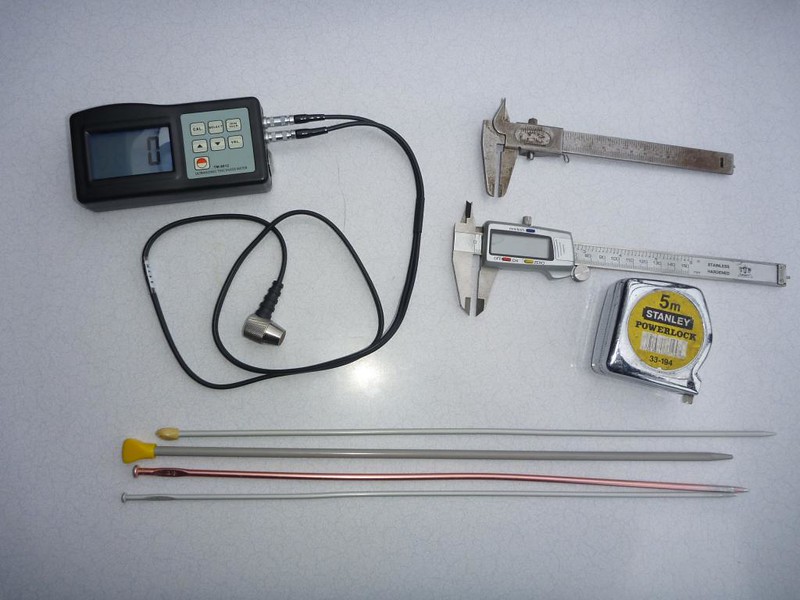
all ready to go for the hull measurement,

- altrasound meter
- calliper
- waterproof calliper (no electronics)
- measuring tape
- knitting needles ( a few spares if I drop them in the sea)
a T-square is on the boat.

anything else ?

i-8QkSk7N-L.jpg
 
Last edited:
Let me try an attempt, ;-)

In your case of the magnetic crab-steel crane,
If there is no metal crab attached, the electrical current in the magnet is almost zero,
If there is metal attached, you have “potential” energy, and a current in the magnet,
If there is lots of metal on the magnet, = a lot more potential energy= strong current in the magnet
Imo the only “heat” generator is the non zero electrical resistance of the wires in the magnet,
This heat generating is linear increasing with the current (Ohms law) ofcause, but is not in the base equation of the forces, it’s a loss.

In your boat on a loooong wave example,
The boat wants to lean on the wave by gravity
The fin is in a fixed negative angle, to produce a force against the water molecules to keep the boat vertical
therefore needs to flow a current (electric energy) in the stab driver to counter react this force.
The electric energy is transferred in to potential energy (bending the water flow) and heat energy (friction of the water molecules) in the water

I can not believe that all the energy for keeping the staps in position is transferred in warmth,
If there is no force on the fins , there will be no current in the electric motor,
Force from the water molecules (kinetic / potential / water heating) energy is counter reacted by the electric energy in the stab motor.

The source of heating the electric motor is the thermal resistance of the wires and mechanical friction of the gearing.

The typical features of a brushless DC motor are:
- High torque at rest
- High efficiency

(its too long ago that I got my ing degree ;-) )
Bart, that just is not correct. When the metal is hanging on the electromagnet crane, there is no change in the potential energy of the metal. It is not moving, so there cannot be. Yes, the electromagnet is still consuming electricity - it has to, becuase you need the current in the winding to create the magnetic field. ALL the electricity consumed by the magnet therefore MUST go to heat in the coil. Likewise with the stabilsers in my example that are resisting the tendency to move to the centre position: ALL the electricity consumed by the (stationary) motor is going to make heat and none of it becomes potential energy or heat in the water
 
all ready to go for the hull measurement,

- altrasound meter
- calliper
- waterproof calliper (no electronics)
- measuring tape
- knitting needles ( a few spares if I drop them in the sea)
a T-square is on the boat.

anything else ?

P1140499.jpg
Nice toolkit!

Bart, take a look at your digital calipers. Look at the tiny pointed part sticking out, at the far right hand edge of your photo - you will see these calipers also function as a depth gauge. Slide the calipers open and that point moves out. I have exactly the same calipers, here in my hand :)
 
you will see these calipers also function as a depth gauge.

no worries John, I perfectly know how calipers work :)


re the magnet issue,
yes I agree, I was confused and mixed up with AC, while in both examples it is a DC current.

BUT,
when the magnet "lifts" the scrap from the ground, there IS potential energy, because when you stop the current the scrap will fall,
this is a typical example of potential energy imo, but agree nothing to do with the electric energy in the magnet.

then in the fin situation, I agree that there is heating, from the DC current in the electric motor,
BUT,
there is created some kinetic and heat energy in the water aswell ?
if the fin is in neutral position, no water is moved by the fin (appart from the minimal drag)
if the fin is pushed with a small force down (and kept there) you will be moving more water (more drag) and create friction between the water molecules,
so you will loose some energy there ?
if the fin is pushed down more, you will feel more resistance, more water is moved, the engines have to work harder, or the boat will go slower....

but agree that during all this, there will be a DC current producing heat in the windings of the electric motors
and we still have to find out which force keeps the stabs in the downwards position.
"one of the key features of a electric DC motor is the high torque when stationary " ?

back to the orriginal question; heating of the electric drives,
actually I don't know for shure yet, but I think it is a non issue, because many CMC electric Stab drive units are located in a (small) water tight box, (ao in SL's )
so then air cooling is minimal,
I can not imagine then that mounting in a bilge without a box would create heat problems.

This problem must even be worse in the bigger stab systems, more DC current for more force, so more heating...
also there, no mentioning of special cooling systems.

but again, I will discuss this issue seriously, and let you know the outcome.
 
Last edited:
Hi Bart,

Sorry for not reading the entire thread here but I wanted to add in some information which may be of use to you.

I have supplied some kit to a Moonen 94 (think its a 94, but don't shoot me if its not) and they've just had some CMC stabs installed. With this thread springing to mind I asked them who they used. I had an E-mail this morning with a glowing recommendation for a company based in the UK. Apparently they did all the calculations, etc etc. Took all the pain out of the experiance, furthermore the price and European warranty/support was 'better than the Italians gave'. Take from that what you wish.

Will PM you the details of the chap if you're interested?

Thanks and best of luck!

Toby

P.S. Particularly like the fact the motor was mounted at 90 degrees to the stab shaft (so it was parallel with the hull). Saved them from sticking out too much.
 
Last edited:
Hi Bart,

Sorry for not reading the entire thread here but I wanted to add in some information which may be of use to you.

I have supplied some kit to a Moonen 94 (think its a 94, but don't shoot me if its not) and they've just had some CMC stabs installed. With this thread springing to mind I asked them who they used. I had an E-mail this morning with a glowing recommendation for a company based in the UK. Apparently they did all the calculations, etc etc. Took all the pain out of the experiance, furthermore the price and European warranty/support was 'better than the Italians gave'. Take from that what you wish.

Will PM you the details of the chap if you're interested?

Thanks and best of luck!

Toby

P.S. Particularly like the fact the motor was mounted at 90 degrees to the stab shaft (so it was parallel with the hull). Saved them from sticking out too much.

Ooh. This is the refit job nr Southampton. Perhaps Illusion can read the manuals that must by now be on the boat and report back on some of the technical questions on here?
 
Bart

I can't add to the complex engineering debate (forgotten more than I ever knew to start with!), but it seems to me that the loads required to counter boat roll may not be as great as one would first think. My entirely unscientific reasoning relates to my flopper stoppers. They had a x-sect area of about a metre each, and four of them hung off the side cleats reduced boat roll by about a quarter on a 60' boat. I was surprised that I could comfortably hold one of them on the upward stroke (ie. under load) even in a quite significant swell. In other words, the load I could hold with my bare hands was able to reduce boat roll by a fair few percent.

Of course your application needs engineering analysis, not "my mate reckons..", and there are far more complex loads and fatiguing to consider, but if the calcs suggest less reinforcing is required than you intuitively expected, then I wouldn't be that surprised, and this may mean that you don't need to cut away the existing structural members in the hull and/or could get away with wooden reinforcement.

It sounds a great project, looking forward to hearing more.
 
Top