Stabilizers for Blue Angel, engineering question

Jfm you tried to send me a PM but my mailbox was full,
I just tried to send you PM but your box was full
my mailbox has space again now.
My PM said I had a backberry problem so I couldn't read your email, but I've now fixed it and sent you an email reply :-)
 
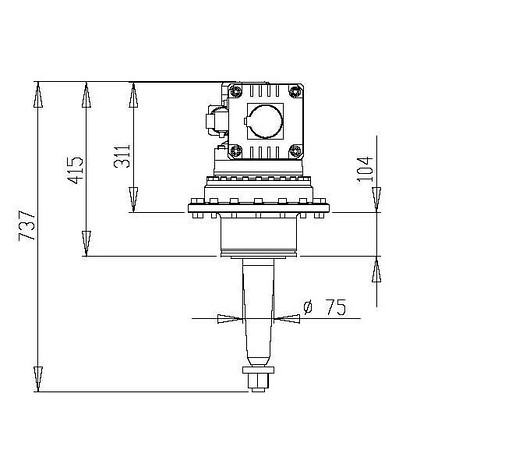
these drawings give an idea of the dim's of the system,
I don't want to post more in order not to get in to trouble with CMC

i-wXBmbDN-L.jpg


i-phVzRJN-L.jpg


i-DftfZFw-L.jpg
 
Last edited:
This is looking good Bart. I would think you should cut out 400mm of the stringer and place the stbd stab actuator on the centreline of the WC. You appear to have the 311mm height there. When you have built up the hull thickness (note: CNC allow 79mm max and I said 60-80) and formed the correct "feathering in" and radiused corners in GRP to avoid notches and stress points, you won't miss that stringer. This project is definitely a runner I would say, with no need to rebuild the cabin
 
Last edited:
This is looking good Bart. I would think you should cut out 400mm of the stringer and place the stbd stab actuator on the centreline of the WC. You appear to have the 311mm height there. When you have built up the hull thickness (note: CNC allow 79mm max and I said 60-80) and formed the correct "feathering in" and radiused corners in GRP to avoid notches and stress points, you won't miss that stringer. This project is definitely a runner I would say, with no need to rebuild the cabin


the system could even go more towards the outside, under the bidet, (= +/-60cm from the side) if this is better for efficiency.
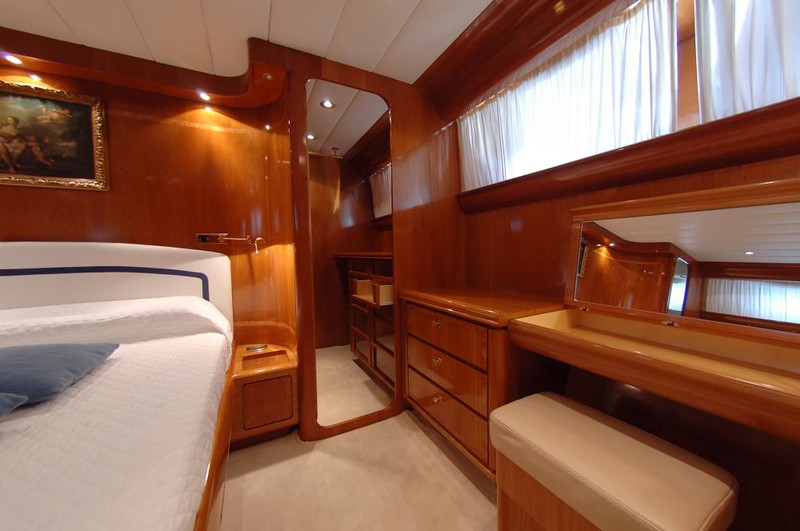
this picture better shows how wide the riser is below the bidet and the WC.
the bidet and WC covering planks are all remove-able, did it ones partially, for a leak on the toilet hose connection.

i-kFSXZT2-L.jpg


on the opposite side, its even more easy,
in the dressing room,
in the corner behind that locker with drawers, is .... nothing (= a gap approx 60cm wide)

i-Wt5khBQ-L.jpg


don't worry, these are old pics, even from before BA was ours,
now, all bathroom taps are chrome instead of brass collor ;-)
same for the electrical switches
and also for the lights very soon ;-)


edit: perhaps you meant below the bidet,
the bidet is the toilet on the left side of the pic in post #19, and visible in the pic here above
 
Last edited:
you should cut out 400mm of the stringer and place the stbd stab actuator on the centreline of the WC.
Mmm... Before cutting out the stringer, I'd rather check the distance of the shaft from the chine assuming to put it between the WC and the bidet.
Which in turn would also improve the available height, of course.
If you looked at the drawing which Bart posted to evaluate the distance from the chine, don't forget that BA hull sides are significantly angled inward, top down.
Besides, to avoid cutting out the stringer, it would be sufficient to drill the shaft hole just 167 mm (335/2) inward, and I don't think that such position would be too far from the chine anyway.
 
edit: perhaps you meant below the bidet,
Ops, that's how I read jfm proposal, actually.
Do you think that the stringer under the bidet is already at 60cm or so from the chine?

PS: hang on a second, isn't the WC which has a cover, and the bidet which doesn't?
 
Last edited:
Ops, that's how I read jfm proposal, actually.
Do you think that the stringer under the bidet is already at 60cm or so from the chine?

PS: hang on a second, isn't the WC which has a cover, and the bidet which doesn't?

Yeas I might have mixed up bidet and WC. I meant the "appliance" that is outboard, closer to the chine. I estimate its centre is 600mm from chine but BartW can confirm this

My view is that it is better to remove the stringer than preserve it. If not, the pad of GRP that is thickened to say 60-70mm must either curl up and over the stringer, yuk, or it will be too small in footprint. I would prefer to cut away that weedy stringer and have a flat pad of 60-70mm GRP with a footprint about 1200 x 1200 (tapered at edges and bonded well to adjacent stringers and frames). This is what Olesinki specced for my boat and it is easy to see the engineering sense in this. In fact he removed a stringer AND a frame - pic below (of match1)

IMG_5581.jpg
 
This is what Olesinki specced for my boat and it is easy to see the engineering sense in this.
Agreed. And I wouldn't dare challenging Olesinski suggestions anyway.
But I don't think you could get the same result by cutting an existing stringer and laying ex-post some more GRP on top of the hull bottom.
I'd rather try to use the existing stringers (and frames, if available - but I don't see any in the above pics), trying to bond/connect them with the thicker layer to be built where the shaft hole must go.
But imho, such thicker layer shouldn't necessarily be glued to the hull bottom. Axially, it can't go anywhere because it's compressed by the shaft flanges.
And transversally, if it's sized to fit precisely between the stringers, and bonded to them somehow, it could make the whole structure hull/stringers/frames (if any) concurrent in supporting the twisting side forces generated by the fin movements.
Well, that's how the fins supports are built in wooden boats anyway, and in mine they are still fine after 16 years...
 
I ‘ve got my head spinning, and am seriously considering this upgrade for the boat. The budget is still steep, and perhaps not in relation to the value of the boat, but I gave myself some good excuses to go for it.

Any input / advice is welcome

Hi Bart,

You will never regret fitting stabs. On Play d'eau, my wife wouldn't come cruising if stabs weren't fitted. With them, she loves cruising and has become a great skipper as well. Sharing the total fun of boating is now a joint affair. Perfect. My advice? Ignore the cost. The benefits are priceless.

Ours are Trax - hydraulic. Gyro stabs on a future boat? No. They take valuable space.

Piers
Play d'eau
 
BartW, you will not regret the stabs if you plan to keep BA for say 10 years. We fitted Wesmar hydraulic stabs in 2002 & in the med with all the wakes around they are invaluable, as for Piers my wife wouldn't boat without them.

The pic shows how we retroffited. Wesmar supplied the massive wood block, i think they are 100mm thick at least. They were installed between two frames overlapping the tops & the frames beefed up to match the block width. As we have a wooden hull, to avoid stress on the planks when the stabs were bolted in, the blocks were floated on polyester to take up any inconsistancies in the wood before tightening the bolts.

Stabs4.jpg

After 11 years we have had zero issues. No leaks, no movement along the chines or plank joints etc. The forces involved are considerable as is evident if i wagle the digital controller & the whole boat shakes as the fins whizz across, & we weigh 20 tons loaded (GB42 Classic 1969). I know we are smaller than you but hope this may help. Its amazing to watch a 2m swell on the beam & not be in the slightest worried about it (well till you have to turn into it lol).

ps. we gave up anchoring at Porquerolle for that very reason.
 
Very interesting pic, it shows perfectly the type of reinforcement I was suggesting, and it's actually very similar to the installation in my boat.
In fact, even if she was originally designed and built to install the stabs, the planks and frames were not modified one bit in the area where the stabs are installed, which was instead simply "filled" with wooden blocks, as to form a solid square of the same thickness of the surrounding frames.
Which is actually the only difference with yours, where the wood block seems (proportionally) even thicker, since it overlaps the frames.
Otoh, on my boats planks+frames mean 40+100mm total thickness, so I suppose it would have been pointless to go any further.
Anyway, in principle, I don't see any reason why the same approach shouldn't work also with a wooden block fitted between the stringers of a GRP hull.
 
Very interesting pic, it shows perfectly the type of reinforcement I was suggesting, and it's actually very similar to the installation in my boat.
In fact, even if she was originally designed and built to install the stabs, the planks and frames were not modified one bit in the area where the stabs are installed, which was instead simply "filled" with wooden blocks, as to form a solid square of the same thickness of the surrounding frames.
Which is actually the only difference with yours, where the wood block seems (proportionally) even thicker, since it overlaps the frames.
Otoh, on my boats planks+frames mean 40+100mm total thickness, so I suppose it would have been pointless to go any further.
Anyway, in principle, I don't see any reason why the same approach shouldn't work also with a wooden block fitted between the stringers of a GRP hull.
MapisM, agreed, and thanks for the pic Forty-two. EXCEPT. I think you gotta look at the spacing of frames and stringers. If their spacing is such that a patch of thicker hull between them resuts in too small a footprint, then it is better to cut them out. If you look at the pics of my boat in build in #47 above, that was exactly the position. By cutting out a frame and a stringer they got a reinforced patch that was 4x area of what you would get if you left the frames and stringers intact. Once properly bonded to hull and bonded+blended to the "cut" frames and stringers, the thick patch created the effect of the stringer + frame so overall there was no actual "loss" of stringer and frame

The forces on BA and Match are an order of magnitude bigger than FortyTwo and yours. They will have to work at 24/30 kts and with fin area 1m sq or something like that. which is a lot compared with say 0.5m sq and 10kts

Anyway, the crucial thing is to decide how big a footprint of reinforce patch you want and whether that is big enough. I have no idea of the frame spacing of Canados 72. You can see Sq78 in my pics above of course it will not be the same in another hull
 
Last edited:
Jfm, you are correct. In our case we effectively incorporated the frames into the blocks as they were much thicker than the frames. Certainly we could have cut a frame but it was traumatic enough cutting the large hole for the stab. Still got the cutouts in my study as a souvenir.
 
Once properly bonded to hull and bonded+blended to the "cut" frames and stringers, the thick patch created the effect of the stringer + frame so overall there was no actual "loss" of stringer and frame
Yup, I see what you mean, and I don't disagree. But this method relies entirely on a "proper bonding/blending", as you also say.
Which of course is no big deal, when it's made while laying the hull, as with your Sq78.
But I wouldn't be so confident to get a comparably good bonding, when working with a 20 years old fiberglass, where it's possibly not trivial to know which resins were used, etc.
My gut feeling is that it would be safer to keep as much as possible the "existing strengths", so to speak (stringers and frames), and make them concurrent with the thicker part strictly necessary for the flanges placement.
But it's not incidental that I'm calling this just a gut feeling...

I'm very curious to hear what a yard with some hands on experience suggests.
Btw, if I understood the one which B has in mind, I've actually seen it, and they give the impression to know their job.
 
Yup, I see what you mean, and I don't disagree. But this method relies entirely on a "proper bonding/blending", as you also say.
Which of course is no big deal, when it's made while laying the hull, as with your Sq78.
But I wouldn't be so confident to get a comparably good bonding, when working with a 20 years old fiberglass, where it's possibly not trivial to know which resins were used, etc.
My gut feeling is that it would be safer to keep as much as possible the "existing strengths", so to speak (stringers and frames), and make them concurrent with the thicker part strictly necessary for the flanges placement.
But it's not incidental that I'm calling this just a gut feeling...

I'm very curious to hear what a yard with some hands on experience suggests.
Btw, if I understood the one which B has in mind, I've actually seen it, and they give the impression to know their job.

All agreed. Neither of us can see the frames and stringers layout anyhow, so we have probably gone as far as we can with "armchair engineering" here. There will for sure be an answer in there, and from an engineering angle this project on BA looks very feasible. Best wishes to BartW with the project and keep us posted!
 
Jfm, you are correct. In our case we effectively incorporated the frames into the blocks as they were much thicker than the frames. Certainly we could have cut a frame but it was traumatic enough cutting the large hole for the stab. Still got the cutouts in my study as a souvenir.
Yup makes huge sense on wooden boat not to cut frames. In any case I bet your fins are about 0.35m sq and you are 10kts, so the very nice install that you have is easily up to the job (as your experienced has proved). I still have my cutouts too - pic above with the Diet Coke can. In my new boat there are no cutouts - they put GRP bowthruster tunnel into the mould and moulded the GRP hull around the tunnels, so the stabiliser holes were created as the hull was formed and the fibres/rovings of glass nicely flow around the edge of the hole, which is is good as it gets.
 
Yup makes huge sense on wooden boat not to cut frames. In any case I bet your fins are about 0.35m sq and you are 10kts, so the very nice install that you have is easily up to the job (as your experienced has proved). I still have my cutouts too - pic above with the Diet Coke can. In my new boat there are no cutouts - they put GRP bowthruster tunnel into the mould and moulded the GRP hull around the tunnels, so the stabiliser holes were created as the hull was formed and the fibres/rovings of glass nicely flow around the edge of the hole, which is is good as it gets.

Spot on with the size & speed! That sounds like the best possible way to do it, all part of the original structure.

Got to go now - Top Gear starting...
 
All agreed. Neither of us can see the frames and stringers layout anyhow, so we have probably gone as far as we can with "armchair engineering" here. There will for sure be an answer in there, and from an engineering angle this project on BA looks very feasible. Best wishes to BartW with the project and keep us posted!

You can tell you mix with the F1 crowd lol.:cool:
 
If you looked at the drawing which Bart posted to evaluate the distance from the chine, don't forget that BA hull sides are significantly angled inward, top down.
Besides, to avoid cutting out the stringer, it would be sufficient to drill the shaft hole just 167 mm (335/2) inward, and I don't think that such position would be too far from the chine anyway.

I'm not yet sure what will be the compromise position for the shaft, (relative to the stringer or the chine) tbc with CMC and a hull structural engineer, ...
but you're exactly right about the significant inward angle of the hull sides;
at deck level, at it widest point, (on the SS rubbing strip) beam of the boat is 5,5m
at water line level, beam is only 4,1m (dim. taken from the hi-lo platform drawing)
 
Yeas I might have mixed up bidet and WC. I meant the "appliance" that is outboard, closer to the chine. I estimate its centre is 600mm from chine but BartW can confirm this

all clear now about which toilet :-)
I think we all agree that the shaft should be as far as practically possible towards the outside,
in the SQ78, approx 60cm from the chine,...
position where my bidet / toilet is

would be interesting to know where they are positioned on a SL72, (looking at pics, this boat has a VERY similar layout like our C70)
also the longitunal position would be interesting to compare.
 
Top