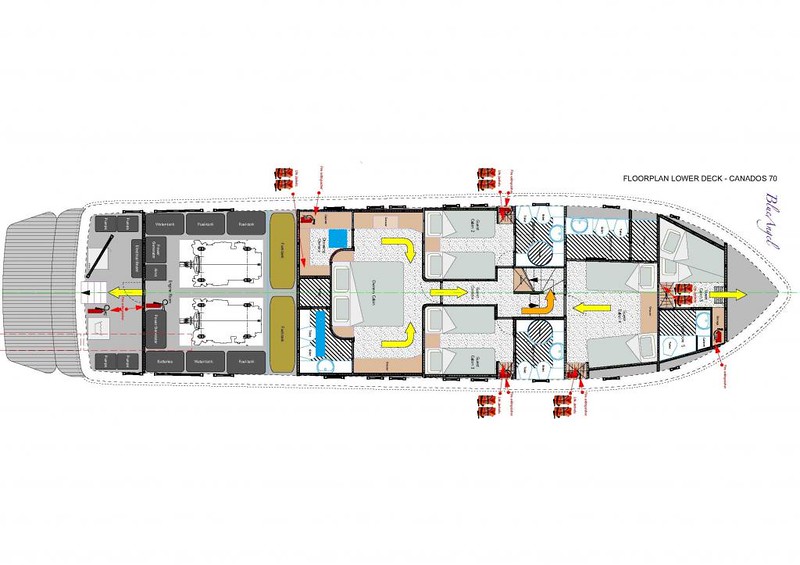
Stabilizers for Blue Angel, engineering question

Now that Bart has said he wants to keep BA in the future the whole project makes more sense. But I cannot begin to imagine the disruption this project will cause to the boat. First of all, how will it affect the interior? Space has to be found to accommodate the system in an interior that was designed without allowing for this space. Then the strengthening of the hull, another 20 layers of GRP over an area of 1.5 x 1.5mtrs, that means more interior having to be removed to get that done. Never mind the cost of the system, I suspect the installation preparations and the removal/redesigning of the interior will be even more expensive. This is just a gut feeling, I have no experience in the installation of these systems. It will make an interesting thread though. :)

Eric,
perhaps the pics posted above can clarify a bit your concerns about the interior ?

coincidently I have a guy drawing for me nice layouts of the boat on scale, ao for the MCA safety instructions
these never existed, neither any plans of the boat,unless very limited hand drawings
as soon these are finished, I'll use them to explain better where the stabs would be situated
 
And remember to add say 40mm of extra GRP thickness. Also you can raise the floor, in the dressing room more easily than the bathroom of course

exactly,

in the bathroom the highest point of the drive could come just under the toilet step (17cm higher then the cabin / bathroom floor)

the flange of the drive system requires 78mm GRP iirc (from the drawings),
 
Bart, have you " lifted floorboards" cabin soles and done a provisional recci @ arround 1/3 rd from the stern ?
I dought you will find wide open blank spaces - waiting to to be " glassed up " - reinforced .
Lots of things / gear will have to be moved and things relocated - perhaps to a detriment ? ?
100 k € will buy a lot of fuel to take you off to far places to dive when SoF is exhausted / boring.
Like Corsica - Sardinia ?
Poss less effected by the mistral , which if I understand your motive correctly is the main driver here?

if the cost would be 100K PF, I would not continue the project !
(total budget still to be confirmed, too many variables...)
but perhaps you noticed that the rebuilding is almost as much fun as the usage of the boat, (for me at least)
after all, its only money ;)
 
here is a priliminary layout drawing (there are a few small mistakes in the drawing, the guy has never been on the boat, he's working on it)

the floor covers/lockers in the pics above,
are the bleu rectangulars in the drawing below (in Master cabin bathroom, and dressing room)
i-SDsHC6q-L.jpg

actually there is no cupboard in the dressing room, against the rear e/r wall, (mistake in the drawing)
there is just bare floor, very easy to open ,
as jfm say's unimportant space,
when needed this floor could have a bumb to enable enough hight for the stabilizer drive moter
 
Last edited:
Bart, you appearing to be investing in BA for your own enjoyment. It appears not to be a short term project, and I guess the key question is would you get a better boat for your use and enjoyment than BA? To me it would seem that you found a great boat for a sensible price, that you are improving. Your mods may not actually add much sales value to BA, but to find a better boat would cost you so much more. If you can afford the mods, go for it.
 
Bart, you appearing to be investing in BA for your own enjoyment. It appears not to be a short term project, and I guess the key question is would you get a better boat for your use and enjoyment than BA? To me it would seem that you found a great boat for a sensible price, that you are improving. Your mods may not actually add much sales value to BA, but to find a better boat would cost you so much more. If you can afford the mods, go for it.


good summery Raf,
BA is our floating home in the med,
moreover she is a very sophisticated and nice machine with lots of old and new technology,
this is my hobby, and this will keep me bussy for a while,
and compared to fe a bike or a expensive car, my family can enjoy her also


re. the honeycomb structure material,
Also Vas mentioned about this in his Mitos rebuild thread

I have to admid that I'm a bit old fashion / conservative with this kind of stuff
I know the product, is used in my business, as a 'solid' front panel in a expensive studio monitor loadspeaker
but
do we know how the strength is in different directions ? (fe when tightening the flanges of the drive)
how does it "glue" on GRP or other boat materials
what's going to happen when salt water comes in the gaps / oxidation of the Alum ?

the weight advantage would be minor in the total sceme of the project / boat,
so better stick with solid GRP imho
 
Bart, you could use something like an aluminium honeycomb for local strength, bonded to the grp. This would be much lighter, and potentially more rigid.
I don't think that makes sense rafiki. Honeycomb is more rigid for a given weight, but not more rigid in absolute terms. Weight isn't an issue in this case. Plus, the two flanges of the stab unit are bolted and the honeycomb is very weak with crushing forces. Solid GRP is much better here and any form of coring would be a bit of a disaster imho
EDIT - oops, sorry, i'm repeating BartW
 
Last edited:
Bart
The walk in wardrobe is easy. Just put a step in the floor. This is done on all fin stabbed Sq78s. Picture bellow, for example
s78-87MenorcamaybeIpwich21Nov201237.jpg


The bathroom is much more difficult, unless you have loads of space under the floor, which I hope you do. On Sq78 the "bar" on which the the basin sits is made deeper and moved inboard. To do that retrofit is VERY difficult. You have to move the WC and bidet inboard, and potentially move the door inboard (unless you make it outward opening), and potentially make the bedside tables smaller. To keep it symmetrical you have to do both sides. This is easily €15k in yard costs. Sketch below. You gotta hope you have the required 350mm or whatever under the existing floor!
VYD-13-BW-BA-30layout_1stabs.jpg
you
 
The red rectangle looks good to me BartW
Seconded 100%.
It's easy to guess that the results of the best possible calculation could be, if not exactly in that position, possibly just a little bit further astern. Surely not more forward, anyway.
But obviously, moving the tanks and/or placing the fins under them would be an insane idea anyway.
Besides, I would bet that with the stabs you will enjoy even more than you're already doing now the slow cruising lifestyle.
For which, as I previously said, the optimal position is a bit more forward than for a hull in full planing attitude.
Bottom line, there you are, Bart: by drawing that red box on the pic, you just saved yourself the fee of a naval architect! :p

Incidentally, the only potential problem of the placement in the master cabin compartment (rather than in the e/r) is that the fins movement noise can be a bit more annoying, if and when overnighting with the stabs on.
But when I asked about the noise to the CMC engineer, he sweared that the whole mechanism of their fins is less noisy than the hydraulic cylinders movement alone.
Which sounds surprising, I know, but he definitely doesn't give the impression to make unsustainable claims - also because it would be sufficient to see/hear one of their equipment installed to check that.

within 2 weeks will go to the yard I had in mind for anual maintenance,
they actually build boats, (but mainly wood iirc) and listen how they would approach the project.
I wouldn't worry if they have more experience on wood than on GRP.
In fact, with all due respect for GRP experts, I'd rather have a GRP boat built by a wooden boat builder than the other way round.
Actually, coming to think of it, I see no reasons why also your internal strengthening couldn't be made in solid wood, possibly "bonding" the two GRP stringers around the area where the fins should be placed.
In this way, the whole structure (external GRP surface of the hull, plus wooden chocks and stringers internally) could work concurrently to withstand the transversal forces transmitted by the fins to the shaft.
To achieve that, it's not necessary that the internal support structure is actually glued to the hull GRP layers.
It's rather a matter of building a stiff and strong structure which can transfer the lateral forces to the hull.
It's a shame that I didn't show you the internal (wooden, obviously) supports in my boat when we met - and I don't have any decent pics - but you would be surprised by how (relatively) small they are.
And in spite of that, I never saw one drop of water entering from there in all these years - touch wood... :)
 
To do that retrofit is VERY difficult. You have to move the WC and bidet inboard, and potentially move the door inboard (unless you make it outward opening), and potentially make the bedside tables smaller. To keep it symmetrical you have to do both sides. .... You gotta hope you have the required 350mm or whatever under the existing floor!

thanks for the drawing, but this mod I would really like to avoid, would be a reason to skip the project,
still hope that the step below the toilet / bidet has enough hight (and could skip the bidet if needed)
we need accurate dimensions from the boat, will post drawing of the drive.

I forgot that the fins must sit preferably as much outwards as possible
how far from the side in M1/M2 ?
 
I don't think that makes sense rafiki. Honeycomb is more rigid for a given weight, but not more rigid in absolute terms. Weight isn't an issue in this case. Plus, the two flanges of the stab unit are bolted and the honeycomb is very weak with crushing forces. Solid GRP is much better here and any form of coring would be a bit of a disaster imho
EDIT - oops, sorry, i'm repeating BartW
I'm sure you are right JFM, given your more extensive knowledge of boats. However I would not dismiss this out of hand, as you could build bearing beams into the structure to take the compressive loads, using the honeycomb section to spread the load. Even using a grp structure, I would be tempted to mound the stab bases to beams.
 
Incidentally, the only potential problem of the placement in the master cabin compartment (rather than in the e/r) is that the fins movement noise can be a bit more annoying, if and when overnighting with the stabs on.
But when I asked about the noise to the CMC engineer, he sweared that the whole mechanism of their fins is less noisy than the hydraulic cylinders movement alone.
Oh thats no issue as I intended never to use stabs / genny's overnight, and in a extreme swell (happened ones to us) I would rather deploy the ketch anker and pull the boat in another direction as a temporary solution.

Actually, coming to think of it, I see no reasons why also your internal strengthening couldn't be made in solid wood, possibly "bonding" the two GRP stringers around the area where the fins should be placed.
In this way, the whole structure (external GRP surface of the hull, plus wooden chocks and stringers internally) could work concurrently to withstand the transversal forces transmitted by the fins to the shaft.
To achieve that, it's not necessary that the internal support structure is actually glued to the hull GRP layers.
It's rather a matter of building a stiff and strong structure which can transfer the lateral forces to the hull.
It's a shame that I didn't show you the internal (wooden, obviously) supports in my boat when we met - and I don't have any decent pics - but you would be surprised by how (relatively) small they are.
And in spite of that, I never saw one drop of water entering from there in all these years - touch wood... :)

You not only enabled me to skip the Naval architect, but even the GRP workers, from the project ;)
now I can do the project all on my own, with my friend carpenter ;)
what a wealth of advice on here
 
I forgot that the fins must sit preferably as much outwards as possible
I did say that in a previous post, but just to put that in perspective, you should consider that the bottom part of the fins should never exceed the hull beam at the waterline, in order to avoid damaging them when docking alongside a harbour wall.
And even then, you should never forget to have the fins, because some harbour wall (I can think of many along the Istrian coast, for instance) are not vertical, so you could underestimate the necessary distance from them to avoid touching the fins.
Therefore, when you consider the fin length and the V angle of the hull, it's rather unlikely that you will be able to place the fin shafts very close to the hull sides.
I'd expect the most outward shaft centerline compatible with these constraints to be at least 50/60cm far from the hull side - maybe more.
 
Bart, here is a quick reminder of 1m sq working in "at anchor" mode. I had to turn them off else I would have hit the Hatt on my port side :-) Of course, underway is more important than at anchor (imho)

 
Jfm you tried to send me a PM but my mailbox was full,
I just tried to send you PM but your box was full
my mailbox has space again now.
 
Top