Spanner kits

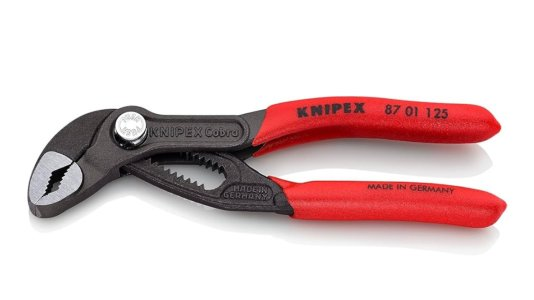
Since someone already mentioned mole grips, when a spanner/socket won’t work, Im going to throw in another great tool, Knipex mini Cobra pliers, amazing grip.

View attachment 195068
Great for rounded nuts/bolts, split pins, shackles, pan head slotted screws with a chewed up slot.
Actually, certain light duty plumbing applications, IMO, is their right place. P traps, for example. Some conduit purposes. Things like that. Vice grip are better for most chewed up things, and then only if the fastener will be replaced once it is out.
 
5000 hours over 20 years & I do not recall ever using a mole grip or any other type of grips on my MD2020.
As for using grips on the bleed screws- Well I suppose a spanner monkey would feel proud of such an achievement. But I would not. A pair of Moles will damage a soft bolt head as seen on a bleed screw imediately. Simply because the jaws are not parallel & have serated teeth. Holding the tool vertically is cack handed way to use it as it puts the wrong twist on the jaws
.
I even made a special tool to fit the butterfly drain plug on the bottom, so I could empty the CAV filter base easily without damage.
Not only are the correct tools faster leaving little damage, but one can feel a suitable torque much better when tightening . assuming a torque wrench is not to hand.
 
I use mole grips for:

1: Unscrewing screws when the head has sheered off
2: Gripping fiddly things that I’m hacksawing
3: Getting the lids off old tubes of glue

So I do have a pair aboard … at the very bottom of the tool case.
 
Sometimes only a Mole type wrench will do the job.
Last winter I replaced 4 winches and 6 cleats in the cockpit. The old fixings were bronze or brass whitworth screws and nuts. As soon as you start to loosen the nut the whole lot starts turning. Unless you have two people or 10ft arms the only way is a mole wrench on the nut inside the boat and a screwdriver from the cockpit end. Removing 24 nuts was time consuming but very easy and the new winches were fitted with new stainless fastenings.
I also have an American made self adjusting wrench where you set the tension and it automatically adjusts to the correct size. This is invaluable when you can't see the nut you are trying to hold and working blind at arm's length.
Leverage tools
 
I use mole grips for:

1: Unscrewing screws when the head has sheered off
2: Gripping fiddly things that I’m hacksawing
3: Getting the lids off old tubes of glue

So I do have a pair aboard … at the very bottom of the tool case.
1 Try using a decent screwdriver & do not rotate the handle in a big arc when turning it. Tends to avoid sheered heads
2 Why are you hacksawing on a boat? Are we now talking boat maintenance- Get a vice for that
3 Old glue needs careful disposal
 
5000 hours over 20 years & I do not recall ever using a mole grip or any other type of grips on my MD2020.
As for using grips on the bleed screws- Well I suppose a spanner monkey would feel proud of such an achievement. But I would not. A pair of Moles will damage a soft bolt head as seen on a bleed screw imediately. Simply because the jaws are not parallel & have serated teeth. Holding the tool vertically is cack handed way to use it as it puts the wrong twist on the jaws
.
I even made a special tool to fit the butterfly drain plug on the bottom, so I could empty the CAV filter base easily without damage.
Not only are the correct tools faster leaving little damage, but one can feel a suitable torque much better when tightening . assuming a torque wrench is not to hand.
Good! The only time I remember using them on a motor was the PO murdered transom clamp bolt on an outboard, which were then replaced. The ends were just round. There may have been a few others over 40-50 years or wrenching on motors, when something was hopelessly corroded.

But I think those that save "Never!" are just as funny. They are a useful tool in the correct (but not universal) application. I suspect the same is true of the new style alligator wrench, where nothing else quite fits. I'm keeping my eyes open.
 
They damage the fitting. Making a proper tool to do the job with no damage is a much better thing to do.
Assuming this is something unique, I think there are readers that would like to see a picture. I've made a few Frankenwrenches over the years to fit specific things nothing else would. My wood lathe requires a very specific wrench to snake between the chuck and headstock; thin plus a slight dogleg. I have power driver heads for my C-clamps and certain feeds on the milling machine.
 
I have at least two sets of everything......one set of ‘reasonable’ quality tools...and sets of cheap tools that I don’t mind cutting up and welding together to make a tool for a specific job. Something useful on a boat where reaching something can be close to impossible
 
I recall, in my very distant youth, that bicycles, for example Raleigh, used to be supplied with a universal spanner. I think it contained all the 'spanners' needed to service the bike. Maybe 5 different bolt sizes? Such devices, from some of the responses here, would be now considered bodges (as the steel use was not very robust). Yet Raleigh bikes were always reliable and lasted, almost, for ever - so presumably designed by engineers.

My example of assembling a Fortress using a Aligator wrench invoked some criticism yet the nuts are specially chosen as not needing to be torqued at all. But maybe real engineers condemn Nyloc nuts as well.

I sometimes get the impression part of the membership here goes sailing and addresses any needs with imagination. Others are hide bound by what they consider correct and possibly never actually sail anywhere (because they don't have the correct spanner. :). If you are half way across the Atlantic and need to use a mole wrench to seize a nut inside the cabin when you are woking on the bolt outside - you do it! - or you never cross the Atlantic (or Channel). Or the holier than thou attitude is simply to provoke (not a bad thing) and when the **** hits the fan - everyone bodges.

I confess I have 2 Mole wrenches a big one and a small one. I also have 2 Stilsons, big and small, they appear to not invoke wrath - nor mentioned....yet. And surely no engineer would admit to using a Stilson - too wobbly. I also have a multitude of shifters - the biggest, I'm guessing, must have a 70mm jaw and be about 0.5m long (and I use it)

Jonathan
 
I recall, in my very distant youth, that bicycles, for example Raleigh, used to be supplied with a universal spanner. I think it contained all the 'spanners' needed to service the bike. Maybe 5 different bolt sizes? Such devices, from some of the responses here, would be now considered bodges (as the steel use was not very robust). Yet Raleigh bikes were always reliable and lasted, almost, for ever - so presumably designed by engineers.

My example of assembling a Fortress using a Aligator wrench invoked some criticism yet the nuts are specially chosen as not needing to be torqued at all. But maybe real engineers condemn Nyloc nuts as well.

I sometimes get the impression part of the membership here goes sailing and addresses any needs with imagination. Others are hide bound by what they consider correct and possibly never actually sail anywhere (because they don't have the correct spanner. :). If you are half way across the Atlantic and need to use a mole wrench to seize a nut inside the cabin when you are woking on the bolt outside - you do it! - or you never cross the Atlantic (or Channel). Or the holier than thou attitude is simply to provoke (not a bad thing) and when the **** hits the fan - everyone bodges.

I confess I have 2 Mole wrenches a big one and a small one. I also have 2 Stilsons, big and small, they appear to not invoke wrath - nor mentioned....yet. And surely no engineer would admit to using a Stilson - too wobbly. I also have a multitude of shifters - the biggest, I'm guessing, must have a 70mm jaw and be about 0.5m long (and I use it)

Jonathan
Using whatever gets the job done mid-atlantic is quite a different matter to wilfully choosing the wrong tool when you have time in hand. I've sucked (and swallowed) diesel through a shower hose to siphon a tank empty mid-atlantic, the right thing to do in that time and place but I wouldn't dream of doing it in anything other than an emergency.

Considering your exactitude in all things anchor I'm frankly astonished at you wilfully shagging nuts and boltheads for the lack of the correct tool for the job, let alone making out that those who don't are some kind of engineering fetishists - it's just common sense to not damage things you're going to need again unless you absolutely have to.
 
Nyloc nuts as supplied with Fortress anchors, or as supplied for any application, should be considered single use, only. I know people use them multiple times - they don't have a fetish. I think Nyloc nuts are suppled with Spade anchors and Viking anchors. I think Mantus anchors are supplied with standard nuts and spring washers - you should watch the video linked earlier for background and damnation of spring washers.

Just tell me how the use of an Aligator wrench (or any adjustable wrench, including a Mole wrench) is going to further reduce the life of a Nyloc nut or cause any damage at all. The whole point, or one of the main points, of a Nyloc nut is that you do not need to torque it up - if you do torque the nut you may damage the head of the bolt, and/or the nut - but you are misusing the Nyloc nut.

I was considering the use of nuts on a yacht and excluding the auxiliary engine and keel nuts most nuts I can think of are Nyloc nuts, usually requiring single installation. Keel nuts would be torqued, requiring specific and defined 'spanners'. The cross beam on our 38' cat was secured with Nyloc nuts (single use only - we never touched the nuts nor bolts)., the steering cross beam was secured with Nyloc nuts. The steering cables, attached to their cross beam, were secured with Nyloc nuts. The radar scanner was secured with Nyloc nuts - once installed it was never removed. The windspeed gear at the mast head was secured with a stainless bolt tapped into the aluminium crane casting and liberally coated with Duralac - and never removed. The nuts or bolts demanding the most attention were the bleed nut and the CAV filter nut and bolt - both survived my inattention for over 20 years - primarily, perhaps, they never required application of much torque. An important application for nuts is in, or on, rigging - again not something to be treated lightly nor something to be treated by a neophyte.

More serious attention to the engines would have required more attention to the spanners and torque - but marine diesels actually are amazingly reliable and few require a re-build demanding torqued bolts, studs or nuts.

Horses for courses - and Nyloc nuts do not require any torque - at all - which is why Nyloc nuts are used in preference to 'other' nuts.

Are Nyloc Nuts Reusable?.


Jonathan
 
Just tell me how the use of an Aligator wrench (or any adjustable wrench, including a Mole wrench) is going to further reduce the life of a Nyloc nut or cause any damage at all. The whole point, or one of the main points, of a Nyloc nut is that you do not need to torque it up - if you do torque the nut you may damage the head of the bolt, and/or the nut - but you are misusing the Nyloc nut. . . .
Well, if using the wrong tool reduces the life of the nut below a single removal, then this will be a problem, won't it? I've seen it happen.

What concerns Nylocs, I have somewhat different information.

NASA don't want you reusing them on spacecraft at all, but the FAA allows it on aircraft, and U.S military standards allow the reuse of Nylocs up to 5 times. Industrial best practice from IFI allows the reuse of Nylocs as long as torque standards are met. The locking power of Nylocs obviously declines with each reuse, but I don't see any problem with reusing them a couple of times. If it's good enough for aircraft, it's good enough for my boat.

And I don't know why you think Nylocs don't need to be torqued. All the standards say, to the contrary, that you have to torque them MORE than standard nuts, to account for the resistance of the nylon locking part.

ISO 2320 says: “The locking feature is a supplement to, not a substitute for, proper tightening.”

ASME B18.16.6 says: “Proper torque must be applied to ensure adequate clamp load; the nylon insert provides resistance to loosening but not preload.”
 
.....Just tell me how the use of an Aligator wrench (or any adjustable wrench, including a Mole wrench) is going to further reduce the life of a Nyloc nut or cause any damage at all. The whole point, or one of the main points, of a Nyloc nut is that you do not need to torque it up - if you do torque the nut you may damage the head of the bolt, and/or the nut - but you are misusing the Nyloc nut.....

Can someone explain this to me? I haven't a clue what he's talking about.
 
Can someone explain this to me? I haven't a clue what he's talking about.
I think Neeves is saying that we shouldn’t all be so high and mighty about Using The Correct Tool and Only The Correct Tool. I sort of agree with him - and am a proud owner of a well used pair of mole grips. I also own a fairly comprehensive set of good quality spanners, sockets, torque wrenches and everything else - by the likes of Snap-on, Gedore, Britool, Norbar and all the other usual suspects (I rebuilt engines for years). It’s about having all bases covered. As I said before, I have removed (previous owner) mangled fasteners that nothing other than mole grips would have removed.
 
… and here’s a good example of a shite tool saving the day: I lost the security socket for locking wheel nuts - so I bought one of those sockets that is full of spring loaded pins that ‘shape’ around “any nut”. It cost less than a tenner on eBay and worked, removing all four locking nuts- which were the sort with an odd exterior shape that no standard hex-head tool would fit.
 
Top