Some Chilean anchorage notes...

Thanks for that! I've looked up Dresden's hidden-holes on the chart of the area that hangs above my desk, referring to your map. Her 'K' anchorage one would certainly have been the least secure – too close to Punta Arenas – and cold too, with glaciers all around. 'B' and 'C' are interesting because the chart in your gif does not accord at all with my Admiralty chart (1981), which for the area still shows dotted lines for the 'C' area of Santa Ines. I would imagine this anchorage to be very blusty and wet. 'A' (caleta Hewitt) would certainly be the snuggest site and there too, still dotted lines in 1981 (and even Google Earth can't shed much light on the area!). I think that's the place I had in mind. I believe I have seen a photograph of it: typical anchorage for the area: trees down to sea-level, full of twists and turns. A strategic site too, because from here (coal allowing), Dresden could break out west immediately into the Pacific (presumably arriving with a gulp of relief because it seems full of semi-charted rocks), or north to Paso Froward and then NW to the ocean.
Anyway, as I'm sure you agree, there's something to see at every turn!
 
Oh dear... you make me realise how many things I should have done.... explorations unexplored... sigh

A book you may or may not have ... 'The enemy fought splendidly' by Surgeon TB Dixon, HMS Kent.
DSC_0539.JPG.jpgDSC_1861.JPG (2).jpgBeen on my bookshelf for some years... didn't realise it was such a wealth of knowledge..

'Tuesday March 2nd... Plan of operations . Bristol and Orama to block the two northern entrances to Canal Barbara. Glasgow to search slowly helped by tug and picket boat while Kent dashed up and stopped Gonzales Channel bolt hole. The tug joined us early on.....'

So much history in these waters....

Such as... Caleta Gallant... and Monte Cruz... yes that is the sun...

Plus a piccy of Sarmiento... just because I can....
 
A lot of history indeed. I remember the lighthouse keeper on Cape Horn Island inviting me to go and visit the trenches they dug against the Argentinians (to me who lives a couple of miles behind the WW1 trenches on the Carso!). There's a building on the very eastern tip of Isla Wollaston, at the entrance to the Paso Bravo, that has always raised my curiosity. There's absolutely no sense to it unless, as I suspect, it was in some way related to the Chilean defences in Argentina's 1978 Operation Soberanía, which sought to wrest these islands to gain a better angle in the 'tart slice' pointing to the South Pole. Love to go and see!
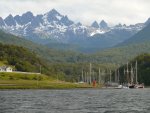
And since you have been kind with pics, here are two more for you: Seno Garibaldi (I think) and approaching Cape Horn from the NW.
1.jpg1 (1).jpg
 
Thanks for that! I've looked up Dresden's hidden-holes on the chart of the area that hangs above my desk, referring to your map. Her 'K' anchorage one would certainly have been the least secure – too close to Punta Arenas – and cold too, with glaciers all around. 'B' and 'C' are interesting because the chart in your gif does not accord at all with my Admiralty chart (1981), which for the area still shows dotted lines for the 'C' area of Santa Ines. I would imagine this anchorage to be very blusty and wet. 'A' (caleta Hewitt) would certainly be the snuggest site and there too, still dotted lines in 1981 (and even Google Earth can't shed much light on the area!). I think that's the place I had in mind. I believe I have seen a photograph of it: typical anchorage for the area: trees down to sea-level, full of twists and turns. A strategic site too, because from here (coal allowing), Dresden could break out west immediately into the Pacific (presumably arriving with a gulp of relief because it seems full of semi-charted rocks), or north to Paso Froward and then NW to the ocean.
Anyway, as I'm sure you agree, there's something to see at every turn!

I was already really enjoying this thread because of the excellent and thought provoking photos, but adding the Dresden story to the mix has made it even better.
 
A lot of history indeed. I remember the lighthouse keeper on Cape Horn Island inviting me to go and visit the trenches they dug against the Argentinians (to me who lives a couple of miles behind the WW1 trenches on the Carso!). There's a building on the very eastern tip of Isla Wollaston, at the entrance to the Paso Bravo, that has always raised my curiosity. There's absolutely no sense to it unless, as I suspect, it was in some way related to the Chilean defences in Argentina's 1978 Operation Soberanía, which sought to wrest these islands to gain a better angle in the 'tart slice' pointing to the South Pole. Love to go and see!
And since you have been kind with pics, here are two more for you: Seno Garibaldi (I think) and approaching Cape Horn from the NW.
View attachment 89021
Yes that is Garabaldi.....

And the business in 1978 almost became a hot war

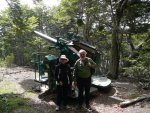
There are still guns close west of Williams.... and an old weapons pit above Puerto Toro - the most southerly civilian settlement on planet earth..... and I believe there are still minefields on Islas Hornos, Nuevo, Picton and Lennox...

On a brighter note... the port captain and 'dog in charge' in Puerto Eden some years ago.... 2006P1020496.JPG (2).jpgP1000761 (1).jpgdog.jpgDSC_0019.jpg
 
Last edited:
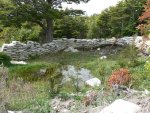
'There's a building on the very eastern tip of Isla Wollaston, at the entrance to the Paso Bravo, that has always raised my curiosity. There's absolutely no sense to it unless, as I suspect, it was in some way related to the Chilean defences'

I've seen a few like that... maybe including that one.... I would say your suspicion is well founded... There are a number of 'farm sheds' on the flat land close west of the Williams airport - where there are no farms - which still have old artillery pieces in them - shades of the Levington Gun Shed.

A crew member discovered them some years ago when he went for a wander and ignored the 'keep out' signs.....
 
I read that Chile was very, very worried of invasion. At the time, although they were a more effective fighting force (as now), Argentina was spending four times as much on its forces and could put far far more men in the fray. The invasion of the islands (Lennox, Picton etc) was given the green light and then cancelled, by which time the first Argentinian forces were perhaps already in Chilean waters. As of today (as you know, Frank), the Argentinians are far, far more relaxed in their treatment of foreign boats, whilst the Chileans are more.... Teutonic!
Another voyage on my wish list: from Harberton along the old trail carved through the hills and lenga forests by Lucas Bridges to their estancia north of the hills. Meanwhile, for the further titillation of those reading this post, here are a few more pics.
1 (2).jpg
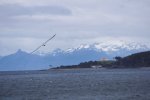
Punta San Isidro on the Strait of Magellan, the southernmost building of mainland America (looking to towards Cerro Sarmiento on Tierra del Fuego) + albatross.
1 (3).jpg
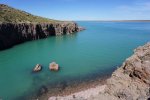
And now for something completely different! An inlet at Puerto San Julian, on the Atlantic coast. Magellan overwintered here in 1520, and hanged some mutineers. Drake hanged Doughty here 58 years later.
1 (4).jpg
Puerto Williams on Isla Navarino (with the Dientes) behind. The Micalvi is the half-sunken (German) ship serving as jetty, (former) bar and clubhouse.

1 (5).jpg
Ushuaia, the largest town in Tierra del Fuego.
 
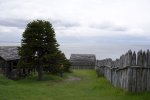
A apropos of nothing, here's the shack where Butch Cassidy and the Sundance Kid hung out for a while before their heist at Rio Gallegos.
1 (6).jpg

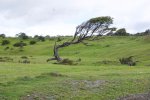
Now you know why they're called 'flag trees'...
1 (7).jpg


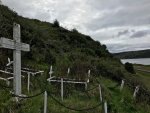
This is the grave of Capt Stokes, the captain of the Beagle on her first trip to these waters, who shot himself in the head but survived nine days.
The bay was used by the British hydrographers in the 19th century and there are a few other graves too. Again, we are south of Punta Arenas.
1 (9).jpg
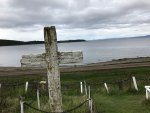
A very lonely and evocative place.
1 (10).jpg

Puerto del Hambre, south of Punta Arenas. Built by the Spanish to thwart the British after Drake found his way through the Strait of Magellan. In 1584, 300 settlers arrived here but when Thomas Cavendish landed there three years later, they were all dead of hunger.
1 (8).jpg

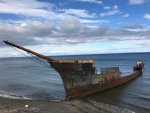
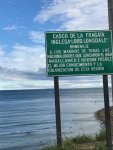
One of the many wrecks littering these shores. This is the Lord Lonsdale
1 (11).jpg
1 (12).jpg
 
This is the grave of Capt Stokes, the captain of the Beagle on her first trip to these waters, who shot himself in the head but survived nine days.

...the opening scene of Harry Thompson's excellent novel "This thing of Darkness" about Robert Fitzroy. A superb read, for those who haven't already enjoyed it.
 
Some random pics.....

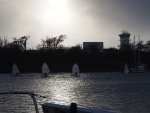
Optimists , Puerto Williams, June..... just before the shortest day....

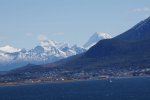
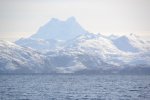
Monte Sarmiento seen from Canal Ballenero in winter.... a few years ago on a very clear spring day I could see
Sarmiento and all the other high peaks on TdF from my hotel window in Punta Arenas....some 90 miles away.

North of Puerto Eden in September.

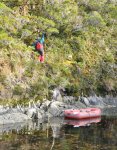
The art of running shore lines... a very long dinghy painter tied to the belt and the shore line with a bowline in the end over the shoulder.... Caleta Extra.... western end of Magallanes. In this case the dinghy painter just wasn't going to be long enough....

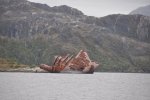
1968 Wreck of Grace Line's Santa Leonor in Paso Shoal.
P6100152 (1).jpgDSC_0286 (1).jpgP9290154.jpgDSC_2355 (4).jpgDSC_2372.jpg
 
Top