Solar wiring - series or parallel

Caladh

Well-Known Member
Joined
25 Oct 2009
Messages
1,540
Location
Out there again and no longer dreaming
Visit site
I've recently bought an MPPT controller for my 4 solar panels and queried with Morningstar whether I'd be best to wire them in series instead or parallel. Their answer is below. However I was unaware that wiring in series was not good in reduced/shaded lighting conditions.

"Series Wiring of Panels"
Connecting solar panels in a line, or series, allows you to build up the voltage to the level you need (as opposed to parallel wiring which allows you to increase current).
The major limitation of series wiring is that performance is adversely affected if all its cells are not equally exposed to the sunlight or some of them are partially shaded. Whether this shading is caused by a neighbor's trees, leaves falling on the panels, snow, or bird droppings, you may lose between 20% and 40% of the potential output of your solar installations because of shade.

"Parallel Wiring of Panels"
Solar panels in parallel are less affected by shading as compared with solar panels in series. That said, shading is never a good idea and can lead to damaged panels before their natural lifetime is over (which can be decades!).
 
It depends on the solar panels you have. They are normally designed for 12V if you have bought them for your boat. you can buy them for 24V and 48V systems. On the back of the panels it will normally say 20V max voltage. These are for 12V systems. If you are conncting in series you are effecrtively creating one big panel and higher voltage. In parallel with blocking diodes on each panel you reduce the effect of shading.
 
Could someone please explain the difference between in series and in parallel wiring? I think I know the answer but obviously not certain.

Thanks
 
Could someone please explain the difference between in series and in parallel wiring? I think I know the answer but obviously not certain.

Thanks
Drawn in answer to a similar question about batteries but the same diagrams apply

scan0009.jpg
 
I was about to write a proposal to connect the panels as 2 24 volt sections, the two sections in parallel. two to port, two to starboard on an arch.

Whilst writing up the reasons I changed my mind! I'll now be connecting mine as 4 panels in series, giving a nominal 48 volts. Most MPPT chargers will happily handle that.

Given the bypass diodes normally fitted, each 12 volt panel is actually 2 6volt sections in series. The diode across each 6 volt section acts as a bypass to the current available from other 6 volt sections.
The shadowing of a 6 volt section in a 12 volt panel will drop the voltage to 6 volts.

With 4 panels connected in parallel and 1 6 volt section shadowed will leave us with 3 working 12 volt panels and a 6 volt one producing no power.
Thus with 4 panels in parallel, shadowing 1/2 of 1 panel stops that panel completely leaving us with 3 panels. 3/4 of the power.
Shadowing the other 1/2 of the same panel, we will still have 3/4 power. 1/2 shading of another panel will also stop it and reduce the power to 1/2.

By putting the panels in series, the shadowing of each 6 volt section will leave all the others still fully working.

With 4 panels in series, full shadowing of any section will effectively remove that section from the 48 volts in 6 volt steps. This will progressively reduce the power available, but with shadowing we expect that.

The same shadowing of 1/2 of 1 panel will leave 42 volts out of 48 = 7/8 of the power.
The shadowing of any other 1/2 panel will reduce us to 3/4 of the power.

That's my theory, any comments?
 
Last edited:
That's my theory, any comments?
You are forgetting the loss in the bypass diodes, but I did some almost identical modelling a year or so back with similar conclusions.

http://www.cruisersforum.com/forums/f14/solar-panels-series-or-parallel-68096.html

It really needs some experimental measurements to confirm this. In practice the exact opposite parallel connection seems more shade tolerant.
conf40.gif

It would be great if someone could do a controlled experiment.
I have found this difficult to do as most of the time I am at anchor, which makes controlling the variables difficult as the boat swings.
 
Last edited:
Thanks for the link
I hadn't forgotten the diodes, I just assessed that their first order impact was sufficiently less than the loss of 1/2 a panel to ignore them. 0.67 vs 6-9 volts, call it 1:10.
You are of course correct that they must be included for a more detailed analysis.
If the answer had been close in my calculation I'd probably have decided that series vs parallel was too close to call.
Theory tells me that serial is the way to go.
I may temporarily rig a switch to toggle between the 2 when I have the arch and the panels.
Thanks.
 
Hmmm, does it not all depend on what your regulator can take?
I have 3 panels and two wind jennies, each wired in series, 2 x solar 80w and 1 x 913 jen the other 1 x solar 65w and 913 jen all works fine, the regulators have a max of 160w solar so two regulators.
 
The watts get added up whether or not its series or parrallel.
The amps to the batteries will also be the same (assuming the same efficiency)

Be very careful of exceeding the max voltage of the controler. Most will be perminatly damaged even if the max voltage is exceeded only briefly.
The better controlers will tolerate high maximimum voltages (150v) so this not usually a limitation preventing series connection on a boat.
 
If input voltage to the MPPT controller is above output voltage than shadow-loss by wiring in series will be negligible.

My MPPT controller is designed for an input of 48v and a maximum of 120v. Because it has a diode fitted, the lack of diodes in all 6 of the PV panels I have is immaterial.
I do go along with Noelex that it's probable that the reduction in current due to the diode resistance is greater than the loss through night-time feedback - an opinion apparently shared by Kyocera (and Panasonic).
 
I've just been through this exercise and purchase 2 nominal 12volt 100watt panels and an MPPT controller. I must confess I didn't know much about Maximum Power Point Tracking Controllers and how best to wire 2 solar panels to the controller. However after searching the web it seems that MPPT controller will work better with the panel in series, the batteries will start charging at a lower light level and there will lower resistive (I^2*R) losses in the controller.
As pointed out above you need to be careful that the maximum open circuit voltage of the panels doesn't exceed the voltage rating of the controller, in my case 2*22.5=45volts when the cells are connected in series and I bought a MPPT controller that has over voltage protection.
You also need to match the voltage outputs of the controller to your battery type, wet, AGM, Gel or whatever, most MPPT controllers seem to have a built in 3 stage battery charger and you can set (or get the dealer to set) the bulk, absorption, float and equalisation voltages to suit your battery type. I think that the latter point is important because with larger panels, which can produce 10amps or more, connected unattended to the batteries for possibly weeks at a time, incorrect settings could permanently damage the batteries.
 
View attachment 27544
However after searching the web it seems that MPPT controller will work better with the panel in series, the batteries will start charging at a lower light level and there will lower resistive (I^2*R) losses in the controller.
.

Most (all?) MPPT controlers are more efficient when the voltage of the solar array is only a bit above the battery voltage. So parrallel connection is more efficient. However the difference is small and is often made up by the wiring from the panels to the controler being more efficient with series rather than parrallel.

It is often believed that series connection, by view of the higher voltage, will start charging earlier. In practice this is not the case. The panels can produce voltages above the battery voltage before they are capable of producing any significant current.

The photo is a bit indistinct, but it shows the panels at 18.0v while not capable of producing any significant current (the produced power will be less than the consumption of the controler tracking circuitry).
 
Last edited:
Hi, I don't agree with Noelex's reply. A solar cell will provide current at zero volts, i.e. a short circuit, the current is limited by the internal resistance of the cells, but they won't provide very much power (volts x amps). The reason you don't see any current until the cells are at 18volts is that the impedance of your controller is too high at that point in its operational envelope and it needs a higher voltage to operate effectively.

Yes, most MPPT controller operate at voltage a few volts above the battery voltage, but they will do that with cells in series as well as parallel. MPPT controllers are designed to seek out the optimum power production point, with 2 cells in series the voltage at which maximum power is produced will be higher and the current correspondingly lower than 2 cells in parallel. A lower current means lower resistive losses and more efficient operation because resistive losses vary as the square of the current.

Check out these websites for more information:
http://www.solar-facts.com/controllers/mppt-controllers.php
http://www.mysolarshop.co.uk/Connecting-solar-panels-to-an-MPPT-Charge-controller-i-227.html
http://www.windsun.com/ChargeControls/MPPT.htm

There are many more sites like these, just Google "solar cells series connection MPPT controllers"

The advice I've had from several suppliers is to connect in series, so that's what I'm going to try first, if I think that it's not work as well as it should do, changing to a parallel set-up is no big deal.
 
View attachment 27604
Hi, I don't agree with Noelex's reply. A solar cell The reason you don't see any current until the cells are at 18volts is that the impedance of your controller is too high at that point in its operational envelope and it needs a higher voltage to operate effectively..

The point was the panels were at 18v, but not capable of producing any useful current due to low light. This is how solar panels work. Series would not help because there is plenty of voltage. My panels in a parallel" are already well above the battery voltage. In series they would be at 72v, but not producing any more power.
My panels are nominal 12v panels in parallel so the Vmp is normally below 18v. The voltage is not restricting the output.

A lower current means lower resistive losses and more efficient operation because resistive losses vary as the square of the current.
.
The resistive losses are less, but the the voltage conversion losses are higher. The overall efficiency of he MPPT controler is less at higher panel voltage.

Above is a typical graph.

The differences are small a few percent, but its a fallacy to think the higher voltage make the controller more efficient. The opposite is true.
 
Moringstars' advice is solid irrespective of the type of regulator.

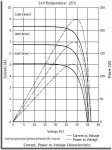
Shading will have a significantly greater effect on a panels output current than its voltage.
This typical solar IV curve (not for a 12v panel) demonstrates the effect of reducing Irradiance (W/m^2).

For optimum array performance, aim to maintain a voltage just above the system voltage you require while allowing for expected shading.
Then utilise whatever current the array will deliver.

There's nothing to be gained in arranging for a much higher voltage than whats needed; the power delivered will be largely determined by the output current, which in turn is determined by the level of Irradiance (and ambient temperature to a lesser degree). This makes the case against a series array when talking about 12v panels & a 12v system.

Some further optimisation may be be achieved by choice of controller, but best to get the power source right first. (no controller will deliver energy beyond what is presented!).

hopefully this pic will upload okay.
(Re: MPPT controllers, the Maximum Power Point, which the MPPT controller attempts to chase, is at the knee of the solid curves).


Solar_IV_curve.jpg
 
Last edited:
Assuming an MPPT controller was going to be used with 12V batteries, then is a better option to buy 24V panels (max 36V) and wire these in parallel? This would seem to give the best of both worlds - high performance from one panel if the others are badly shaded and there'd still be some charge into the batteries in low light levels.

Most MPPT controllers are rated to at least 50V so 24V panels for a 12V system seems logical way to go (unless you already own 12V panels of course!).

Old thread I know, but any thoughts welcome?
 
Top