Solar Panel Broken?

Petronella

Well-Known Member
Joined
29 May 2004
Messages
325
Location
Scarborough Marina, Australia
Visit site
I have two solar panels mounted on port and starboard rear guard rails. One is 100W, the other is 80W. Normally they give around 5A each in good sunshine.

Recently the output of the 100W panel has dropped so that it rarely exceeds 1.5A whilst the 80W panel is still showing 4A-5A (although VERY occasionally the 100W one will VERY briefly show up to 4A-5A). Open voltage is 20V, open current 1.5A.

I have worked back through the cabling and connections and everything seems fine. However if I connect the suspect panel direct to the battery I still only get a reading of 1.5A max. I therefore deduce that either the panel or the diode connections are faulty. Is this a correct deduction?

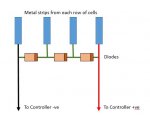
If so, can anyone explain how I can bypass the diodes to eliminate them from the system and hence hopefully prove that they are the problem? When I take the cover off the "diode box" on the underside of the panel I see four "wires", one coming from each row of cells. The outer two are connected to the positive and negative leads out to the battery (via the MPPT controller). All four"wires" are also connected together with a diode (3 in total) in line between each pair. What needs to be connected to what to bypass the diodes?

My understanding(?) is that I don't actually need these diodes anyhow as the output is fed to the batteries via a SunSaver MPPT controller with its own blocking diodes so if it is the diodes causing the problem I could remedy things by simply bypassing the panel diodes. Again is my understanding correct here?

This is at the limit of my electrical understanding so please be gentle!

Thank you.
 
ITYWF they are bypass diodes not blocking diodes.

Google will find explanations.

but it would help if you posted a diagram to support your description.

but I expect connections within the panel are corroded and broken...............in short its knackered.......... ( note to mods; used in the sense of ready for the knackers yard ... not as a vulgarity)
 
Last edited:
I will be honest, I don't understand your diagram, but one possibility is that the diodes have blown and are effectively shorting out the panel. I assume since you posted all the voltage and current readings that you have access to a multimeter, can you disconnect the diodes and test them?
 

No sorry I dont understand the diagram either

I would expect to see groups of cells in connected series with a diode wired across each group so that if one group is in shadow the diode wired across it provides a low resistance path bypassing that group

something like this:

alt12.gif


There could be a blocking diode as well located in the output connection
 
Last edited:
Yes use your multimeter to check the diodes after disconnecting one end of each. Now your multimeter might have a special diode test switch position and function. This is excellent. It passes a current through the diode showing the voltage drop.
Hopefully your diodes are schotky type dropping about .25 volt in the forward direction. In the opposite direction leads reversed you get a very high voltage or over range on the meter which is good.
Now if your multimeter does not have a diode test position it is more tricky to interpret results. In the back direction you should get very high resistance measured using a high ohms range. In the forward direction you will get a number of ohms indicated (several hundred typically). This is probably an OK diode. This is because in a DMM a constant current is applied to a resistor and the resultant voltage drop indicates resistance. But diodes have an inherent volt drop regardless of current non linear not like a resistor. So yes check with your meter on ohms but beware the results. good luck olewill
 
I'd check the connection to the solar panel. I had a panel that was giving dodgy readings - it turned out to be corroded connections inside the little black plastic box, which more or less fell off in my hand. This was one of those flexible panels. Fixed it by soldering directly onto the copper track and filling up the black box with sticks like sh*t.... Worked a treat! :)
 
To relate to VicS's diagram, I think you have:
path3063_0.png


To test:
place panel so it is evenly illuminated, with it connected to MPPT measure the voltage across each panel (put probes on metal strips).
If all are about even, no problem in this box, or panels.
If any are significantly lower than the others, mark them.
next remove any marked diodes (disconnecting one end will do), repeat first step.
If all are even, the marked diodes are broken.
If any are low, that row of solar cells is broken.

note, 100W is to be respected, be careful with the meter probes.
 
Thanks guys - I think we have it. Dougal I believe you are correct in your interpretation of my diagram with VicS's expected set up.

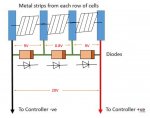
I have followed you excellent instructions and the results are shown in the modified diagram below:

Solar 4.JPG

So, 20V across the whole array, 9V across two of the diodes and just 0.8V across the central diode. I then snipped the central diode as per your instructions and the tested again. The values were identical to before.

I guess this means my panel has had it and there is nothing else I can do other than replace it? Any reason why this 2 year old panel should suddenly conk out?

This is bad in that I need to spend some money. However it is good because I now understand a bit more about how these diodes work and also good because I am only 5 minutes from one of the few chandleries in the Caribbean where I can buy a replacement.

Anyway thanks to all of you who responded to help provide a definitive diagnosis.
 
Recently the output of the 100W panel has dropped so that it rarely exceeds 1.5A whilst the 80W panel is still showing 4A-5A (although VERY occasionally the 100W one will VERY briefly show up to 4A-5A). Open voltage is 20V, open current 1.5A.

I guess this means my panel has had it and there is nothing else I can do other than replace it? Any reason why this 2 year old panel should suddenly conk out?

Anyway thanks to all of you who responded to help provide a definitive diagnosis.

the fat lady hasnt sung just yet.

Now that you know which panel is faulty, and you have some idea of its construction, the snippet from your first post warrants some more investigation.
It would appear to be an intermittent connection, the prime candidate for such a connection is where the panels are connected to the metal strips that you cab see. There will be other similar junctions throughout the panel. If you can access these then you may be able to repair it.
 
Top