Solar for dummies

MJWB

Well-Known Member
Joined
24 May 2019
Messages
309
Location
Yorkshire coast
Visit site
I know nothing about solar systems on boats (or off for that matter) and am very basic on electricity. I've tried reading quite a few of the threads on here about making and connecting solar charging systems and I'm very rapidly out of my depth completely. Please can someone help?
On my new berth I'll have virtually no access to shore power. There's a story behind that which I won't go into here but suggestions like move to another place won't be helpful.
So I need to keep my batteries charged. One house battery. One engine start. Simple set up I assume on my 26 footer.
I'm really not keen on fitting panels to hatch garage, spray hood, fitting a gantry etc etc.
Is it possible for me to have something I can rig up, put out, plug in whatever when I leave the boat? Or have up when I'm aboard. Take down quickly when going sailing. Put up if at anchor say. Something which will just trickle charge the batts while I'm away and not cause them to fry? Something quick, easy but effective and not a permanent fitting?
If so please can some tell me, in simple terms (no electrical sounding language) what I should be looking for and how to do it? Please?
 
Yes, very, very simple. You don't have to fix the solarpanels at all, just put them in the sun while away or at anchor, and put them below deck when sailing or need the space.

You will only need 4 cables, the solar panel and a charge controller (that watches your battery for you). Easiest thing ever. Mounting is the tricky part about solar panels tbh. Get a small 30w solar panel and a charge controller (they often come together, cheap one will do) and a few m of cable.

And since you only want trickle charge you don't need a huge one either.

How it works: You connect the battery to the charge controller (neg to neg, pos to pos) and then the charge controller to the panel (also pos to pos and neg to neg). And then put it in the sun. That's all. Very simple. Easy as pie.
 
The simplest setup is a single panel to a single battery. You still need a simple regulator. Just for trickle charging, a mere 20 or 30W panel is fine. Then you need a regulator suitable for that wattage (maybe you buy a set) and also for the battery type. The regulator takes whatever variable voltage and current chucked out of the panels and ensures the correct input voltage of 13.5 or 14.2 or whatever - you may have to define settings for your battery type.

The regulator should also stop you frying the batteries.

You MUST have the right wiring from the regulator to battery and also the right fuse or breaker for the regulator output. Small panels at 12v equates to low amps therefore thin wires and small fuse. Bigger panels e.g. 240W instead of 20W start to require bigger cables after the regulator and a bigger fuse, because they could chuck out 240/12 = 20 amps. The regulator will specify the minimum cable diameter and breaker. Erring larger won't hurt at all; my panels often outperform the stated wattage so I had to upgrade the wiring and breaker.

You SHOULD have the regulator as close as possible to the batteries for efficiency. My suggestion would be to mount the regulator permanently and keep the panel loose-wired so you can position on when and where required.

If you don't expect to run a fridge or instruments on solar alone, 20W should suffice. If you want to live on the hook without running the engine, you need to budget inputs and outputs.

You complicate it a bit by asking for two batteries. Personally, I have solar for the house batteries and the engine start looks after itself. My regulator has an "excess" output that allows it to run directly to e.g. the fridge when the house is fully charged, but it wouldn't be suitable for the engine battery as it wouldn't modify output (risk of overcharging).
 
Essentially a solar panel has a number of cells in series each able to produce about .4v with no load current. Voltage falls with load quite dramatically depending on the size of the cells. So a solar panel usually is set up with enough cells to produce 20v with no load. If you connect this to a battery the voltage falls with current flow to equal that of the battery. 20v allows for diminishing voltage in poor light but still enough to overcome battery voltage to put some charge in. The maximum current a panel will produce is panel watts ie 10w divided by 20 volts to give half an amp. Now half an amp for say 78 hrs per day into a decent sized battery say 100AH will not harm the battery but will keep it close to fully charged. This would be described as a trickle charger. However if you had a 100w panel at 5 amps current this could over some days over charge your battery and damage it. So you would need a controller to cut current when battery becomes fully charged. People say 10 w is the max size you should use without a controller (regulator)
Now the size of the panel you buy depends in the first instance on where you are going to locate it and store it if you are going to remove it for sailing. Also of course on the amount of money you want to spend. A small panel will help keep batteries charged when the boat is left unattended. Larger panel may supply power for fridge etc etc.
I am guessing that 10w is all you want. Just connect it directly to your battery with a small fuse in the positive wire near the battery terminal. The fuse is not for safety of current from the panel but rather current (unlimited) which can flow from the battery into panel wiring if the wires are shorted together.
You can fit another panel in the same way to the other battery. Or there is a trick where you fit diodes in the positive panel wire then ends of the diodes going to each battery. So the anodes join together and to the positive panel wire. The separate cathodes go to each battery positive. The negative of the panel goes to both battery negatives.
I found the best option on my little sail boat is to glue straps to the back of the panel and strap it around the sail cover with wires going through the entry hatch gap to the battery. I remove it before sailing and stow it away. My panel is 5watt that keeps my battery charged. No other charging available. ol'will
 
On my 24ft Snapdragon, I fitted a pair of 20w panels, wired in parallel (+ to +, - to -), to the hatch garage and this controller, which I set up to charge the starter battery until it's full then, the domestic, as I can live with a low domestic battery, but I really want the engine to start! A pair of panels, because one was likely to be partly shaded much of the time, and the controller charged two batteries. The setup kept my batteries charged, even topping them up during the week after a weekend aboard in winter, and keeping up with our modest needs at anchor in the summer. If you go this route, I'd get as big panels as will fit in the space and your budget, on the basis that too much is better than too little, especially on grey days.

I know you aren't keen on putting panels on the hatch garage, but doing this transformed our power management, and putting the panels there really wasn't the inconvenience when getting the main up and putting it to bed that I expected it to be.

If you want a removable system, and are prepared to put up with the inconvenience and low output, then I'd follow William H's plan. You'd probably get away with just one setup, as starting a healthy engine takes very little out of the battery; even though it's a big jolt, it isn't for long, and 10-15 minutes running should put it all back, It's the long slow drain of lights and instruments on the domestic battery that will need to be topped up
 
I would strongly recommend a permanent installation - no messing around with plugging/unplugging - it simply produces power whenever there's enough light. I've had this system with 4 boats varying in size from 17' to 30' on a swinging mooring with no access to power (obviously).
I've generally used 20w semi flex panels in any suitable position and a simple £10 - £20 eBay PWR regulator. You need reasonable sized cable to keep voltage drop to a minimum.
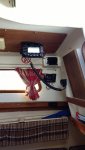
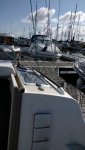
I'll try and put some pictures up but have to fiddle around re-sizing them (which I find challenging).
On both dual battery installations I installed a VSR set up to prioritise the starter battery till it was full and then charging the services battery. In practice, this is not really necessary because once the engine starts, the start battery is replenished in minutes.
Installing solar is really simple although it seems magical. Just look upon the panel as a source of charge.
 

Attachments

  • Resizer_16493171515453.jpeg
    Resizer_16493171515453.jpeg
    257.3 KB · Views: 78
  • Resizer_16493171369881.jpeg
    Resizer_16493171369881.jpeg
    295.8 KB · Views: 78
Last edited:
I've got that on my boat, and have only 1 reservation concerning it, and that's the durability of the USB port on the back. Mine was outside and didn't do well over the winter. I repaired it, and it's now in the cockpit tent, working happily from there. I would simply spray a little WD40 into it, were I to buy anew. Works very well.
 
That's ridiculously cheap if it's as advertised. I've ordered one anyway for my boat and, at £17.99, it won't be too much of a loss if it's naff.
I'd be a bit concerned that it's described as flexible panel. I've used semi flexible panel which have lasted well. They bend about 5° but the really floppy ones are too feeble for life at sea IMHO.
 
I know nothing about solar systems on boats (or off for that matter) and am very basic on electricity. I've tried reading quite a few of the threads on here about making and connecting solar charging systems and I'm very rapidly out of my depth completely. Please can someone help?
On my new berth I'll have virtually no access to shore power. There's a story behind that which I won't go into here but suggestions like move to another place won't be helpful.
So I need to keep my batteries charged. One house battery. One engine start. Simple set up I assume on my 26 footer.
I'm really not keen on fitting panels to hatch garage, spray hood, fitting a gantry etc etc.
Is it possible for me to have something I can rig up, put out, plug in whatever when I leave the boat? Or have up when I'm aboard. Take down quickly when going sailing. Put up if at anchor say. Something which will just trickle charge the batts while I'm away and not cause them to fry? Something quick, easy but effective and not a permanent fitting?
If so please can some tell me, in simple terms (no electrical sounding language) what I should be looking for and how to do it? Please?


On the assumption that you go sailing once or twice a week with the odd weekend thrown in. And that you use the engine a bit and it charges both batteries. And your house battery is a big un, c 100Ahr or larger.

...........then (as you have found) you don't need much at all. Nasa do a 10W panel that you can connect directly to your big battery and off you go. If you are using it as needed, it is convenient to plug it in via a cigar lighter socket below decks, then placing it in the best light.
With no controller, at the end of a sail I put a fabric cover over my little fixed panel if I know the battery is 100% rammed.

Eventually, as the other have said, you may find it handier to fix the thing. A 10W panel is not much over 1ft square so quite easy even on a small boat. I have seen them hanging on the guardwires with a simple system to prop them towards the sun.

.
 
Note that it is described as "slightly waterproof".
Suitable for a boat?

Indeed, also in one of the pictures there's some dimensions which would be impossible for a 100W panel. But it's a chinese site and the descriptions often are poor and if you paid with paypal it shouldn't be too difficult to get a refund. I have in the past bought stuff from gearbest, alibaba and banggood (which incidentally is not pornography) with no issues at all. I haven't seen this site before though...
 
I'd be a bit concerned that it's described as flexible panel. I've used semi flexible panel which have lasted well. They bend about 5° but the really floppy ones are too feeble for life at sea IMHO.
It won't be used at sea, just in the marina or the yard when we're away from the boat for several weeks at a time. £17.99? I'll take my chances! ?
 
Sticking with the thread, "Solar for dummies" I have just bought my first panel. Question is does it matter if my panel is not connected in the sun whilst I mount it and sort out the cable runs?
 
Top