
Shore power wiring

dolabriform

Well-Known Member
Joined
12 Sep 2016
Messages
1,917
Location
Kent
freewheeling.world
Hi all
I've had a problem with my shore power cutting out over the weekend, and took the cover off the consumer unit to test yesterday.
The RCD on the right is loose in it's mounting, and moving it causes the power to cut out and in again. I've bought a new one just in case it's not fixable, but the way the whole thing is wired seems screwed to me.

The red ( presumably positive ) cables are all connected to the N ( negative ) terminals, which would mean that the circuit breakers and RCD won't trip.
So I'm guessing it's a rewire job to do it properly, I'm just amazed that someone has done this.
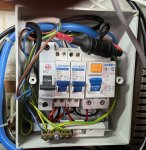
IMG_5026.jpg
 
Is the unit on your boat or part of the marina kit ? If the latter surely this is the responsibility of the yard/marina ?
 
Allied to this installation, does anyone know the correct BS/EN/ISO for shore power installations on European based boats? I know there is one, and it’s different to the US standard.
many thanks
 
Hi all
I've had a problem with my shore power cutting out over the weekend, and took the cover off the consumer unit to test yesterday.
The RCD on the right is loose in it's mounting, and moving it causes the power to cut out and in again. I've bought a new one just in case it's not fixable, but the way the whole thing is wired seems screwed to me.

The red ( presumably positive ) cables are all connected to the N ( negative ) terminals, which would mean that the circuit breakers and RCD won't trip.
So I'm guessing it's a rewire job to do it properly, I'm just amazed that someone has done this.

View attachment 133638
That looks criminal to me. I would not use that in a million years. Rip it out . If not sure get professional advice. Seriously! It is not just the RCD the whole box looks like an accident waiting to happen.
 
A Darwin Award Candidate - we don't see such obvious entries on here so often now !

If you have your mitts inside a 240V AC box and then refer to "(presumably positive) cables" and "N (negative) terminals" my advice is that perhaps you get your mitts out, get the cover back on and get someone out who understands what the N means on an AC installation (and also where the positive connections are !).

I know I am being blunt, but 240V AC in a seawater environment will kill, and in this instance the one device that might save you from your clear lack of knowledge is the subject of the opening paragraph of your post.

However, looking more closely the blue thicker cable I assume is the shore power lead connection, but what is obscured is what colour goes where onto the RCD input connections. The interconnects on modern wiring should be Blue for Neutral and Brown for Live, but the electricity does not itself care what the colour of the plastic cable covering is. Have you a photo of the blue arctic cable cores into the RCD ? If the Brown core is to the right and blue core is to the left then the connections are correct, just the local wiring inside the panel has used incorrect colours, and of further concern the out run neutrals all appear to be on the live side of the sub-breakers.

What does the black two core cable going through the fat black lump go to - it looks like it might entirely bypass the RCD ?
 
Last edited:
I once bought a boat where there was an automatic bilge pump linked to the 12v batteries, The cockpit sole leaked and the bilges would slowly fill with water.
There was a cable going to the mains on the pontoon which kept the battery charger supplied with power should the batteries powering the Bilge Pump be running below 12v
Somebody must have unplugged the mains plug for a short time and re-plugged it in.
The electrics in the boat did not re-set and the batteried did not receive a charge when needed.
Consequently the water level in the bilges rose higher, covering the starter, and rising above the dipstick level, thus filling the sump with water.
Of course I did not know all this when I bought the boat,
 
A Darwin Award Candidate - we don't see such obvious entries on here so often now !

If you have your mitts inside a 240V AC box and then refer to "(presumably positive) cables" and "N (negative) terminals" my advice is that perhaps you get your mitts out, get the cover back on and get someone out who understands what the N means on an AC installation (and also where the positive connections are !).

I know I am being blunt, but 240V AC in a seawater environment will kill, and in this instance the one device that might save you from your clear lack of knowledge is the subject of the opening paragraph of your post.

However, looking more closely the blue thicker cable I assume is the shore power lead connection, but what is obscured is what colour goes where onto the RCD input connections. The interconnects on modern wiring should be Blue for Neutral and Brown for Live, but the electricity does not itself care what the colour of the plastic cable covering is. Have you a photo of the blue arctic cable cores into the RCD ? If the Brown core is to the right and blue core is to the left then the connections are correct, just the local wiring inside the panel has used incorrect colours, and of further concern the out run neutrals all appear to be on the live side of the sub-breakers.

What does the black two core cable going through the fat black lump go to - it looks like it might entirely bypass the RCD ?

Seems unnecessarily abrupt.

240v AC will kill anywhere, not just in a seawater environment.
 
A Darwin Award Candidate - we don't see such obvious entries on here so often now !

If you have your mitts inside a 240V AC box and then refer to "(presumably positive) cables" and "N (negative) terminals" my advice is that perhaps you get your mitts out, get the cover back on and get someone out who understands what the N means on an AC installation (and also where the positive connections are !).

I know I am being blunt, but 240V AC in a seawater environment will kill, and in this instance the one device that might save you from your clear lack of knowledge is the subject of the opening paragraph of your post.

However, looking more closely the blue thicker cable I assume is the shore power lead connection, but what is obscured is what colour goes where onto the RCD input connections. The interconnects on modern wiring should be Blue for Neutral and Brown for Live, but the electricity does not itself care what the colour of the plastic cable covering is. Have you a photo of the blue arctic cable cores into the RCD ? If the Brown core is to the right and blue core is to the left then the connections are correct, just the local wiring inside the panel has used incorrect colours, and of further concern the out run neutrals all appear to be on the live side of the sub-breakers.

What does the black two core cable going through the fat black lump go to - it looks like it might entirely bypass the RCD ?

Far to kind ;)

As it happens I know exactly what I'm doing inside a 240v box and a 12v DC box.

My reference to the presumably positive was to the RED CABLE as this would normally be positive. I haven't done a full trace back yet, but at first glance it appears that this is the positive cable connected to a N terminal, though it's difficult to see until I can get to the top of the RCD to look.

The black 2 core is to a polarity indicator light. That comes off the input side of the RCD, so you can check polarity before switching on.

The output cables seem to follow the red / black connections logically, so it would indicate red is indeed positive, but some ( insert appropriate word ) has done a rather poor job of wiring this up.

I will be investigating further, belling out the connections to the shore power inlet to make sure the colours are correct, and then rewiring this monstrosity properly.
 
Last edited:
Far to kind ;)

As it happens I know exactly what I'm doing inside a 240v box and a 12v DC box.
But 240v AC does not have "positive" or "negative" terminals, as you described them.

Being alternating current the polarity of the current reverses 50 or 60 times a second,

I too was alarmed that someone who apparently didn't know this was messing around with their AC.
 
Hi, it looks like some person has wired their own unit. Most of us buy a “Garage” Unit pre-populated with a B6 and B16 MCB, RCD as a main switch or both. This includes the copper “comb” that cross connects all the breakers and makes wiring, the whole thing, much more straightforward. Ideally, installed with a schedule of test results and installation certificate/page (Basic reference info) for future use/reference. Not saying a full cert, but a page of notes on key information, dated and who did it.
 
But 240v AC does not have "positive" or "negative" terminals, as you described them.

Being alternating current the polarity of the current reverses 50 or 60 times a second,

I too was alarmed that someone who apparently didn't know this was messing around with their AC.

Yes, but neg is connected to ground at the substation , hence you really do want the circuit breakers etc on the live side.
 
Good lord, whoever thought that was a good idea needs to sued for gross incompetence.

If you are not sure with AC electrics get an electrician to do the job. Is that a DC fuse I seen in the box?

DC colour coding for the DC stuff and AC colour coding for the AC stuff, simples.
 
Good lord, whoever thought that was a good idea needs to sued for gross incompetence.

If you are not sure with AC electrics get an electrician to do the job. Is that a DC fuse I seen in the box?

DC colour coding for the DC stuff and AC colour coding for the AC stuff, simples.

Except black and red were standard colours for fixed AC wiring up until the standards changed in 2006, and the boat was made in 1999.
 
Top