Shock Cord Crimp/Ferrule?

scholar

New Member
Joined
29 Oct 2017
Messages
4
Visit site
Hello

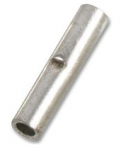
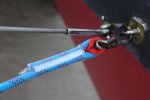
Does anyone know how I can replace the shock cord that ties down the oars on my old Quicksilver dinghy (when the oars are stowed). The existing shock cord is perished - it is 3 or 4 mm (maybe 1/8”) and the two ends are neatly crimped with a double-ended stainless steel ferrule that hides away in the plastic fitting.

I can find shock cord, of course, but cannot find any ferrules like this.
2012B423-DFCB-44B4-B26A-E1FB66E457EF.jpeg
 
Hello

Does anyone know how I can replace the shock cord that ties down the oars on my old Quicksilver dinghy (when the oars are stowed). The existing shock cord is perished - it is 3 or 4 mm (maybe 1/8”) and the two ends are neatly crimped with a double-ended stainless steel ferrule that hides away in the plastic fitting.

I can find shock cord, of course, but cannot find any ferrules like this.

View attachment 134928
Suggest either a whipping or a double fisherman's knot.

www.solocoastalsailing.co.uk
 
If you sew a mouse line to the end and then thread the connector up the mouse line - now stretch the cord - it will now be thinner. Size the connector so that its a snug fit when stretched. Slide on connector and compress preferably with an appropriately sized swaging tool. This also works if you want to whip. Simply stretch the cord between two 'strong' points - whip the thinned cord and when you release the tension you have very tight whipping. You can cut of one end to neaten it up and melt if necessary. Leave enough tail to the whipping to sew through the cord.

Then for complete belt and braces - cover your whipping with a swage, or shrink fit cover. The best shrink fit covers are marketed for rope, to cover splices, rather than electrical covers that are not as robust.

Clear Heat Shrink Tube - Glue Lined Dual Wall

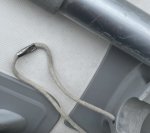
Not quite the same as bungy - but a similar result

IMG_4760.jpeg

This is professionally sewn - I hand sew (not quite so neatly :) ) and then also add a shrink fit cover. I remove the plastic thimble - its a waste of time.
Jonathan
 
Last edited:
View attachment 134964

This is professionally sewn - I hand sew (not quite so neatly :) ) and then also add a shrink fit cover. I remove the plastic thimble - its a waste of time.

Jonathan
I have used shrink fit sleeves on some loops. ie lazy jacks etc. But I do a full whipping. I do not see the point of sewing through the line in the way shown. It puts an uneven strain on both outer & inner sections & takes longer to do for no obvious improvement in result. Why would one do that I would ask?
 
I use these for bungee loops on our club committee boat. But then I do use a lot. A chandler may be able to sell you half a dozen & you can overlap the ends of the bungee & fix 3 .If you want you may be able to form 2 loops in the bungee at the base where it fits to the boat so that the upper section does not have the joint showing
crimps
 
If you sew a mouse line to the end and then thread the connector up the mouse line - now stretch the cord - it will now be thinner. Size the connector so that its a snug fit when stretched. Slide on connector and compress preferably with an appropriately sized swaging tool. This also works if you want to whip. Simply stretch the cord between two 'strong' points - whip the thinned cord and when you release the tension you have very tight whipping. You can cut of one end to neaten it up and melt if necessary. Leave enough tail to the whipping to sew through the cord.

Then for complete belt and braces - cover your whipping with a swage, or shrink fit cover. The best shrink fit covers are marketed for rope, to cover splices, rather than electrical covers that are not as robust.

Clear Heat Shrink Tube - Glue Lined Dual Wall

Not quite the same as bungy - but a similar result

View attachment 134964

This is professionally sewn - I hand sew (not quite so neatly :) ) and then also add a shrink fit cover. I remove the plastic thimble - its a waste of time.

Jonathan

This sewing is on one arm of a bridle, a snubber. The eye takes any tension in an anchor rode and is sewn right through to offer maximum strength for a potentially critical component (the back stop is the chain). The rope is a kermantle construction - its not a lazy jack. Its not my design - I don't think the stitching is long enough and on our snubbers/birdle I have the stitching over a longer length.

Stitching eyes are common place - a simple Google search throws up a number of examples, just one:

https://aspiringsafety.com.au/product/aspiring-stitched-sewn-rope-eyes-8mm-20mm/

I would never, ever, suggest whipping to form an eye on a bridle or snubber nor on any eye to be used in a critical a[pplication.

If there is knowledge at to how to splice an eye in Kernmantle - there are a thousands who would welcome the technology. You can use a knot, we have used a halyard knot - but they look clumsy..

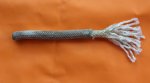
This is Kernmantle

IMG_4822.jpeg

But you do not need to learn to spice kernmantle - sewing as shown in the photo is common place - and if you have a friendly sailmaker or decent heavy duty sewing machine - its neither difficult nor expensive.

The image was to show a shrink cover, without the need for the introduction of the word 'anchor' into the thread.


I apologise for introducing some thread drift but for those critical of sewing an eye. Hopefully the drift has opened one or two of the minds of the luddites.

Stitching Instead of Splicing - Practical Sailor

The work has been done - no need to guess.

I was introduced to sewing braided rope by Pryde's in Hong Kong. They inserted sheets into hollow tape, a sewed the sheets into the tape. The tape then was cow hitched - and being tape was low profile and did not catch on shrouds or forestay. If sewing thought braided was good enough for N Pryde - it was cetasily good enough for us. We use the same technique now - updated as we sew through dyneema hollow tape with braided dyneema thread.

Take care, stay safe

Jonathan
 
Last edited:
Thank you for all the suggestions everyone - these were helpful in thinking it through.

I have decided to try to copy the original as far as possible, with:

- 4mm shock cord (thanks for the suggestion of fusing the two ends in the joint - I will try that; and

- a length of 6mm/0.5mm wall SS tube that I will cut to length and crimp in the vice with a suitable spike to copy the original crimping. I have various electrical crimps, but didn’t think these would be tough enough. [The tube is available on eBay, from China, so will take a month]

As far as I can tell, the dimensions of the above match the original pretty well.

I’ll see how it goes - its not safety critical, just a neatness thing ?

Cheers
 
Last edited:
Top