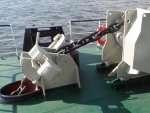
Ships' anchors

ISTR there was (a few?) thread touching on this somewhere in the dim distant past - a poster maintained that ships anchors were designed to drag and posted some links to back it up, maintaining the chain was designed to take the load or something like that. from memory one of the links went into design but said that it was not practical to have a ships anchor big enough to hold in severe winds, so they will drag & use engine power when the wind gets right up.
 
I had a mini stockless anchor (like a ship's) that I used for a dinghy. I have heard that stockless anchors can roll themselves out of the bottom and indeed I saw my dinghy anchor do this in sand. According to 'Knights Modern Seamanship' ships use greater lengths of chain than we might. For maximum holding, Knights quotes 64 fathoms when anchoring in 5 fathoms and 150 fathoms of chain when anchoring in 20 fathoms.
 
We have an anchorage off Newcastle that 'runs' parallel to the coast in the Tasman Sea. The ships are larger bulk carriers waiting to load coal to take to Asia: China, Japan, Korea etc. When winds are forecast to be over 25 knots they are ordered out of the anchorage (there is no shelter) - no exceptions - the last one to drag ended up on a Newcastle beach.

Really reiterating what GHA suggests: It merits note - ships don't anchor and the crew leave - they remain manned (and I assume they have some sort of anchor watch). I spoke with the Captain of a decent sized cruise ship who was forced to anchor in the Great Australian Bight when seas were forecast to be 11m off Cape Leuwin (his route took him into the prevailing winds on his way from Sydney to Perth. He simply anchored and planned that the ship would drift back on its anchor. He set perimeters and had the officers of the watch work within the confines of his perimeters by lifting the anchor, motoring forward deploying again etc. His greatest fear was that the pawl (not sure they call it a pawl) or chain lock might fail - which I found a bit of a worry - I'd have hoped it was man enough for anything.

I'm not sure how the passengers with cabins located at the bow reacted - it must have been a noisy night :(

Jonathan
 
With 11m seas, I wouldn't have though anyone was getting a lot of sleep!

Do ships have a positive locking device for the chain, or do they rely on the windlass brake? Also, do they have any sort of snubber? If not, I would think shock loads must be enormous in big seas.
 
With 11m seas, I wouldn't have though anyone was getting a lot of sleep!

Do ships have a positive locking device for the chain, or do they rely on the windlass brake? Also, do they have any sort of snubber? If not, I would think shock loads must be enormous in big seas.
Ship's windlasses do have positive chain locking devices. No they don't merely rely on the windlass brake. No, I've never known of a ship using a snubber. They do tend to anchor in deeper water than us, and so they benefit from the catenary of the chain. The circumstances to which Neeves refers, is ships anchoring in open sea conditions, with no shelter. Normally, ships, like ourselves choose more sheltered conditions in which to anchor. It would be extremely unusual for a ship to anchor, and then for the whole crew to go ashore. Recreational craft do so regularly, so requirements are very different.
 
Stemar

I obviously confused - the cruise ship took shelter in Esperance and anchored overnight. The 11m seas were at Cape Leuwin, SW corner of Australia, a mere 1,200/1,500 km further on from Esperance. Because the stop was enforced and the ship lost time the cruise ship operators decided, wisely, not to schedule further passage against the prevailing weather across the Great Australian Bight in winter. Anyone could have told them this.

We do get 11m seas outside Sydney Harbour in the Tasman. The last time I recall - about 3 years ago - a cruise ship was refused entry, the seas and wind would have been on the beam to enter the harbour, and the ship with a full complement of passengers had to weather the swells outside the heads (with lots of damage, balcony windows and furniture). It featured highly on the local news, lots of video.

The lock brake was a large steel rod that simply slotted into a link on the chain wheel - the anchor weighed in at 10t. The chain links were bigger than head sized, about 500mm and the 'wire' would be about 100mm.

I am not aware that any ship using anchors that size (and some considerably smaller) uses snubbers. I have seen snubbers used on Superyachts - I did ask a deckie why they were used - to reduce the noise of the chain grumbling on the roller was the answer - but they were short snubbers and would also take the load off the windlass. (though I was looking from the outside and they may have been attached to the windlass :( )

Taking up Norman's point - there is no shelter across the Great Australian Bight - or not that we would recognise as shelter. With 11m seas forecast ahead of you - you make the best of what you have (or go back) and wait till the conditions improve. Parts of our coast are very inhospitable.
 
Last edited:
Yes, the scale factors involved with large ships mean their anchoring system does not have much in common with our sized boats.
They tend to use poor anchor designs. Diving on the anchors of very large ships is not normally practical. They are anchored too deep, but I have occasionally dived on superyachts using similar designs and they don’t tend to work very well. This anchor is typical. It is on its side and is not holding. The anchor looks small in the photo but it was large (several hundred kilos?) :

S6JTppT.jpg


We have sometimes shared anchorages with large ships (although they will be anchored further out of the bay in deeper water) and have noted them dragging in conditions where we held fine. This ship re-anchored a couple of times. You can see conditions were not pleasant, but nothing a good reasonable sized anchor on our type of vessels would not be able to manage.
egszCHE.jpg


KsHCUKf.jpg
 
Last edited:
I have landed in a helicopter on a semi-sub in 11 metre seas in North sea. It was anchored, although using a complex system utilising a number of anchors. The experience remains with me: astonishing amplitude although a semi-sub damps much of the movement
 
I was thinking of snatch loads on large ships.

The environment is different for large ships - they tend to anchor in open roadsteads and are less, or not, subject to wind shear. The wind is steady. We anchor in sheltered places, as sheltered as possible (usually) and shelter then means the wind direction is dictated by the geography less than the wind direction - and shear develops when the steady wind from over the sea meets, any, land. We are thus subject to wind in often variable directions and sometimes bullets much stronger than the average windspeed. Ships thus lie to a constant wind direction and don't yaw about, as we might. Ships also lie to a single anchor, usually, and live at a slight angle to the wind. Ships do set twin anchors, in a 'v' for the same reasons we do - if the ship is veering, they might be anchored where islands cause shear, than they will (or can) use 2 anchors to steady the ship and reduce veering.

The other factor is the huge bulk of the ship - like a heavy displacement long keeled yacht - size is important. Its not as if ships are normally considered as flighty :)

Added to this - as Norman said - ships anchor in deeper water and are better able to take advantage of catenary.

None of this makes their anchors any better but they do use anchors that are much more accurately tested and many, or all the modern ones, are rated HHP, the same as a Delta, CQR and 'our' Bruce. Later versions of the Bruce (in commercial sizes) the Twin Shank are also rated SHHP, the same rating as Rocna, Spade, Excel, Fortress, Ultra and Supreme. Noting, of course, a Bruce will not fit in a ships hawse pipe. One reason commercial anchors are not as good as ours is because the designers are restricted - because they need to fit the hawse pipe. The overlap with design comes with the Danforth, as we and they use the design (and variants of it).

Though the Danforth gives the overlap in design our anchors diverged in design fairly early on with the introduction of the CQR, with the ballasted toe - which morphed into Delta, Spade and then Rocna + many others. Ships anchors also carry ballast, but on the heel (or crown).

Ships have the same problem as we do with anchors arriving at the hawse pipe in the correct orientation - and many ship's anchors, or the rode, incorporate a swivel. I have not checked but I think the AC 14, (a British Admiralty design) which seems to be current state of the art for commercial anchors, incorporates the swivel in the shank of the anchor itself.

The design perameters of commercial anchors and our anchors, the fluke/shank angle, the fluke/seabed angle the penetration or engagement angle are all the same - the designs of our anchors and ships anchors are all restricted by these same - and well researched restrictions. Our anchors and theirs are more similar than different - the big difference being that restriction imposed by the hawse pipe.

I don't have the reference to hand but the Classification Societies make it very clear - ships anchors are not carried to provide security in a storm - they are demanded to allow a ship to anchor prior to entering port etc - the fact they don't offer security in a storm is not unexpected. Mooringa for ships, in open roadsteads, do use conventional anchors, oversized, and commonly 3 of them and sometimes set in a tandem. But the moorings are sized for specific sizes of ships and, I imagine, are used by the correct sized ship.

Jonathan
 
Last edited:
Thin,

Good link.

I may not understand the detail but

If I interpret correctly the yawing, causing dragging, in the report is as a result of a single yaw. My interpretation of 'our' yawing is multiple yaws from side to side resulting, often, in snatch loads at the end of each yaw. Each successive snatch, and the snatch may simply be an increase in tension and not a catastrophic or significantly noticeable event, but each yaw is in a different direction, separated by a significant number of degrees.

I have measured the angle of the rode for the end of each yaw - and have a 60 degree difference from side to side (the alignment of the yacht is greater than this). The measurement is easy - but you need to have your anchor buoyed and simply measure bearings. You can measure the orientation of the yacht from its compass. I might add I have been in anchorages where the yacht, our cat, has yawed through 180 degrees - 60 is nothing!. Shore lines and anchors in a 'V' are but one answer. If your anchor is being tensioned alternately at a difference of 60 degrees with no snubber - then dragging should not be entirely unexpected. If you dive on your anchor and touch it in conditions where your chain is all off the seabed, so above 20 knots, and your yacht is yawing then you will find. disregarding any snatch loads at the end of a 60 degree yaw, the anchor is constantly twitching. If your anchor is buried the twitching is less, because the buried chain reduces transmission of the vibrations through the seabed, though the anchor still twitches. A twitching anchor will reduce the shear strength of the seabed in immediate proximity to the anchor. If your anchor is buried, prod it with a screwdriver - or long steel rod and simply hold the rod firmly on the fluke or shank - you will feel the twitches.

So for those that dive on their anchors - touch your anchor! You don't need to do it often and you will feel the difference between a well buried anchor and one one part buried.

As twitching is deleterious and a buried anchor more stable then small chain, no swivel and a deep set anchor (not a monster) will increase your security. There are number of options, power setting being another. But a snubber is also advantageous as it better accepts the constant energy development of the yawing (and hobby horsing) yacht.

Twitching is not an original study - the US Navy have spent considerable time on the topic - and was the prompt for me to look and snuggle up to anchors - eschewing the opportunity to take pretty pictures.

Jonathan
 
I spoke to a man who had been a deck officer on an aircraft carrier. He told me they 'always' dragged (presumably not in very quiet conditions) . A junior officer was permanently stationed at the bow to inform the bridge when dragging had gone too far, upon which they would steam forward and re-anchor.
 
I spoke to a man who had been a deck officer on an aircraft carrier. He told me they 'always' dragged (presumably not in very quiet conditions) . A junior officer was permanently stationed at the bow to inform the bridge when dragging had gone too far, upon which they would steam forward and re-anchor.

An aircraft carrier would have incredible 'windage' creating huge forces and causing drag. A Merchant vessel on the other hand is much less windage and therefore able to hold anchor position better. On various tankers - I've held position in near gales ...

Earlier a question was raised about how the 'chain' is made secure ...

When anchored - last action is to ease the chain till a 'flat' occurs just before the roller at the 'hawse pipe' - then a Deadman - a solid pivoted block is dropped into place that mates with a U form other side. It is NOT pinned - unfortunately some less experienced crews have been known to pin it in place - causing untold damage ...
The chain is then held by the windlass with the Deadman providing the insurance.

When anchor is stowed - the deadman again is dropped into place - but often it doesn't sit into a flat ... Next wire strops are passed through the last link / shackle that can be got at at the Hawse pipe and then large bottle screws used to tighten the V of strops as insurance. Windlass again being the main holder.
The Hawse then has metal plates slid over and on older vessels bundled waste cotton and cement applied over the plates if a long voyage.

I would show all this IF Photobucket was sorted - but unfortunately PB still hasn't sorted out its server crash.
 
You would expect the holding area of the anchor to increase as the square of its linear dimensions and the wind pressure on the ship to do much the same. On the other hand, the ship's displacement would cube, so that, taking into consideration the other factors already referred to, the situation must be very complex. I imagine that standards are derived from experience rather than theoretic considerations.
 
The windlass will hold the chain once the anchor is set-----a bit like putting your auto gearbox in "park" but the brake is used to stop too much chain running out while anchoring. One potential problem is overheating and brake fade which can result in the entire chain running out. If there is too much energy built up it can pull our the stopping bar in the chain locker and you lose it.
 
Top