
PabloPicasso
Well-Known Member
Is it better to shackle the halyard to the mainsail, or use a knot?
What are the advantages and disadvantages of each method?
What are the advantages and disadvantages of each method?



I have not removed the halyard on my last two boats. I use a knot and re-tie it to more the wear spots every 2-4 years. The halyards were tensioned in such a way that they did not slap. On one boat I spliced to the sail (Dyneema halyard), but the halyard did not come off for years at a time and I could make the splice in a few minutes. As with the knot, I liked moving the wear (clutch and sheave) zones.Shackle as it is normal to remove the halyard when the main is stowed. The shackle may be attached to the halyard with either a knot (my preferred method) or spliced.
... unless, in a rush, the shackle does not close properly, is not tightened properly and so forth, depending on the style.As per @Poignard - wichard shackle spliced to the halyard. Simple, neat, zero muck-ups possible.

You could add a simple soft shackle, or a dog bone to the available methodsIs it better to shackle the halyard to the mainsail, or use a knot?
What are the advantages and disadvantages of each method?
 The dog bone minimizes the necessary distance between the headboard and the halyard sheave.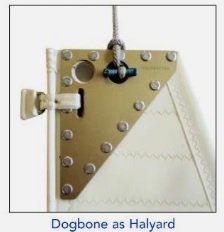


More than one way to skin a catWell, it seems that there is more than one way to hoist a sail.
Actually, I am not so surprised.


I have never marked the halyard with my single line reefing. I never let a bunch of halyard off to reef but let it off slowly as I reef the sail down. I am always looking up at the sail so I have 2 bits of tape on the mast for 1st and 2nd reef. Just before the batten reaches the mark on the mast I lock the clutch & wind the batten down to the mark & the correct tension is applied. That way I am looking at the sail & the halyard has been fed out neatly.Both are fine.
Shackle gives you the advantage that the rope is always in the same place, so you can mark the halyard to be able to quickly go to repeatable settings. Useful for either performance or single line reefing.
Sailed for years and years on Dad's boats with single reefing. Take the time to mark the halyard and reefing was simple, even in the dark. Ease halyard down to mark whilst pulling through reefing line by hand, lock clutch, wind on reef line.I have never marked the halyard with my single line reefing. I never let a bunch of halyard off to reef but let it off slowly as I reef the sail down. I am always looking up at the sail so I have 2 bits of tape on the mast for 1st and 2nd reef. Just before the batten reaches the mark on the mast I lock the clutch & wind the batten down to the mark & the correct tension is applied. That way I am looking at the sail & the halyard has been fed out neatly.


