Servicing winches - excessive grease?

Do the below look excessively greased, please?


T5rnsBl.jpg
G4yjqW7.jpg
82u3gty.jpg
2Q0ENkG.jpg
RtHQnHB.jpg


Related previous thread for those who missed it: Barient winches: 28 vs 28+ models - what's the difference?
Any that gets on the deck is definitely excess....
 
One lesson I have learned is that when lifting the drum off, put a hand underneath. Otherwise the bearings that are between the drum and the spindle drop out unexpectedly and may bounce off the deck into the water. Ask me how I know!

TudorSailor
 
Roller bearings used in an application where rotational speeds are low do not need any lubrication, unless to inhibit corrosion. In fact the presence of oil or grease can prevent their correct function by permitting skidding. This in turn can lead to flats being formed on the rollers and then they certainly won't roll. Compared to the roller bearings in, for instance a car's transmission, the winch bearings are fairly soft. This is because they are manufactured from corrosion resistant materials which are generally incapable of being hardened to the requirements of those in a car's gearbox, which is a very different environment, where oil or grease is necessary to dissipate heat and prevent corrosion.
The Lewmar video is IMHO a very good demonstration of the maximum amount of lubrication that could be applied to a winch.
Mike
 
The video has completely changed my idea of 'lightly greasing'!
I have to say that it reassured me - I found the video a few years ago with a new to me boat as was struggling to get the drum off and thought i had missed something so watched the video to ensure i wasn't being an idiot. ( I wasn't in this case!!) Without seeing this i would have over greased
 
I have to say that it reassured me - I found the video a few years ago with a new to me boat as was struggling to get the drum off and thought i had missed something so watched the video to ensure i wasn't being an idiot. ( I wasn't in this case!!) Without seeing this i would have over greased

I do hope you are not doing as he did because you will end up with zero grease. He's demonstrating a method, not doing the actual job.
 
Well, thanks for the thread, it reminded me that my winches were due a bit of TLC. Three 50 year old winches in Tuphnol(?) and bronze - Barton? They turn a lot easier now, with a firm click as the pawls go over the ratchet teeth. I even managed to get the pawls in the right way round after a couple of tries! The hard bit was getting the old grease out with white spirit (all I had) and a toothbrush
 
Well, thanks for the thread, it reminded me that my winches were due a bit of TLC. Three 50 year old winches in Tuphnol(?) and bronze - Barton? They turn a lot easier now, with a firm click as the pawls go over the ratchet teeth. I even managed to get the pawls in the right way round after a couple of tries! The hard bit was getting the old grease out with white spirit (all I had) and a toothbrush

It made me sort mine as well .....

I did have to fashion a DIY spring though as one did a WHEEEEEEEE I'M FREE !!

Must get round to ordering a packet of springs.
 
Reason for not smothering in grease .....

Grease captures and holds salt / crud / any grit and can actually lead to it doing damage. Light smear is less likely to do that. Second - the excess actually never does anything except just be excess !
Doesn't seem to make complete sense. I would expect a greased surface to trap grit etc, and that to be independant of the grease thickness. IOW I wouldnt expect thicker grease to trap much more

OTOH once its trapped, thicker grease might tend to dilute the grit a bit and render it less damaging.

OTOOH, the old hard grease was a pain to remove, so I didn't put very much back on the two old Tuphnol/bronze ones I did this afternoon, but I supplemented it with PTFE thread tape wrapped around the central pedestal. These winches didnt have roller bearings, just this plain bearing surface.
 
Doesn't seem to make complete sense. I would expect a greased surface to trap grit etc, and that to be independant of the grease thickness. IOW I wouldnt expect thicker grease to trap much more

OTOH once its trapped, thicker grease might tend to dilute the grit a bit and render it less damaging.

OTOOH, the old hard grease was a pain to remove, so I didn't put very much back on the two old Tuphnol/bronze ones I did this afternoon, but I supplemented it with PTFE thread tape wrapped around the central pedestal. These winches didnt have roller bearings, just this plain bearing surface.

a. The Harken video is funny as a reference since he doesn't apply any. Basically meaningless, other than to imply you don't pack it in.

b. The real reason not to over-grease is that the excess will spread, get on the pawls, and they will hang up and not work. This can cause both spinning in reverse and also cause serious damage when they only half-engage.

Unlike a wheel bearing, where the grease can partially melt and redistribute, winch grease stays where you put it. Once it squeezes out it's just mess, making the next cleaning harder. Other than a coating, extra isn't useful. It does not dilute grit or protect the bearings. It's just extra. Most likely, the small amount of excess in the first image didn't hurt a darn thing other than the viewers' eyes, but it was excessive.

Do most people really service the winches every year? As if ....

---

But yes, these threads bring out the OCD.
 
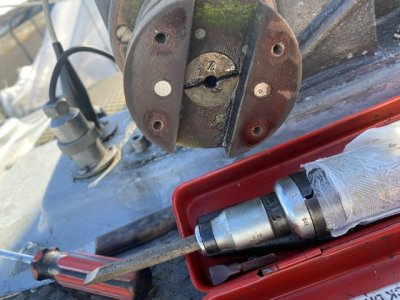
Tuphnol/bronze Sheet winches were simple and came apart easily, causing me to approach the on-mast halyard winch with confidence which appears to have been missplaced. The last 1 out of 4 screws holding the top plate on yielded to an impact driver, (
which surprised me since I thought Tuphnol might absorb the shock) but what lies beneath is disturbing, since it seems to need The Mother Of All Screwdrivers for the big slot, but also has a small chewed and very chewable grub screw. Having a tea break to stop me breaking it. THink Ill douse in WD40 and put it back together for now.

Tricks?91B68CAE-FBA6-4A32-BD0D-34CCDA67120A.jpeg
 
Top
