Seago vs Ocean Safety Liferafts

Did you have a valise or a canister and how much of an issue to repack I'm thinking of tackling this myself.
I repacked an ocean safety 6 man into a cannister. I used one of those large vacuum bags for storing stuff under the bed... I think the secret is to vacuum the raft down and then to fold carefully...
 
There are pitfalls. I tried to fire my Plastimo, the painter stuck. The painter was linked to the bottle lanyard through the vacuum bag. The bottle lanyard was too long, so the painter pulled the bag against the inside of the canister, the raft didn't fire until I cut it open and pulled the bottle.
 
Hi all, fully qualified liferaft service engineer here. I'll be honest there isn't a lot really to choose between the different rafts these days. You could have an Ocean Safety, Seago, SEA-AIR, Lalizas all sat next to each other and barely tell them apart. Occasionally we might get in a +15 year old Seago G series raft (which Seago instructs must be withdrawn from service) and we find them to be in very good condition. Ocean Safety generally make high quality products and the rafts will have decent flares, torches, bellows and components supplied by the likes of Leafield. Asking Seago vs O/S (for rafts anyway) is a bit like asking Ford vs Vauxhall IMO.
 
Hi all, fully qualified liferaft service engineer here. I'll be honest there isn't a lot really to choose between the different rafts these days. You could have an Ocean Safety, Seago, SEA-AIR, Lalizas all sat next to each other and barely tell them apart. Occasionally we might get in a +15 year old Seago G series raft (which Seago instructs must be withdrawn from service) and we find them to be in very good condition. Ocean Safety generally make high quality products and the rafts will have decent flares, torches, bellows and components supplied by the likes of Leafield. Asking Seago vs O/S (for rafts anyway) is a bit like asking Ford vs Vauxhall IMO.
Can you confirm how a raft being serviced is inflated? Is it through the top-up valves or is via the hose which connects the tubes to the bottle?.
 
Can you confirm how a raft being serviced is inflated? Is it through the top-up valves or is via the hose which connects the tubes to the bottle?.
I always inflate through the hoses/t-junctions to check correct inlet valve opening and reseating. Pressure readings usually through the topping up valves inside. Accidental inflation could be due to a very sharp drop or somehow pulling the entire length of painter line.
 
I always inflate through the hoses/t-junctions to check correct inlet valve opening and reseating. Pressure readings usually through the topping up valves inside. Accidental inflation could be due to a very sharp drop or somehow pulling the entire length of painter line.

Thanks for that info.

I once tried to inflate an ocean safety raft via the hose as you described. Only one tube inflated. I took the valve apart, it seemed to have been assembled incorrectly. It inflated fine afterwards and stayed up for ages.

Have you ever come across this.?

Surprisingly the raft had been serviced twice by different stations...

the first were complete cowboys who had sold me the raft as being brand new...(even though it had been serviced and rolled up in a bit of old plastic.)

The second company repacked it without the protective foam, so the vacuum pack wore through, they put in old batteries that would have expired before the next service date...(they cut the dates from the packages, but the manufacturer were able to track the batch numbers)
 
Thanks for that info.

I once tried to inflate an ocean safety raft via the hose as you described. Only one tube inflated. I took the valve apart, it seemed to have been assembled incorrectly. It inflated fine afterwards and stayed up for ages.

Have you ever come across this.?

Surprisingly the raft had been serviced twice by different stations...

the first were complete cowboys who had sold me the raft as being brand new...(even though it had been serviced and rolled up in a bit of old plastic.)

The second company repacked it without the protective foam, so the vacuum pack wore through, they put in old batteries that would have expired before the next service date...(they cut the dates from the packages, but the manufacturer were able to track the batch numbers)
I did have one raft in for service around 18 months ago which refused to inflate through the hoses. The source of the problem was incorrect length springs fitted to the inlet valves, no amount of air/gas pressure would be able to lift the diaphragms off their seats. Generally rafts are very reliable these days and you can have confidence buying from any major manufacturer - just make sure that they are serviced at recognised stations (preferably MCA approved) at the stipulated intervals.
 
............. just make sure that they are serviced at recognised stations (preferably MCA approved) at the stipulated intervals.
When my Seago reached its 12th birthday I opened it and inflated it. The raft had been serviced at the prescribed 3 yearly intervals by an MCA and manufacturer approved service organisation. Inside I found out-of-date seasick pills and out-of-date hand flares, admittedly not by more than a couple of months, but definitely passed their expiry date. The explanation from the service station was that with a 3 year service interval and the short lives of the flares and pills it was impossible to always achieve in-date items at the end of the in-service period. I smelt bullshit but did not take it further.
I am sure both the pills and flares would have been fine but how far does the adherence to date limits go with a box that 99.9% of owners will never see inside?
 
When my Seago reached its 12th birthday I opened it and inflated it. The raft had been serviced at the prescribed 3 yearly intervals by an MCA and manufacturer approved service organisation. Inside I found out-of-date seasick pills and out-of-date hand flares, admittedly not by more than a couple of months, but definitely passed their expiry date. The explanation from the service station was that with a 3 year service interval and the short lives of the flares and pills it was impossible to always achieve in-date items at the end of the in-service period. I smelt bullshit but did not take it further.
I am sure both the pills and flares would have been fine but how far does the adherence to date limits go with a box that 99.9% of owners will never see inside?
We always try to ensure that all dated items will last the full duration of the certificate issued (normally 3 years, 1 year for SOLAS compliant). On occasion this isn't always possible especially in the current climate with ongoing issues with supply chains. Be assured that exceeding the expiry dates is something the manufactures factor in. Sometimes we will reduce the time to the next service in agreement with the customer. You would be surprised just how many people don't even bother with raft (or lifejacket) servicing, even the commercial guys need an occasional nudge by the MCA to get their stuff surveyed and tested.
 
We always try to ensure that all dated items will last the full duration of the certificate issued (normally 3 years, 1 year for SOLAS compliant). On occasion this isn't always possible especially in the current climate with ongoing issues with supply chains. Be assured that exceeding the expiry dates is something the manufactures factor in. Sometimes we will reduce the time to the next service in agreement with the customer. You would be surprised just how many people don't even bother with raft (or lifejacket) servicing, even the commercial guys need an occasional nudge by the MCA to get their stuff surveyed and tested.
I wouldn't be at all surprised! It is a thankless and expensive task keeping safety gear that has an almost zero probability of being used in date. Those who race don't have the luxury of letting it slide if their gear is inspected. One day out of date and that's it. Cruisers are only guided by their consciences - and not all have very strong ones.
 
Hi all, fully qualified liferaft service engineer here. I'll be honest there isn't a lot really to choose between the different rafts these days. You could have an Ocean Safety, Seago, SEA-AIR, Lalizas all sat next to each other and barely tell them apart. Occasionally we might get in a +15 year old Seago G series raft (which Seago instructs must be withdrawn from service) and we find them to be in very good condition. Ocean Safety generally make high quality products and the rafts will have decent flares, torches, bellows and components supplied by the likes of Leafield. Asking Seago vs O/S (for rafts anyway) is a bit like asking Ford vs Vauxhall IMO.

Thank you Helidan. Your opinion as a life raft servicer is especially valuable. I made my original post because the Seago is circa £900 and the Ocean Safety is circa £1800. From the responses posted here, it seems like there’s absolutely no good reason to spend double on the Ocean Safety version. I’m getting the Seago!
 
I did have one raft in for service around 18 months ago which refused to inflate through the hoses. The source of the problem was incorrect length springs fitted to the inlet valves, no amount of air/gas pressure would be able to lift the diaphragms off their seats. Generally rafts are very reliable these days and you can have confidence buying from any major manufacturer - just make sure that they are serviced at recognised stations (preferably MCA approved) at the stipulated intervals.
Well if the raft you found to be faulty was assembled by a major manufacturer and it could not inflate, confidence may be misplaced.

I bought a 3 year old Seago which I am dithering about leaving sealed, opening up and test inflating via the hose. Giving to a service station parting with half the price of a brand new raft and hoping that they will do their job properly.
 
Seago just quoted me £299 + £35 carriage for 1st service on a 4 man valise LR. They advised getting it booked in quickly as they are snowed under.
I tried 2 other local service centres who seemed cheaper but it seems nobody else deals with Seago. So I'm locked in.
If you read the manual that comes with the seago you will see that you are entitled to discounts on the first 3 services if you register it within 30 days of purchase
 
I have just been having a look at my Seago Raft. I bought this secondhand and it is still packed with a lead/ seal in place. Albeit the vacuum seems to have escaped (if that is what vacuums do).

Through the velcro flap at the side I was looking at the painter and it's connection to the raft.

It seems the trigger mechanism is within the vacuum bag, with a button on the end of a wire. This wire /button is held in the jaws of a bracket which is then tied with a strop, to the painter so that the raft will trigger when this short strop is pulled.

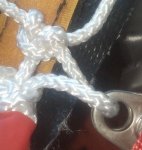
The knot where the strop is attached to the bracket was loose and instead of something like a bowline with a stitch or tape to secure it, it was just two hitches around itself so that with any pressure it simply slipped and had no possibility of activating the raft...

I suggest anyone with a Seago Raft should have a peak at what is behind the velcro flap.IMG_20220228_173107.jpg
 
Top