Seacock on engine exhaust

webcraft

Well-Known Member
Joined
8 Jul 2001
Messages
40,410
Location
Cyberspace
www.bluemoment.com
.
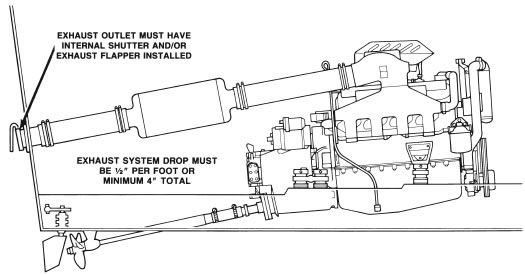
Avy-J has quite a long overhang at the stern with the engine exhaust exiting just above the waterline. There is a seacock, (gate valve, seized in the open position but otherwise looks OK). There is a gooseneck with the loop coming up to just below deck level.

exhaust.jpg


I assume the seacock was fitted so it could be closed in the event of big following seas that could perhaps flood the engine, thoguh it is hard to see how the water would get up and round the gooseneck. Perhaps the overhang and the exhaust exit angle means a lot of pressure can build up in the right following sea conditions?

Should I leave it, dispense with it or replace it? And what would be an indication that it was time to close it?


- W
 
These have gone out of fashion since waterlocks and high swan/goose necks (always wondered whether swan necks have higher status given the royal connection!) effectively prevent water flowing back into the engine. If you do want to keep it suggest you replace with a ball valve and shut it when you are offshore and just sailing - remembering of course to open if you need to start the engine. Personally I would either leave it seized open or get rid of it.
 
An exhaust exit like that can be subject to a lot of instananeous pressure if the stern 'slaps' on wash, even when moored.
A waterlock does not prevent the exhaust filling with water, it merely means quite a lot of water and a bit of pressure is required.
If you ever moor your boat where every passing vessel causes the stern to slap, you might like to close the seacock.

If the hose ever fails you will definitely want to close the seacock.

I personally know tow people who've lost engines to following seas despite having the same swan necks andwaterlocks as the rest of us.
I think the moral is to start your engine at least twice a day in those conditions. Or sail faster perhaps.
 
My exhaust exits the side of my boat and I do have a large ball valve at the top of the gooseneck.

I some times careen my boat for a scrub and close the seacock to prevent water inflow.

I can also close the seacock if I leave my boat in a remote location to prevent the engine being started as no one will know or find the exhaust valve,
 
Webby, some of the smaller Rivals suffered from water ingress via the exhaust. The issue appears to caused by momentum and less to do with pressure. As the yacht pitches water starts to slosh back and forwards and at certain pitch rates overcame the water trap. The problem was exacerbated by a long longitudinal run before the small swan neck (Tranona cracked joke, very good).

My boat has a gate valve, large at 4” NB, I have no idea how old the valve is but it is still working today with no maintenance beyond the odd open and closing. I don’t lose it because I have a very high swan neck.

Your own set up does sound quite similar to the smaller rivals that did not have a high gooseneck. I suggest you get a working valve if going southwards on long runs. I can imagine a situation where the yacht deacelerates, the stern is picked up on the next wave and the water sloshes forward and a small amount over tops, repeat for a long duration and you end up with a water locked engine.
 
.
I've bitten the bullet and fitted a new seacock, a ball valve - although I have also been told that this is not ideal for an exhaust as if the engine overheats (eg no water) for any length of time it is possible to melt the nylon lining. This could cause the seacock to fail to operate, but at least it would seize in the open position in this situation.

It is also quite difficult to get at so will need a bit of preparation when the lazarette is full of cruising crap. Good idea to shut it at the start of a long downwind run, methinks - and it is easier to get at to open again than it is to close, so not too much of an issue in the event of needing a rapid engine start.

Will probably never use it , but it's there now.

- W
 
That might be possible, but not easy - and would you ever be sure it had in fact operated?

I think there is room to put a wee hatch in to reach it through.

- W

Could you get an electrically operated one that will open when you turn the ignition?

I can't say I've seen them in large enough sizes and in DZR though, but it would be flash if you could fit one and get it working.
 
Some years ago, I had a similar worry, and bought an exhaust "check valve" from ASAP (51mm), but never got around to fitting it before I sold the boat. It is still in my workshop somewhere, never been used. I have just looked up the latest price on the ASAP website, and I'm shocked to find that it's over £100 !
I will put it in the "for sale" section here immediately if anyone is interested at £40 inc postage.
 
Last edited:
.

It is also quite difficult to get at so will need a bit of preparation when the lazarette is full of cruising crap. Good idea to shut it at the start of a long downwind run, methinks - and it is easier to get at to open again than it is to close, so not too much of an issue in the event of needing a rapid engine start.

Will probably never use it , but it's there now.

- W

You could put a second seacock somewhere more accessible, between the water trap and exhaust outlet, perhaps? That would prevent the backfilling towards the engine, leaving the one on the outlet just in case you ever get a detached exhaust hose.
 
Well, by the time we got to Cascais the engine was full of water and essentially scrap. Turns out the exhaust system was very poorly designed, though the final straw might have been prolonged cranking with the inlet seacock open and the decompressors open.

Currently in the process of replacing it with a Beta, with a high rise exhaust elbow, bigger waterlock and 8" higher gooseneck. Going to remove the seacock on the outlet.

- W
 
Sorry to hear that webcraft, exhaust systems the main downfall of most marine engines unfortunately.

Many water locks incorporate a drain. Both Vetus and halyard do. So it’s possible to use this to periodically reduce the water in the lock. - very commonly used on motor yachts going on transport or on ships as deck cargo.

Can be worth opening it if you expect the exhaust is gathering water.
 
I've known of a couple of engines lost to following seas shoving water up the exhaust.
I think some boats need a non-return flap valve somewhere in the system.
Or a seacock.
I'm not sure opening the little drain on aVetus waterlock will do much other than slowly fill the bilge.
 
A motorboat I used to work on had a flap on the exhaust fitting, a bit like the kind of thing you get on top of a tractor exhaust. When burbling at idle it made a pleasant soft "clang clang" noise. I've never seen one fitted to a yacht, is there a reason it wouldn't work?
 
A motorboat I used to work on had a flap on the exhaust fitting, a bit like the kind of thing you get on top of a tractor exhaust. When burbling at idle it made a pleasant soft "clang clang" noise. I've never seen one fitted to a yacht, is there a reason it wouldn't work?

It really depends on if the engine is above or below the waterline and if a high enough swan neck can be fitted at the exhaust exit.

inlinemufflers.jpg
 
Top