Sea/Land breezes?

C08

Well-Known Member
Joined
8 Feb 2013
Messages
3,962
Visit site
I have been sailing long enough to know this but I am not sure. My question is how big an island has to be to be able to stimulate land or sea breezes> Specifically thinking about the channel isles?

 
I’d expect Herm and Sark to be too small, and probably Alderney too. Jersey and Guernsey may well generate a sea breeze, provided you’re on the right bit of coast for a gradient wind to help.
 
I think the answer is "it depends". You can see VERY local expressions of land/sea breezes if there is a very great difference in surface temperature - I've seen it over a narrow country road I'm the Fens, where the black tarmac gets much hotter than the neighbouring ditches. And that's the mechanism of land/sea breezes - during the day the land heats up more than the sea, so air rises over land, and is replaced by cooler air from the sea, and vice-versa at night, when the land cools faster than the sea. However, the extent of a land/sea breeze can't extend much further offshore than the dimensions of the landmass, so the land/sea breezes of a small island won't extend very far and will be much weaker than those of a larger landmass.
 
There have been some very unusual winds and very light in the Solent recently - I put it down to the forecast NE 'fighting' the S (ish) sea breeze. I had become used to the prevailing SW being supplemented with a sea breeze making decent sailing on many afternoons over the last couple of seasons.

Has my theory got any legs or is that BS?
 
I’d expect Herm and Sark to be too small, and probably Alderney too.

I doubt it. I used to sail a dinghy on a sheltered stretch of a narrow river, and on windless summer evenings could sail - albeit at a very slow pace, generally just about winning, but intermittently losing, against the current - on the rivers edge with the faint breath of air created by the banks being hotter than the seemingly quite warm water in the river.

So I'm pretty sure that in still hot weather you'd sometimes have enough wind to sail adjacent to an island the size of Alderney, and quite probably ones the size of Herm and Sark.

With those particular islands, because of the strength of their tides and proliferation of rocks, personally I wouldn't want to be dependent on it, though! :D
 
I guess it is all relevant land mass size and temperature to wind strength generated. Our gliding enthusiasts will pick up rising air from some item of the ground that is hot (large rock area for instance and get a lift from it. That lift must generate a local inrush of cooler air. albeit small and local.
Here in West oz with a near north south coast and hot summers the sea breeze is very consistent arriving around 1300 every day and consistently 15 to 18 knots from South west. (remarkably consistent direction) Rottnest Island about 10 by 19kms sits in this sea breeze (20kms off coast) but does not seem to affect it at all.
Each evening around 0100 the land breeze sets in from North West gentler than sea breeze but consistent. dies out by 1000. Wind is esentailly blowing from the cool sea to hot land in day time from cold land to warm sea at night. These breezes extend 100km or more inland each day. (the shift left of the wind direction is caused by corealis effect. ) ol'will
 
The UK mainland can generate enough sea breeze to blow 10 or 20 miles inland, I think. Maybe 30 or 40 miles but I doubt more than that,

If flying paragliders in a nice northerly wind at Devil's Dyke, 5 miles from the Brighton coast, then it's quite common for a sea breeze to come in that far and blow over the back of the hill. Fliers are grounded for the day, perhaps able to launch at south-facing Caburn, unless they're able to climb out in the convergence. I did this once and a hang-glider plot told me the next day that he'd got some distance by following the convergence inland.

So I would have thought small islands like the Channel Islands (or islands of Brittany) would not create significant enough sea breeze to affect the geostrophic wind.
 
Great question. As hinted at above, even small islands will have small sea breezes early on (say 1100-1200h), but the local breeze will be overcome by the geographically “larger” sea breeze if there is a nearby mainland coast. Hence the Rottnest Island example. (It would be interesting to see if Rottnest behaves as I describe - ie with its own little sea breezes early on.) The small sea breeze of a small island will also be inconsistent, as the rising air doesn’t rise in a consistent mass but rather in ‘bubbles”.
An excellent book was “Wind Strategy” by David Houghton
 
I don't know the answer, but sailing in the Western Solent on days with little prevailing wind I've often experienced a 'better' wind closer either to the mainland or to the island, mid-channel being the calmest and most fickle. (Yes I'm aware of the effects of tide and back-eddies, but this has been real wind having an effect on the sails not induced wind.)

In general, it surely depends on which is the dominant force - an established sea breeze on a day with little force in the prevailing or a stiff prevailing wind overwhelming local effects - and that, ignoring topography and other complicating factors like elevation etc, the smaller or narrower the land-mass the weaker the sea breeze is likely to be.
 
I guess it is all relevant land mass size and temperature to wind strength generated. Our gliding enthusiasts will pick up rising air from some item of the ground that is hot (large rock area for instance and get a lift from it. That lift must generate a local inrush of cooler air. albeit small and local.
Here in West oz with a near north south coast and hot summers the sea breeze is very consistent arriving around 1300 every day and consistently 15 to 18 knots from South west. (remarkably consistent direction) Rottnest Island about 10 by 19kms sits in this sea breeze (20kms off coast) but does not seem to affect it at all.
Each evening around 0100 the land breeze sets in from North West gentler than sea breeze but consistent. dies out by 1000. Wind is esentailly blowing from the cool sea to hot land in day time from cold land to warm sea at night. These breezes extend 100km or more inland each day. (the shift left of the wind direction is caused by corealis effect. ) ol'will

and on the other side of the same island, on which William_H resides, and with a similar NS, also very long, coastline the timings are similar, except the breeze is a North Easterly and can be much stronger. Oddly, or not, we don't have many, almost none, offshore islands.

We also have a warm water current, the East Australian Current, that flows south from the tropical north with its impact becoming negligible off the east coast of Tasmania. The current can flow at 5 knots.

Plan carefully when heading south and passage times can be exceptional - with the converse being frustrating.

It is luck to enjoy the best of both effects as the Seabreeze is beneficial closer to shore and The Current at the 100 fathom line.

Jonathan
 
I had intended responding to the OP and am surprised that I have not.


First, i nave seen much crap in textbooks about how the sea breeze forms. It is NOT caused by convection leading to an inflow of air as in geography textbooks. The sea breeze causes the cloud rather than vice versa. See my site or Reed’s Weather Handbook. Coriolis is another on which Yachtie articles and books give you garbage.


There is no definitive answer to this one. Any size of land will heat up in the sun and so result in a local effect on the pressure. Whether this causes an observable onshore wind which then veers (backs in Oz) will depend on both large and small scale effects. It is better to talk about the sea breeze effect rather than a sea breeze. For the W arm of the Solent, strong heating over the mainland towns can reverse a morning NE F3/4 to a SW F3/4. But, along the N coast of the IOW, heating over the island can reduce pressure there and cause a weaker SW than further out to sea.


The classic sea breeze veers but the sea breeze effect can cause a backing. Down the Portuguese coast, the predominant winds are N’lies, Portuguese Trades. Over night cooling leads to an offshore component - land breeze effect. By day, the land heats up, the Spanish heat low deepens and the wind over the sea becomes onshore. Going down that coast, we used to fly the kite until about midday but then drop it around noon and gybe to starboard.


More interesting is how far the sea breeze extends out to sea and inland.


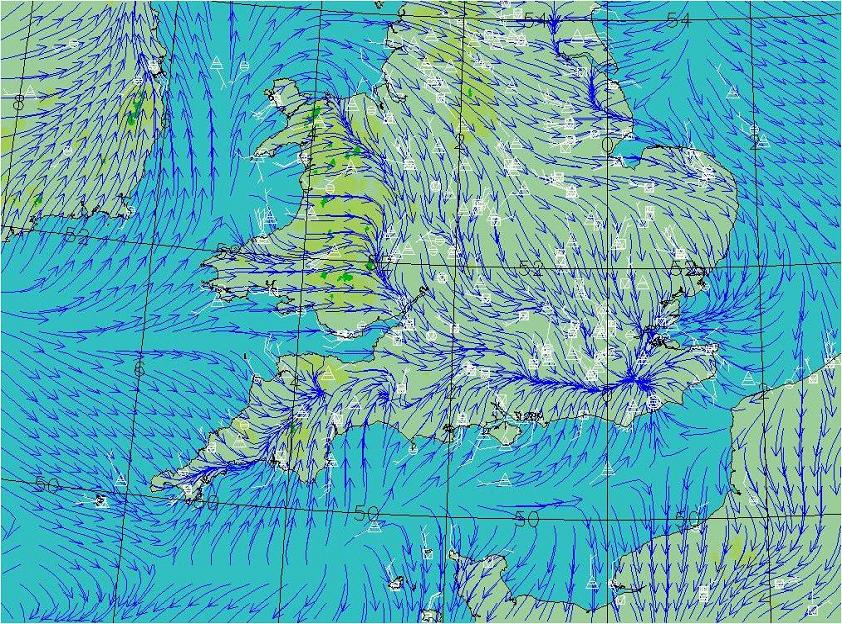
sea-breeze-large.jpg


I got this several years ago from a Met Office contact. It was a hot day with little gradient wind.The sea breeze effect went halfway across the Channel. During my time in Aden in the 60s, we saw sea breeze effects 100 miles offshore up the Red Sea. Working at Porton Down in the mid 50s we were setting up an experiment to measure diffusion. Just about to go and the wind suddenly, at about 1700 hours, turned from a light NW to a marked S’LY. In our dinghy racing days on the Thames, just above Chertsry, on a hot day, the sea breeze came in from the east by about 1700 LT.


Turning the question on its head, so to speak, I met a sailing instructor from Island Barn many years ago, Island Barn Reservoir Sailing Club - Sailing and dinghy racing in Surrey, Middlesex and West London. Windsurf and Paddleboard or Learn to sail with us. He said that on a day with virtually no gradient wind he felt a slight wind round the reservoir. He had a very light dinghy, or maybe one with a large sail relative to weight. He claimed that he gave the boat a small initial push but then sailed right around the reservoir on the same tack. Of course, on a hot day the land would get very hot and the water stay relatively cold. In principle, the same could happen with a small island getting very hot but the sea staying cold. I doubt that anyone has ever seen such an effect in the real world.

Computer models can handle large scale sea breezes quite well, eg between Ile d’Yeu and Concarneau. I doubt that the would get the Tor Bay effect although a former colleague did tell me that the Met Office UKV cou Ltd get the Solent effect of the wind coming up both arms, being sucked into Southampton Water.

Sorry about the length but I could not give a helpful reply to the OP.
 
Last edited:
Top