Scheiber Water Gauge

[163233]

...
Joined
13 Jun 2016
Messages
2,382
Visit site
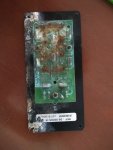
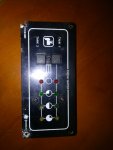
I've got one of these:-
IMG_20200616_122638.jpgIMG_20200616_122616.jpg
As you can see it may have suffered a little from dampness.
Does anyone know where I can get one at a reasonable price? Scheiber weren't very helpful.

Alternatively, the electronics look pretty simple, and I think I could probably figure out the circuit board tracks, has anyone an idea of how such a thing might be made?
It looks like a bunch of transistor switches the tank probe is just a series of bolts at different levels.
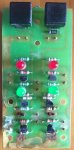
 
Component side....
Someone else must have one of these things?

IMG_20200618_105215.jpg

I don't suppose any of the electronics people could give me an idea what the circuit diagram would be for this?
Someone mentioned being able to get boards made up online somewhere as well?
 
Component side....
Someone else must have one of these things?

View attachment 92830

I don't suppose any of the electronics people could give me an idea what the circuit diagram would be for this?
Someone mentioned being able to get boards made up online somewhere as well?


I would give the board a good clean with a contact cleaner and check all the PCB tracks to dee if any are damaged

The resistors, Transistor and LED's should all be the same and available from most local electric component shops.

If there are any breaks in the tracks it would be easy to solder a bridging wire then resolder the damaged components onto the repaired board.
 
Do you know how it connects to the water tank? It would be useful to understand how it works if you are trying to repair the existing unit or replace it.

I know that later Scheiber units have a small box beside the tank and the sensor units might be a car fuel tank style rheostat, simply wires from screws drilled into the tank at various heights or a sensor with rods going down to different levels. The box outputs discrete voltage steps relating to the sensor levels.

The box on my unit has following spec.
1,00V < 1,10V < 1,20V Empty
2,10V < 2,20V < 2,30V 25%
3,20V < 3,30V < 3,40V 50%
4,35V < 4,45V < 4,55V 75%
5,50V < 5,60V < 5,70V 100%

The code and hardware to read these voltages isn't very complex and could easily drive LED or an LCD using Arduino or ESP32. I could probably dig out something relevant. Starting point would be understanding your existing sensor. Hope this is of some help.

I suspect older units wouldn't even use anything as complex to simply turn on LEDs but hardware would be more complex and arduino/ESP32 are cheap. Looking at your pictures, I suspect it might just be resistors and diodes to turn on LEDs. The circuit for that would be very simple and the giveaway would be that you'd have lots of wires feeding into it, one per level LED plus one extra.

Newer more complex systems only have 3 wires (2 power in and one for voltage out)

EDIT:
Brain fade, I had not scrolled back up to look at your first picture. My wife called me out to help in the garden and I didn't scroll back to the earlier pictures. It does look like a very simple circuit with resistors, diodes and a switch for each tank. Rogershaw is correct, the missing bits will be the same as the damaged resistors and transistors. You could fit new parts and bridge any damaged strips with wire & solder. Good chance it will be quite easy to get it working (though front side won't look great).
 
Last edited:
I've got one of these:-
View attachment 92746View attachment 92748
As you can see it may have suffered a little from dampness.
Does anyone know where I can get one at a reasonable price? Scheiber weren't very helpful.

Alternatively, the electronics look pretty simple, and I think I could probably figure out the circuit board tracks, has anyone an idea of how such a thing might be made?
It looks like a bunch of transistor switches the tank probe is just a series of bolts at different levels.

Have you any Cillit Bang in your cupboard ? when I get some 35 year old helm panels back for repair, they resemble your picture. First job is to attack them with Cillit Bang, leave for a few minutes then srub with a small stiff brush and wash well with hot water. Usually removes the rubbish leaving a clean PCB, you may find it workable, you may find large areas of track missing, a few link wires and your running, of it's scrap bin.

Brian
 
...in the end I started using Jeanneau Spares & After Sales in the UK and worldwide they managed to get me various bits and bobs including a bow roller delivered to bicycle rental office on a small remote Greek island, very helpful, give them a try.
I used them for the wooden nubbins on the cupboards but at 15 quid a pop for a nubbin anything that looks like technology is likely challenging on the wallet.

I would give the board a good clean with a contact cleaner and check all the PCB tracks to dee if any are damaged
The resistors, Transistor and LED's should all be the same and available from most local electric component shops.
If there are any breaks in the tracks it would be easy to solder a bridging wire then resolder the damaged components onto the repaired board.
Excellent advice, I will try give it a clean, if the board is good that'll be a great starting point.
The transistors are unmarked, I guess I'm probably looking for an NPN that can survive 12v?

Do you know how it connects to the water tank? It would be useful to understand how it works if you are trying to repair the existing unit or replace it.
I know that later Scheiber units have a small box beside the tank and the sensor units might be a car fuel tank style rheostat, simply wires from screws drilled into the tank at various heights or a sensor with rods going down to different levels.
Sorry, I should have elaborated, the tanks just have a set of bolts for the various levels, I think they run straight back to the unit. I might double check that.

EasyEDA - Online PCB design & circuit simulator online tool to design a PCB and then you can sent it to their other site for printing.
But as others say, try to clean the tracks at the back. I'd not be surprised if it can be repaired...
Cheers, I was looking for that, but couldn't find it.

Have you any Cillit Bang in your cupboard ? when I get some 35 year old helm panels back for repair, they resemble your picture. First job is to attack them with Cillit Bang, leave for a few minutes then srub with a small stiff brush and wash well with hot water. Usually removes the rubbish leaving a clean PCB, you may find it workable, you may find large areas of track missing, a few link wires and your running, of it's scrap bin.
Great advice, I shall give it a clean, and see what lies beneath.

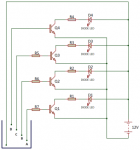
View attachment 92852

I wouldn't be too surprised if your circuit looks similar to this if you trace the working parts
They might have rusted off, but I only have 3 transistors for 4 LEDs...

That's exactly what I expect, but R's 1 through 7 (and possibly 8 that you've missed out) are hard to guess.. Strangely the values seem to vary across the circuit, but they couldn't have known the resistance of the tank when they made the board.

I have a meter so I could measure the tank resistance when full (empty it will presumably be high enough not to matter). But what should I aim at?

Do I need posh LED's to cope with 12v or just a good amount of resistance?
 
LEDs should be OK as the resistors will drop the voltage I'm guessing around 600 ohms for 12V (go a bit higher as you'll get 14V+ when charging). Around 1k might be OK and I think that's what you have on your board. The others might be 5.2k but very difficult to make out the colours.

To be honest, a small power supply from eBay might be worthwhile to use a stable lower voltage anyway. Perhaps someone else can comment.

Tank resistance is difficult to guess as it will depend on the bolts or screws in the tank (i.e. the Sensors). The resistance will vary with distance between the bolts and also some over the wire back to the panel. You could start around 10 - 40 kOhm as an initial guess.

I rebuilt my multi-display a few years ago and used a pair of arduinos connected to an DIY IO board. Your setup is much simpler because I'm convinced you don't have a remote box to do conversion. Just a bundle of wires to each tank instead of one wire and all the work is done at the panel. The number of wires should be a giveaway as I said earlier. You have a twin tank system and would need about 5 wires to each tank from the panel.
 
Last edited:
LEDs should be OK as the resistors will drop the voltage I'm guessing around 500 ohms for 12V (go a bit higher as you'll get 14V+ when charging).

To be honest, a small power supply from eBay might be worthwhile to use a stable lower voltage anyway. Perhaps someone else can comment.

Tank resistance is difficult to guess as it will depend on the bolts or screws in the tank (i.e. the Sensors). The resistance will vary with distance between the bolts and also some over the wire back to the panel. You could start around 10 - 40 kOhm as an initial guess.

I rebuilt my multi-display a few years ago and used a pair of arduinos connected to an DIY IO board. Your setup is much simpler because I'm convinced you don't have a remote box to do conversion. Just a bundle of wires to each tank instead of one wire and all the work is done at the panel.

Just uses the conductivity of the water to provide ground to transistors base, so this is normally high so hi-gain transistor with little resistance transistor base..

I use two probes that use the resistance of the water between them, as water level falls the resistance increases, this voltage is then used to feed a 10 dot bar-graph.

Brian
 
Just uses the conductivity of the water to provide ground to transistors base, so this is normally high so hi-gain transistor with little resistance transistor base..

I use two probes that use the resistance of the water between them, as water level falls the resistance increases, this voltage is then used to feed a 10 dot bar-graph.

Brian

Makes sense, I thought OP wanted to check his wiring from panel through to a filled tank and was making a guess based on assumed tank size to get a ballpark figure. Actual value won't be important to operation of his system if I'm correct about the design.

To be honest I'd probably go down bar graph route or even use an ESP32 to feed both display and mobile phone display (via webpage). I'm assuming OP isn't really into that. Hence sudden change in direction when I belatedly noticed that his system pre-dates the type I have.

I think he'll be OK with a magnifying glass to check transistors for any markings. Also worth measuring resistors with worn markings. Any suggestions for transistors if OP can't find markings (BC547 perhaps).
 
Makes sense, I thought OP wanted to check his wiring from panel through to a filled tank and was making a guess based on assumed tank size to get a ballpark figure. Actual value won't be important to operation of his system if I'm correct about the design.

To be honest I'd probably go down bar graph route or even use an ESP32 to feed both display and mobile phone display (via webpage). I'm assuming OP isn't really into that. Hence sudden change in direction when I belatedly noticed that his system pre-dates the type I have.

I think he'll be OK with a magnifying glass to check transistors for any markings. Also worth measuring resistors with worn markings. Any suggestions for transistors if OP can't find markings (BC547 perhaps).

Don't use a lot of transistors, used BC327 and BC337 years ago in a design had them in stock and tended to work around them, must look if w more modern is around cheaper.

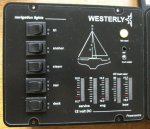
Have been looking to go micro for last 25 years, long story, what do you think of ESP32, ? would need to drive a touchscreen display, this is the current system, can have a digital display as well. Reads service volts and amps, bow volts and charge amps,, engine volts and water tank on bow ammeter.

Brian


2017-09-21 New Folder (31).JPG
 
Don't use a lot of transistors, used BC327 and BC337 years ago in a design had them in stock and tended to work around them, must look if w more modern is around cheaper.

Have been looking to go micro for last 25 years, long story, what do you think of ESP32, ? would need to drive a touchscreen display, this is the current system, can have a digital display as well. Reads service volts and amps, bow volts and charge amps,, engine volts and water tank on bow ammeter.

Brian


View attachment 92873

Go for it, ESP32 gives you a lot for the money. You can start with basic stuff and then use extras already built-in (Wifi, Bluetooth, multiple cores etc.). I have used Wifi to feed the display to web pages and it works well. No problem with simple stuff such as display and measuring things.

I made a multi-display with Arduino and it uses 2 Arduinos (one for IO and the other just for display) with a DIY IO board to do all measuring and protect the Arduinos from high voltages. It measures all the things you mention

I have read comments saying Arduino is a better starting point. Probably because it is simpler and probably a bit more robust. However, you can avoid complex stuff initially and stick to things Arduino has. It's lower voltage and I guess that gives less leeway for errors.

It does have a lot of performance advantages if you need it, 2 processor cores and a third programmable core in the RTC (never used that one). You could start with Arduino and also try ESP32 using the same Arduino IDE so cost of trying both is minimal.
 
Last edited:
a note of warning re ESP32. Check v.carefully the ADC of them. Accuracy can be let's say challenging, ppl often employ dedicated chips for that, lots of info online. Of course OTA update of code is brilliant as well as being wifi.
For the record, I scrapped them and went back to Teensy3.5 -3.6 for what I do.

V.
 
a note of warning re ESP32. Check v.carefully the ADC of them. Accuracy can be let's say challenging, ppl often employ dedicated chips for that, lots of info online. Of course OTA update of code is brilliant as well as being wifi.
For the record, I scrapped them and went back to Teensy3.5 -3.6 for what I do.

V.
Good point, I used Arduino on my multi-display but most things went through things like ADS1115 so didn't pay much attention to ESP32 ADC. However, I do remember reading that output was non-linear and needed processing if you wanted to get even moderate accuracy over a range. I haven't actually needed to measure anything accurately yet with ESP32, just switches via interrupt , pulse counting and other on/off stuff.

BTW I didn't need OTA when I last used ESP32 so altered the memory map for more storage for other purposes. Nice to have that flexibility.
 
pretty sure Brian will need ADC, point was to make sure he is aware of the issue. BTW, it's impossible to measure anything with a reasonable range and moderate accuracy at 12bit, 10bit is slightly better, but really abysmal compared to a teensy off the box!
 

Other threads that may be of interest

Top