Scheiber Water Gauge

What ranges /accuracy are we talking ?

Brian

Off the top of my head:

Arduino is 10-bit but you need to use a divider to drop voltage to a safe level. Assume 10-bit over a 4.5V range initially
ESP32 is 12-bit and that sounds better. However, it won't handle 5V on the pins and that means 12-bit over maybe 3V. But it is notoriously non-linear.

However, you can buy dirt cheap ADS1115 or similar to get 16-bit and build an IO board to keep higher voltages away from the Arduino or ESP32. I used that approach because I already had a problem with a voltage spike on the original system. I designed the IO side to handle 100V if I remember correctly. A bit overkill but accuracy was so far above my requirements that it wasn't an issue. ADS1115s are addressable and that makes it simple to have more than one on the same board feeding data to the same pin on Arduino or ESP32.
 
Last edited:
  • Like
Reactions: vas
Off the top of my head:

Arduino is 10-bit but you need to use a divider to drop voltage to a safe level. Assume 10-bit over a 4.5V range initially
ESP32 is 12-bit and that sounds better. However, it won't handle 5V on the pins and that means 12-bit over maybe 3V. But it is notoriously non-linear.

However, you can buy dirt cheap ADS1115 or similar to get 16-bit and build an IO board to keep higher voltages away from the Arduino or ESP32. I used that approach because I already had a problem with a voltage spike on the original system. I designed the IO side to handle 100V if I remember correctly. A bit overkill but accuracy was so far above my requirements that it wasn't an issue. ADS1115s are addressable and that makes it simple to have more than one on the same board feeding data to the same pin on Arduino or ESP32.

Thanks, I tend to run at 5 volt supply to cover low battery voltage, monitor volts at 1/5th and amps at 2.5 volt = zero. So voltage may not be a issue, we can always put n another power supply, but linearity may be.

Brian
 
Thanks, I tend to run at 5 volt supply to cover low battery voltage, monitor volts at 1/5th and amps at 2.5 volt = zero. So voltage may not be a issue, we can always put n another power supply, but linearity may be.

Brian
I don't want to hijack the thread but would suggest you look at ADS1115. I bought some from China for under £2 each a couple of years ago as I wasn't in a hurry to get them. They have 4-channels and I used unit for Voltages from domestic, start, bowthruster and fuel. The second one measured 2xwater and current via a shunt. The ADS1115 has a differential mode using 2 channels to measure small voltage changes, very useful across a shunt.

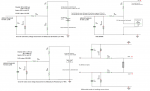
Make a simple board for IO, connect to ADS1115 pins and then run back to one Arduino/ESP32 pin. You select the unit and channel in software and read the value. I can PM some basic details if it would help, not my field but just result of a couple of days reading about the subject a few years ago. Some rough example circuits below.

Schematics2.png
 

Other threads that may be of interest

Top