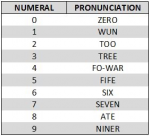
Saying two on vhf

Using phonetics and radio procedure reminded me of my friend who was going for his solo aircraft licence. Right from the start he was flying aircraft with a call sign of (say) Mike Echo Bravo 1 05 but on the day of the solo test they switched aircraft because of maintenance requirements.

As he taxied for the airstrip he could hear the control tower calling an aircraft to switch runways. As he got nearer his runway he realised the guy in the control tower was becoming increasingly frantic but he didn't worry as it didn't concern him..

He lined his aircraft up at the end of the runway and opened up the throttle. As he got further down the runway he spotted workmen running for their lives and as he passed overhead at about 5 meters they were angrily shaking their shovels. (In case you are wondering he didn't pass the test) ?
 
For those speaking radio French while cruising Brittany Normandy, to distinguish between "six" and "dix" which may sound very similar, it is often used "six, deux fois trois", or "dix, deux fois cinq", 6:2x3, 10:2x5.
10 - dix is also "Unité - zéro", channel often used by signal stations/sémaphores.

Never heard phonetics for weird numbers quatre-vingt-dix-neuf or soixante-dix-huit, they should imitate Swiss with "nonante-neuf" or "septante-huit" :)
 
I'm amused by the snowflakers in call centres re-inventing their own 'received pronunciations'..... Bless!
 
After the phonetic alphabet was developed by the International Civil Aviation Organization (ICAO) it was adopted by many other international and national organizations, including . . . International Maritime Organization (IMO), . . . and by many military organizations such as the North Atlantic Treaty Organization (NATO) . . .

The same alphabetic code words are used by all agencies, but each agency chooses one of two different sets of numeric code words. NATO uses the regular English numeric words (Zero, One, with some alternative pronunciations), whereas the ITU (beginning on 1 April 1969) and the IMO define compound numeric words (Nadazero, Unaone, Bissotwo…). In practice these are used very rarely, as they frequently result in confusion between speakers of different languages. . . However, as of 2002, the IMO's GMDSS procedures permit the use of the ICAO numeral pronunciation. . .

The pronunciation of the digits 3, 4, 5, and 9 differs from standard English – being pronounced tree, fower, fife, and niner. The digit 3 is specified as tree so that it is not pronounced sri; the long pronunciation of 4 (still found in some English dialects) keeps it somewhat distinct from for; 5 is pronounced with a second "f" because the normal pronunciation with a "v" is easily confused with "fire" (a command to shoot); and 9 has an extra syllable to keep it distinct from German nein 'no'. . .
NATO phonetic alphabet - Wikipedia

So, you are expected to use either the 'bissotwo' etc. that Roberto mentioned at post no.5, or (more widely understood) the pronunciation I set out at post no. 3 and below.

1580852894094.png
 
Top