st599
Well-Known Member
I normally go to Nevada in Portsmouth - specialist supplier with decent stock.Such as?

I normally go to Nevada in Portsmouth - specialist supplier with decent stock.Such as?

Yep - or go for RG8 mini which is available in all good radio stores for a similar price to RG58 in a chandlers. The key is getting a decent antenna with a proper connector you can use it with.I don't really see why someone would spend over the average price for a antenna and use it with rg58 coax. Rg58 coax can be bought for as little as 30p/metre.
Buy a really cheap antenna and use a better coax, that will probably outperform any expensive one using rg58.
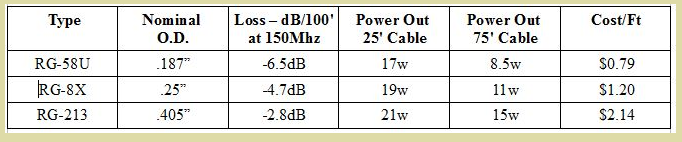
100ft cable run with rg58 using 25w, output at antenna about 7.5w.
100ft cable run using rg400 @25 w , output at antenna around 23w.
Use a antenna such as the one suggested by momac which takes a pl259 plug and you can use a higher grade coax of your choice.
I was given a lot of rg400, double braded and silver plated. It was truly amazing the difference it made over the rg58.

They suggested a Sirio SB2/SI normally go to Nevada in Portsmouth - specialist supplier with decent stock.
Isn't 7.5 w overkill for say 15 mile range anyway? Genuine question.I don't really see why someone would spend over the average price for a antenna and use it with rg58 coax. Rg58 coax can be bought for as little as 30p/metre.
Buy a really cheap antenna and use a better coax, that will probably outperform any expensive one using rg58.
100ft cable run with rg58 using 25w, output at antenna about 7.5w.
100ft cable run using rg400 @25 w , output at antenna around 23w.
Use a antenna such as the one suggested by momac which takes a pl259 plug and you can use a higher grade coax of your choice.
I was given a lot of rg400, double braded and silver plated. It was truly amazing the difference it made over the rg58.

If you fire 25W in to a system and lose 75%, you're heating up a lot of components.
The highest power gives you the best chance in an emergency.
Checked one of the boats I worked on a few weeks ago, 1.08:1 at the top of the mast, 1.18:1 at the VHF. RG8 mini in to a Metz Manta with TNC joins at the mast base.I have just replaced my antenna with a Metz that I got from Salty John a few years ago before he closed.
The 30 year old antenna with RG 58 had been bashed and the coax had worn through the insulation and braid where it rubbed on the bolt for the lower shrouds ( no mast conduit).
I was expecting great improvements with the Metz and RG 8 coax but the VSWR only improved from 1.77 on the old antenna to 1.74 on the Metz.
What sort of VSWR are people getting on their installations? I was hoping for about 1.5 or thereabouts as at the moment I am only transmitting about 18W. I know it is an inverse square law but I would still like to push out another couple of watts if possible.
I think they did decades ago about antenna separation distance ….. made great sense…… the days when the magazine was thick in size. Or else I read it somewhere else, or discussed it with a friend working at BAE (uk) but most people know 2 antennas should not be ‘next’ to each other if they have read a bit about the subject.PBO needs to do an article on this stuff.
PBO needs to do an article on this stuff.
I would think you need better coax - over 20 years ago I measured the vswr of my Metz and it matched the marketing value …… it was superb. At £60 I was very happy.I have just replaced my antenna with a Metz that I got from Salty John a few years ago before he closed.
The 30 year old antenna with RG 58 had been bashed and the coax had worn through the insulation and braid where it rubbed on the bolt for the lower shrouds ( no mast conduit).
I was expecting great improvements with the Metz and RG 8 coax but the VSWR only improved from 1.77 on the old antenna to 1.74 on the Metz.
What sort of VSWR are people getting on their installations? I was hoping for about 1.5 or thereabouts as at the moment I am only transmitting about 18W. I know it is an inverse square law but I would still like to push out another couple of watts if possible.
I have not found an emergency antenna that is anywhere near as good as masthead ones , let alone the Metz. Those short stubby antennas are poor (according to my measurements and real life tests). I could not be heard with a standard horizon handheld radio as standard (well ‘barely readable was coastguard reply), but when I attached an antenna I had made ( held at same height as stubby) I was ‘loud and clear’Checked one of the boats I worked on a few weeks ago, 1.08:1 at the top of the mast, 1.18:1 at the VHF. RG8 mini in to a Metz Manta with TNC joins at the mast base.
Slightly worse on the emergency antenna, but that's a small compromised size.
(10 years old - only issue we've had is having to replace self amalgamating tape every year)
I have not found an emergency antenna that is anywhere near as good as masthead ones , let alone the Metz. Those short stubby antennas are poor (according to my measurements and real life tests). I could not be heard with a standard horizon handheld radio as standard (well ‘barely readable was coastguard reply), but when I attached an antenna I had made ( held at same height as stubby) I was ‘loud and clear’
The best I've seen is an inflatable based on a scuba marker boy.I have not found an emergency antenna that is anywhere near as good as masthead ones , let alone the Metz. Those short stubby antennas are poor (according to my measurements and real life tests). I could not be heard with a standard horizon handheld radio as standard (well ‘barely readable was coastguard reply), but when I attached an antenna I had made ( held at same height as stubby) I was ‘loud and clear’
The best I've seen is an inflatable based on a scuba marker boy.
It contains a full size J-pole or helicoil antenna, folds down to a small pouch and if you're in a real rush, will inflate off a CO2 canister. Can be held aloft or raised on a string.
Thank you for that link.