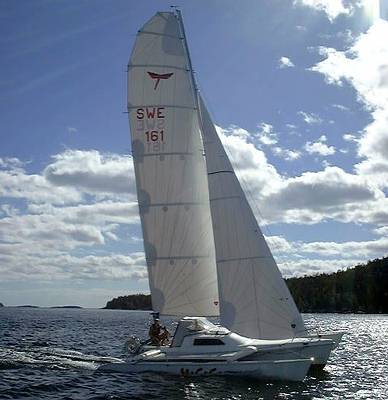
Also bear in mind a cat sail will be in a heavier fabric and construction due to the stability of boat which will usually produce a heavy and/or more expensive sail. Jibs will have been cut to accommadate the increased forestay sag of a cat and the main usually will have a much larger roach to keep the centre of effort low, this also has implications on sail twist and mainsheet tension.
[ QUOTE ]
main usually will have a much larger roach to keep the centre of effort low
[/ QUOTE ]
Hmm. Tris have a large roach, because it's an efficient sail shape. The greatest extra roach compared to a monohull's (with backstay) sail appears to be near the head, so wouldn't the centre of effort be higher?
This sort of mainsail wouldn't fit a mono with backstay anyway.
If the mainsail were to be of the same area a more triangular sail would have to increase the height of the mast. Boom length tends to be at a maximum limited by the length of the boat. The taller mast will give a higher CofG
I see what you mean now. I was assuming an equal mast height, not an equal sail area.
Still reckon that the primaray reason for an increased roach is sail shape efficiency though, lowering CoE a secondary reason. That's what my sailmaker (UK McWilliams) says anyway.
A lot of cats, particularly Prout's and Patterson designs, have the mast set much further aft than on a monohull, this creates some perculiar sail shapes!
To sum up what's being said: a multihull main will almost certainly be unsuitable because of teh roach (wont fit through the backstay when tacking) and the jib/genoa will be too flat cut for full efficiency and will be unnecessarily heavy. It will also, probably, be high cut in the clew to rise over the bridgedeck. I would thank the gentleman kindly but decline his generous offer.