Sailing around the world on a budget

We hand steered across and back first time because of a continuously failing autopilot.
My idea of hell.

But I find steering (unless racing or doing close quarters manoeuvres) utterly tedious.

I’ll very occasionally steer to windward for a bit but we try not to sail hard on the wind if we can possibly avoid it. .
 
Just reread Peter Pye's "The Sea is for Sailing".

29ft boat "Moonraker", 3 people, an engine sometimes, no autopilot, watermaker etc. Whale of a time.
View attachment 189835
Don't we just overcomplicate things!
Possibly. But as I quite like sailing with Mrs Morris, and Mrs Morris and I like to have the occasional shower, ice in the gin, fresh food in a fridge, (I could go on), a generator, water maker, and other mod cons are essential. Life is full of choices and I gave up hair shirts awhile ago.
 
Possibly. But as I quite like sailing with Mrs Morris, and Mrs Morris and I like to have the occasional shower, ice in the gin, fresh food in a fridge, (I could go on), a generator, water maker, and other mod cons are essential. Life is full of choices and I gave up hair shirts awhile ago.
And me, especially the engine, autopilot, navigation aids and dry bedding. But it goes to show how progress changes the game.
 
I didn’t say they weren’t good. I said that some people who circumnavigated on what these days is considered a very basic boat have said they no longer use it. Florence are very back to basics people and I doubt they said that lightly.
I've been in a lot of places with liveabord cruisers. The hydtovane topic comes up often. Very rarely have I heard people unhappy with it. If do its often been poor installation problems.

I have no idea who the sailing brothers are, but after many, many thousands of miles with a wind vane and hand steering, I absolutely know which I prefer!

This time last year I bought a friends catamaran from South Spain to the Canaries. The newly allegedly refurbished autopilot lasted 30 minutes. We had a chat and decided that either we wait weeks to get it fixed or press on hand steering. So after we got here, spent ages doing software updates, fixing wiring problems and it now works great.

Until it doesn't. :)
 
I've been in a lot of places with liveabord cruisers. The hydtovane topic comes up often. Very rarely have I heard people unhappy with it. If do its often been poor installation problems.
Indeed, and Florence didn’t say they were unhappy with the windvane either, just that they no longer use it.
I have no idea who the sailing brothers are, but after many, many thousands of miles with a wind vane and hand steering, I absolutely know which I prefer!
They sailed from Wales in a Rival 36 and are currently somewhere near Australia. They had a budget of zero and used to drive vans for Asda. They like their windvane too, but they’ve also documented how it’s broken on multiple occasions. You were implying vanes were infallible while electronic APs are unreliable, I was suggesting that’s opinion rather than reality. A well installed electronic one is every bit as reliable.
 
I've been in a lot of places with liveabord cruisers. The hydtovane topic comes up often.
We have seen surprisingly few windvanes on our travels. I'd assumed they would be ubiquitous, but they are generally the preserve of smaller and older boats. As I type this I am looking across at a lovely HR44 who has chosen davits instead of a windvane. Quite common round here.

Of course nobody in the Caribbean is crossing oceans on a daily basis, we are day sailing from island to island. But all of these boats got here somehow from wherever they were built.


Very rarely have I heard people unhappy with it. If do its often been poor installation problems.
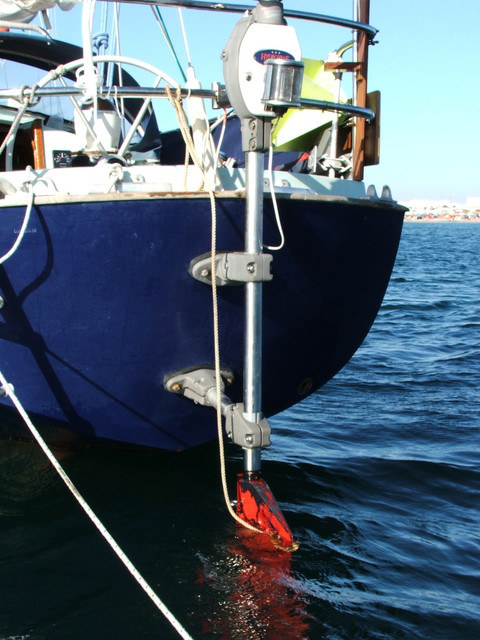
Maybe I didn't go a good job installing mine, or maybe the unit is defective. It was secondhand after all. The thing that really surprises me is that the rudder only had a few degrees of movement either way. But I can't find anything wrong with it, or any way of increasing the amount of deflection.
The Hydrovane's ability to only make minor course changes is what I dislike about it, compared to the little Navik I installed on my first boat. A big enough wave, or a sudden enough change in wind speed, overpowers its ability to keep course.

In its defence, it did most of the miles on our crossing, so it can't have been that bad. But in squally and changeable conditions it was simply easier to use the autopilot, rather than continually fiddle with the wheel offset, sail balance, or vane setting.


after many, many thousands of miles with a wind vane and hand steering, I absolutely know which I prefer!
I agree with you, but a good autopilot is the third option that you miss out of that choice.

I have never had a single problem with the autopilot. It's one of the most reliable bits of kit on the boat.
 
I’ve met (and heard of) many autopilots failing on ocean crossings. People don’t realise just how hard they have to work on downwind legs in big swells. They can also be power hungry.

We have a powerful autopilot that works directly onto the rudder stock and we use it 99% of the time. However for ocean passages, the Hydrovane is engaged.

Our Hydrovane rudder moves much more than a few degrees. Most of the problems I’ve come across with Hydrovane use is not balancing the boat (sails & steering) and then allowing the Hydrovane to keep the base course.

Each to their own. Perhaps I’m just old fashioned.
 
I’ve had 4 windvane now, used in earnest.
A Hasler
A Mustafa home made copy ( like a posh Hydrovane, with trim tab and lift up)
A Hydrovane
A Monitor

Would not go to sea without.

When the chips are down….

Oh, and windvane are -generally-fixable at sea, whereas a soggy autopilot can be a tad more challenging. Even with oscilloscope and signal generator and more stuff, none of which I own.

Otoh rtw racers seem to have amazing high end electronics that win races but, at what ££££ cost ?
 
Last edited:
Indeed, and Florence didn’t say they were unhappy with the windvane either, just that they no longer use it.
On the other hand, their recent around-the-UK trip was mostly coastal. That's when we mostly go with the electric as well.
I think we only used the windvane on the Irish Sea when we were around there, and maybe on the Orkney-to-Cape Wrath leg. Our Atlantic crossing was 90% steered by the Windpilot (we only used the tiller pilot sometimes under spinnaker when apparent wind was low). No energy problems on the crossing, and only one engine hour...

Probably different story with bigger boats. We have a 31ft classic double-ender. I don't think I'd go on a longer trip without both self-steering options. Enough to do on watch without being a slave to the tiller.
IMG-20250112-WA0001_Original.jpeg
 
I’ve met (and heard of) many autopilots failing on ocean crossings. People don’t realise just how hard they have to work on downwind legs in big swells. They can also be power hungry.

We have a powerful autopilot that works directly onto the rudder stock and we use it 99% of the time. However for ocean passages, the Hydrovane is engaged.

Our Hydrovane rudder moves much more than a few degrees. Most of the problems I’ve come across with Hydrovane use is not balancing the boat (sails & steering) and then allowing the Hydrovane to keep the base course.

Each to their own. Perhaps I’m just old fashioned.
Perhaps mine is defective. If yours is set up, I'd be interested to see the range of movement, I've we catch up with you.

I completely agree that autopilots can and do break, and people give them a hard time. We generally do ten minutes or so of hand helming at every change of watch to check that everything feels ok and balanced.

I think it would be madness to set off on a long offshore passage without several different options, whether that be enough crew to hand helm, enough spares to fix any conceivable autopilot failure, a windvane, or a combination of all of these.

As far as I'm aware steering loss is the single biggest cause of boats being abandoned mid ocean. I don't want to become a statistic.
 
The discussion about the power demands and the physical strains on autohelms prompts my post. I had a Cape Horn wind vane self steering system ( CapHorn Produits Marins Inc – Régulateur d'allure ) installed on our 30 foot Alberg years ago and it has served us well since. It shows its worth on long passages but is also quite useful on day passages for the reasons that others have already mentioned (short handed sailing, tedium of tiller steering for hours etc). One of its useful features is that the quadrant that drives the tiller lines has an attachment point for an autohelm piston arm. In that configuration the autohelm mimics the response of the wind vane (which is removed while the autohelm is at work) to a change in direction of the boat relative to the wind (or vice versa) which causes appropriate deflections of the servo rudder which, in turn, provides the force required to move the boat's tiller via the tiller lines. The beauty of this arrangement is that the autohelm does very little physical work compared to when it is directly connected to the rudder shaft or tiller. This massively reduces both the strain on the motor and gears and also the electrical demand. With the boat's motor running to keep the battery charged you can use the Cape Horn/autohelm for as long as the gas tank holds up and follow whatever course has been programmed into the plotter. I never leave port without it :D
 
I completely agree that autopilots can and do break
Both systems do, pretending that vanes don’t is as big a folly as assuming electric ones do. I don’t think vanes are outdated either, I was surprised to hear Florence saying this but they’ve certainly demonstrated they are entitled to comment.
Either way, with current pricing I can buy around three electronic ones for the price of a hydrovane which is fascinating given the simplicity of the vane and the relatively cheap materials, many of which are essentially metal tubing. Perhaps the thing that ultimately kills them will be lack of orders. If they were selling thousands a year a vane ought to be about £1000 but I’d guess their profit these days comes from tens of units or low hundreds so the price reflects that niche.
 
Perhaps mine is defective. If yours is set up, I'd be interested to see the range of movement, I've we catch up with you.

I completely agree that autopilots can and do break, and people give them a hard time. We generally do ten minutes or so of hand helming at every change of watch to check that everything feels ok and balanced.

I think it would be madness to set off on a long offshore passage without several different options, whether that be enough crew to hand helm, enough spares to fix any conceivable autopilot failure, a windvane, or a combination of all of these.

As far as I'm aware steering loss is the single biggest cause of boats being abandoned mid ocean. I don't want to become a statistic.
Interesting. One of the instruments we have is a helm position indicator. It’s amazing how useful it is. We can be tramping along on a close reach with the autopilot on and the only clue that the autopilot is beginning to work hard is the rudder indicator starting to creep more and more off the centre. Weather helm (and excess weather helm) is there before your eyes. A quick trim of the sails or a reef taken in and the results are obvious.

Of course if you were hand steering you’d have felt the need to trim or reef, but the autopilot steers on ‘manfully’ (if allowed to say that) struggling to keep the course without complaining. On a wheel steered boat without a helm indicator, it’s possible to not notice what’s happening.

And before anyone asks we’ve got a Turks head on the wheel at ‘midships’ but there are three wheel positions where it is at 12 o’clock and only one of them is ‘midships’.
 
As someone who has come to terms with the knowledge that he will never sail across an ocean, I find something very romantic in the sight of a hydrovane self steering array. The possibility of dreams, or something like that. I do hope they don’t disappear.
 
I would not cross an ocean without one. Not that I know bugger all about crossing oceans, but I hope to, and have read a lot. I would want to have a system that can work if the batteries go tits up for any reason.
If I was crewed, I might decide that people can steer if the autopilot dies, but I’ll be singlehanded, so I would want a more reliable non electric fall back system than a single human.
 
There’s been a few points made about windvanes breaking as well as autopilots, which is fair enough. But its not really a fair like for like surely? If an autopilot fails, it’s probably not fixable on board, whereas a wind vane probably is.
A windvane can fail for mechanical reasons only. An autopilot can fail for mechanical or electrical reasons, more to the point, the autopilot could be perfectly rugged and able to function, but be useless because there is no power available to run it.

I would have both but I would expect the autopliot to be a much bigger risk when it comes to failing to get the job done.
 
I bought my first Hydrovane in about 1995. I drove up from Sussex to Nottingham to collect it and spent some time looking for the address of the manufacturer, expecting at least a small factory type building. Wrong! I was directed down the side of a small Town centre building and found a semi basement where the Hydrovanes were finished and test assembled...by hand. One man, some lathes and Bench Drills.
I was amazed. He trimmed and fitted the heavy stainless tubing into various cast metal brackets. Having checked that everything fitted perfectly he then dissembled the rig and packed it for transport. I had a long chat with him and realised then why the Vane was so expensive, at that time they were virtually hand built.
Some years later, when I bought a second Hydrovane for another boat I found that the company was then ( about 2008) Canadian owned. I corresponded with the owners and found them really helpful people to deal with. That 2nd vane, built in England was delivered, so I never found out if the company had moved out of the tiny basement in Nottingham.

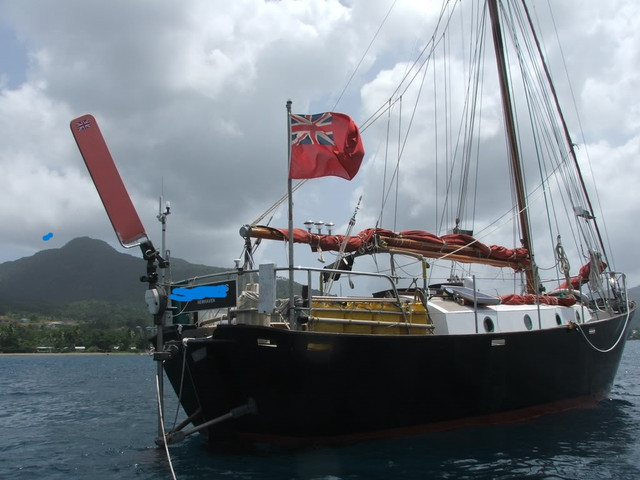
Fitted to my 12 ton steel Gaff Cutter.. Somewhere in the West Indies, Dominica? Can't remember now.


That first Hydrovane steered me faultlessly for many thousands of sea miles in all weathers.

The second Hydrovane that I owned I fitted to my Nic 32, and on that boat I struck an under water object which would have destroyed many of the 'Paddle' or other type vanes. The impact practically stopped the boat, but after some drama and jury rigging in a full gale in the dark, I managed to get to Peniche on the Portuguese coast and reset the auxiliary rudder.


Back to normal..


I'll bite the bullet and say that if a Hydrovane is not working properly it is either not fitted correctly or the user hasn't got the vessel balanced under sail properly. Attempting to unlock a Hydrovane before the boat is balanced will result in a snakey wake..:LOL:
 
I'll bite the bullet and say that if a Hydrovane is not working properly it is either not fitted correctly or the user hasn't got the vessel balanced under sail properly. Attempting to unlock a Hydrovane before the boat is balanced will result in a snakey wake..:LOL:

I'll put my hands up and admit that mine may not have been perfectly well set up. I've only done about 3000nm with it. And maybe I'm a bit spoiled because my previous servo pendulum system was absolutely foolproof. So I was expecting a bit more from the Hydrovane.

I have no problem getting the boat balanced to the point where she almost steers herself. I found that this often meant putting a reef in the main to avoid too much weather helm.

The problem I would encounter is that if I got the boat balanced for 10kt of wind, it wouldn't necessarily remain balanced at 20-25kt. The weather helm would build and she would want to round up. At a certain point the Hydrovane would be overpowered and we would end up in irons unless I intervened. If I adjusted for the higher speed, I ran the risk that in a calmer spell the boat would turn off the wind. It seemed very hard to find the sweet spot.
During particularly squally and unsettled spells it was simpler to just sit behind the wheel to feed in whatever adjustment was needed. Which somewhat defeats the purpose!
Most of the time, conditions were settled enough that this issue didn't arise, but it was pretty annoying when it did, and it was very tempting to just press the button on the autopilot instead.

Maybe my vane is defective, maybe my crossing was unusually unsettled, maybe I don't have a clue what I'm doing.

The Hydrovane probably steered us for 80% of the crossing. I was glad to have it. But we were undoubtedly slower under windvane, thanks to the need to adjust the sails for balance rather than speed, plus the weaving around adding extra miles through the water. It needed far more attention than an electric autopilot. I'm not in any way against windvanes, but I don't buy in to the idea that they are infallible or essential. Just another tool which has good and bad points.
 
Top