
Saildrive eaeth

PabloPicasso

Well-Known Member
Joined
12 Feb 2010
Messages
2,945
Visit site
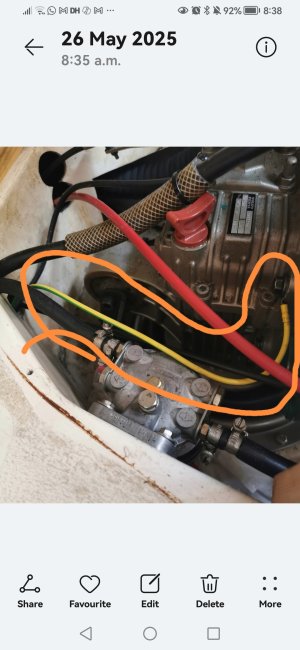
On my new to me boat there is an earth lead connected to the saildrive (see pic)

I think it maybe to do with the shore power system, is this right? I thought the saildrive was meant o be electrically islolated?

I'm on a swinging mooring so not using shore power at the moment.
 

Attachments

  • Screenshot_20250526_083832_com.android.gallery3d.jpg
    Screenshot_20250526_083832_com.android.gallery3d.jpg
    783.9 KB · Views: 16
What engine / saildrive is it? On a lot of Volvo's the saildrive is isolated from the engine with a isolation gasket and isolating washers. If yours is one of these there should be no electrical continuity between the engine and the saildrive. However, its not uncommon to fit an additional dedicated hull anode for the saildrive as the ring anode behing the prop is on the small side. This serves as a backup and must not be connected to anything else. It should definitely not be bonded to the shorepower installation.
 
Nothing should be connected to the saildrive housing except if an additional anode, either hull or hanging is used - both of which are unusual.
 
How should UK shore power be connected to a sailing boat in a seawater marina?

Anyone got a simple clear diagram including a galvanic isloator?
 
How should UK shore power be connected to a sailing boat in a seawater marina?

Anyone got a simple clear diagram including a galvanic isloator?
Incoming Earth goes to GI, from GI to the consumer unit. A Earth wire from the consumer unit to the water, in the case of a GRP boat that's usually to a hull anode. Do not connect it to the saildrive.
 
Incoming Earth goes to GI, from GI to the consumer unit. A Earth wire from the consumer unit to the water, in the case of a GRP boat that's usually to a hull anode. Do not connect it to the saildrive.
Is there another hole in the hull to take a terminal to a hull anode?

If there is a shore power what is the typical earth to water arrangement?

Is this why some boats have an anode hung over the side when moored on a marina?
 
Last edited:
Why hang an anode over side if you have one on saildrive and on the hull and the bowthruster? A galvanic isolator is standard fit nowadays I thought at least in past 20 years new builds?
 
Is there another hole in the hull to take a terminal to a hull anode?
If you don't have a hull anode you can fit a small button anode, just for the Earth.
If there is a shore power what is the typical earth to water arrangement?
Hull of a metal boat, ground plane if there is one, hull anode...
Is this why some boats have an anode hung over the side when moored on a marina?
No. That's usually an extra anode to make the fixed ones last longer.
 
Why hang an anode over side if you have one on saildrive and on the hull and the bowthruster? A galvanic isolator is standard fit nowadays I thought at least in past 20 years new builds?
A galvanic isolator should be fitted if the shore power Earth is connected to the water, which has be part of the new build standard for several years. If there is no Earth connection to the water a GI is pointless.
 
So there should be a shorepower earth and an isolator on most newish boats -clearly we don’t know age of op vessel though. I assume the deterioration on anodes varies depending on location of vessel but we annually replace sail drive one but the hull one seems to vary little (much large lump though) and saildrive ones cheap compared to other bits of metal nearby of course. I’m not certain why you would not have a hull anode bolted through?
 
Can you explain that a bit more please?

Is this below the waterline, a new hole to be drilled when next ashore?

Any photos of the inside of this connection?
Has to be below the waterline to create an Earth path to the water. It's just a small, round anode with a central fixing, you connect the Earth wire to the fixing (bolt).

If you don't have the Earth connection to water you don't need a galvanic isolator.

What boat do you have ? What year is she ?
 
Hanse 301 from 2001

The wiring is all wrong. Seems the consumer unit is before the GI. And it looks like the earth wire runs to the saildrive.

I'm moored fore and aft so not usually on shore power. I am reluctant to use the shore power until I get it sorted out properly.

I pressume not having an earth connection is just dangerous
 
Last edited:
Yes correct. You isolate the ships earth from the shore earth by the GI, a diode. Ships earth is provided by the hull anode, most definitely not the engine leg. In the event of an electrical failure when something conducts to earth and it goes above 2 volts or so, the GI passes the current to shore earth. At other times it isolates one from the other so you don't end up being an anode for the whole pontoon. You need to rewire the earth to the GI before the consumer unit, fit a hull anode and move the wire from the leg to the new anode.
 
Hanse 301 from 2001

The wiring is all wrong. Seems the consumer unit is before the GI. And it looks like the earth wire runs to the saildrive.

I'm moored fore and aft so not usually on shore power. I am reluctant to use the shore power until I get it sorted out properly.

I pressume not having an earth connection is just dangerous
1) In 2001, when your boat was built, there was no requirement to connect the shore power Earth to the water. The shore power Earth would have been connected to the consumer unit and from there to the sockets and equipment etc. As there was no connection to the water there was no need for a galvanic isolator.

2) Current standards require that all new build boats have to have a connection to the water, so they need a galvanic isolator or an isolation transformer to stop your anodes from protecting the whole marina.

If your boat was built to 1) above there is no requirement to change it to 2)

If you do not connect the Earth to the water you don't need a GI, but having one does no harm, it's just a useless piece of equipment.

If you do connect the Earth to the water you must correctly fit a GI or isolation transformer.

In your case you can remove the connection to the water (presumably the sail drive is the only connection). The GI will not be doing anything and it's in the wrong place, so remove it and connect the two wires going to it together to restore the shore power Earth. You will have reverted to how the boat was built and it will be as safe as it was when new.

If you so choose, you can refit the GI before the consumer unit and at next lift out fit a small button anode to make an Earth connection to, this should be the only Earth connection to the water. It will not act as an anode, just a connection point for the Earth.

IMPORTANT If you have an inverter or generator you must have the connection to the water so you have an Earth connection when not plugged into shore power.
 
Last edited:
Slightly confused by this thread, my current and previous boats were all built comfortably after 2001 and neither have a hull anode.

The only one that did was built back in 1994 and didn't have 'proper' shore power fitted.
Paul explains why pre 2013 RCD boats do not have earths for shorepower, but it makes sense if installing it retrospectively (as I did) to follow the latest standards and earth to water plus fit a GI. This is nothing to do with using anodes for local protection of items like propellers or the anodes on saildrive housings. It is just a convenient way of providing a route to water. The little button anodes come with an M8 stud for through hull which then provides an attachment point for the earthing cable.
 
Great. Thanks for that.
1) In 2001 there was no requirement to connect the shore power Earth to the water. The shore power Earth would have been connected to the consumer unit and from there to the sockets and equipment etc. As there was no connection to the water there was no need for a galvanic isolator.

2) Current standards require that all new build boats have to have a connection to the water, so they need a galvanic isolator or an isolation transformer to stop your anodes from protecting the whole marina.

If your boat was built to 1) above there is no requirement to change it to 2)

If you do not connect the Earth to the water you don't need a GI, but having one does no harm, it's just a useless piece of equipment.

If you do connect the Earth to the water you must correctly fit a GI or isolation transformer.

In your case you can remove the connection to the water (presumably the sail drive is the only connection). The GI will not be doing anything and it's in the wrong place, so remove it and connect the two wires going to it together to restore the shore power Earth. You will have reverted to how the boat was built and it will be as safe as it was when new.

If you so choose, you can refit the GI before the consumer unit and at next lift out fit a small button anode to make an Earth connection to, this should be the only Earth connection to the water. It will not act as an anode, just a connection point for the Earth.

IMPORTANT If you have an inverter or generator you must have the connection to the water so you have an Earth connection when not plugged into shore power.
So no inverter, no generator.

I will do as you say and disconnect the GI, reconnect the earth.

Then, as a winter project, upgrade with the button anode, GI before the consumer unit, etc when the boat is ashore.

Many thanks for your help with this, much appreciated.

Any comment on location of the Button anode, or can it go anywhere convenient below the waterline?
 
Last edited:
Top