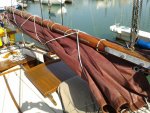
Sail ties

I believe that I am the last person left on earth to still use a single continuous line for tying down the mainsail. I tie the aft end from the cockpit when the sail comes down to stop it flopping past the lazyjacks and then continue the tie at my leisure. I have a simple technique involving a slip-knot at each node and have chosen a shiny line to enable this. I make no claims to this being any better than ties, but it's just what I have always done.

Don't do that, but even with lazyjacks sometimes a rapid dump of the main in lumpy seas leaves an untidy sail on the boom. Rather than try to sort it out in difficult conditions I quickly put a couple of sail ties round the boom and sail to keep it under control. The main halyard just goes onto a cleat at the mast until later. If the conditions are better I have no problem with a tidy, properly flaked drop. Sail ties (with loops) are universally useful items!
 
Elastic sail ties with clips or toggle and eye systems are sometimes seen, but are usually deprecated because of the potential for a toggle or clip flying into someone's eye!
I witnessed someone being hit by a ball at the end of such an elastic tie. He later told me his ophthalmologist said he had been very lucky, one mm to one side would have cost him his eye. So these things are outlawed on my boats.
 
Don't do that, but even with lazyjacks sometimes a rapid dump of the main in lumpy seas leaves an untidy sail on the boom. Rather than try to sort it out in difficult conditions I quickly put a couple of sail ties round the boom and sail to keep it under control. The main halyard just goes onto a cleat at the mast until later. If the conditions are better I have no problem with a tidy, properly flaked drop. Sail ties (with loops) are universally useful items!

We do much the same with our fully-battened stackpack. We use the sail tie about a metre out along the boom from the mast and include the slackened off main halyard. This saves having to undo the halyard shackle and also keeps the halyard from frapping against the mast. Quicker on the re-hoist as well.
 
Rather than faff about with single-strand sailties with little loops sewn into one end, I've made up 'continuous' loops of cheap light webbing about 1 metre long.

They drape around the neck, so both hands are free for the clamber from cockpit up onto the coachroof....

It doesn't matter which 'end' you pass under the sail - you can feed one end through the other regardless of whatever is presented, without fumbling to open a slightly too small sewn eye....

If you only know one knot - the reef knot - then you'll be pleased to hear that you need only use the much simpler, even-more idiot-proofer 'half hitches'.....

You can do the same in any old cord lying about.....

Seemples! Tchk! ;)
 
On the basis that sail ties are useful and multi-purpose, I bought a pack of 4 complete with plastic clips from a boat show chandler a few years ago. I’ve only had occasion to use them for the first time this season as I had a stitching problem with my stack pack bag. After only a couple of weeks the sun had pretty much destroyed them, just trying to add a little more tension broke them. So in addition to the already identified issue of flying clips, my conclusion is that they are rubbish.

Quality sail ties, with the sewn-in loop, from a sail maker, are much preferred.
 
I believe that I am the last person left on earth to still use a single continuous line for tying down the mainsail. I tie the aft end from the cockpit when the sail comes down to stop it flopping past the lazyjacks and then continue the tie at my leisure. I have a simple technique involving a slip-knot at each node and have chosen a shiny line to enable this. I make no claims to this being any better than ties, but it's just what I have always done.

I did try this idea, but maybe I’m clumsy, I found that my foot got tangled up in the loose end whilst I was bouncing around on the cabin roof trying to wrap it around the flaked sail in a bit of a swell, so went back to 1.5m sail ties and reef knots.
Oh and NEVER bungy type sail ties I too almost lost an eye with one.
 
Last edited:
I did try this idea, but maybe I’m clumsy, I found that my foot got tangled up in the loose end whilst I was bouncing around on the cabin roof trying to wrap it around the flaked sail in a bit of a swell, so went back to 1.5m sail ties and reef knots.
Oh and NEVER bungy type sail ties I too almost lost an eye with one.

I virtually never leave the cockpit when in open water since I can make the first tie from the cockpit and have lazyjacks. I solve the problem of delinquent rope by keeping it in a small coil with the tail wrapped tightly round, leaving me with just a small bunch to hold, though this still leaves me with the need to use two hands, leaving none to hold on with, though sail ties have the same problem. The only solution is to arrange not to have to tie down at sea. It often surprises me to see people hoisting and lowering sails out in the open when sheltered water is available within the harbour or marina, even in relatively small places such as Blankenberg.
 
Before fitting a stak pak and lazyjacks, I had two bungee cords running under the length of the boom, whipped together at intervals. Between the whippings, on one piece, hooks were threaded on. Taking the hook up one side of the boom and the other bungee up the other, they could be hooked together over the sail. Quick, easy and safe
 
Before fitting a stak pak and lazyjacks, I had two bungee cords running under the length of the boom, whipped together at intervals. Between the whippings, on one piece, hooks were threaded on. Taking the hook up one side of the boom and the other bungee up the other, they could be hooked together over the sail. Quick, easy and safe

+1 An excellent system. I have been using that for may years. Always there when you want it, no loose ties and will not ping up into your eye.

www.solocoastalsailing.co.uk
 

Attachments

  • 20150415_150700a.jpg
    20150415_150700a.jpg
    310.3 KB · Views: 1
I've always used random lengths of dubious rope which I keep cowhitched to one of the grab handles by the main hatch. Some have spliced loops in one end, some have bowline loops on the others I often use a timber hitch.
Most of my sailing friends use the same "system'.
 
When you want to use them in a hurry, you won't want fo faff about with clicky things. Sail ties can also be useful for 9other stuff besides sails, so stick to traditional ( 2 sizes, long & shorter).

And having the two sizes in different colours is a convenience.
 
Here's my invention that no-one else has mentioned. Take a conventional sail tie with a loop on one end. On the other end, create an aglet using heat shrink. The stiffer end facilitates normal use and, in my case, enables it to be threaded through eyelets at the reefs. This allows reefs to be tidied away neatly with nice soft ties.
 
What's an aglet?
Here's my invention that no-one else has mentioned. Take a conventional sail tie with a loop on one end. On the other end, create an aglet using heat shrink. The stiffer end facilitates normal use and, in my case, enables it to be threaded through eyelets at the reefs. This allows reefs to be tidied away neatly with nice soft ties.
 
Top