Rudder damage

Not sure why you are reluctant to involve your insurer - insurance is for just this situation. You have nothing to lose by notifying them. They will ask you to get quotes to repair the damage. You can either do this by engaging a surveyor to assess the damage and then get quotes or go straight to a boatyard and get a quote. It could be that it is less than your excess, in which case you don't actually claim. If the damage was caused by a failed mooring then your insurer will try to claim from the person responsible for the mooring. This does not affect your claim on your insurer as you have a contract with the insurer that says they will pay for any damages covered by the policy. It may well be that they will increase your premium next year, in which case ask them before you make the claim. It may be that their payout after your excess is small and not worth having if it is less than the increase in premium.

One thing is certain you can't make the decision until you know what the repair will cost and you are not in a position to judge that without professional advice.
 
One of the skegs on Jazzcat was a bit wobbly, so I came out of the water this winter to deal with it. I started by grinding away the gelcoat, expecting to find glass before long. Bluddyell, this gelcoat's a bit thick! Bugrit, I've gone right through! I never did find anything that looked like the GRP elsewhere. I don't know if it was like that from new, or it was a bad repair, but several layers of glass/epoxy on the outside and an H -shaped reinforcement inside, well glassed in, and I can't move it at all, so it's got to be stronger than it was.
 
I wouldn't hesitate in contacting your insurer. I hit a floating object which caused my keel to leak. The insurer advised what to do temporarily and arranged a surveyor to assess the damage and paid for the extensive repairs. As someone else has said - why have insurance and not use it. Also the quality of the repair will be 'as new' rather than amateur standard.
 
Assuming you have insurance then make contact. I suspect if you have boat lifted and rudder dropped out it can be taken away for repair which might involve checks on the core and structure plus and bearings which might have been damaged by impact. An old rudder like that might have been suffering osmosis for years and have a rotten core but I guess until opened up or sampled it might not be obvious as to what has already occurred prior to impact and what is impact damage but given rudder is rather important to your future enjoyment and safety I would be getting a few quotes from rudder repair specialists in your boatyard area and even looking to see if replacement is possible.
 
Trapped water - a lot of rudders have moisture within. Not a fundamental problem.
I'm not so sure about this, I've seen the inside of rudders after years of water ingress, where the welds between the tangs and the stocks have completely rusted away. SS is only stainless in the presence of oxygen, and that is probably in short supply inside a wet rudder blade . Because the welds will have different material properties, they can be , and usually are, more susceptible to rust.
In the worst case, you'll turn the wheel or tiller and nothing will happen!
My inclination is to bite the bullet, get the rudder out, split it down the leading and trailing edges, inspect the innards, and then re-build it, making good the more recent damage. Without doing that I wouldn't have the confidence to take the boat out in any sort of bad weather.
 
Last edited:
I'm not so sure about this, I've seen the inside of rudders after years of water ingress, where the welds between the tangs and the stocks have completely rusted away. SS is on stainless in the presence of oxygen, and that is probably in short supply inside a wet rudder blade . Because the welds will have different material properties, they can be , and usually are, more susceptible to rust.
In the worst case, you'll turn the wheel or tiller and nothing will happen!
My inclination is to bite the bullet, get the rudder out, split it down the leading and trailing edges, inspect the innards, and then re-build it, making good the more recent damage. Without doing that I wouldn't have the confidence to take the boat out in any sort of bad weather.
Or ask a reliable firm to rebuild the rudder just like that -in the uk I guess around£600 by now I suspect
 
If you go the new rudder route - then is the time to consider a carbon rudder - which will be much lighter. Obviously if its prohibitively expensive you can forget it and stay conventional. If you take the current rudder off yourself - have something under neath to support it - they are surprisingly heavy (which is why I suggest carbon). Dropping the rudder is not complicated, support underneath, remove all the pieces inside the locker and tiller and it should fall out - unsupported and it will split further.

Getting it right will maintain re-sale value when you come to upgrade.

Jonathan
 
Two days before I was due to haul out my boat, my mooring line failed. The boat was med-moored stern-to and was blown stern-first onto the dock, with the rudder catching on a submerged rock right next to the dock.

The focus on the thread has been the damage to the rudder. Now that most of the options have been expressed. and analysed I wondered about the cause of the accident. Defining the cause might be educational.

I understand from the Opening Post that it was the bow line that failed.

I simply wondered:

To what was the bow line attached

Why did the bow line fail.

My guess is that the stern was attached by one or two lines from the transom and that these lines led to a quay or pontoon. Once the bow line failed the stern lines would lose their purpose. The OP mentions that this was a Med Moor - most Med Moorings would be with chain and using an anchor. The suggestion seems to be it was cordage - so what was it attached to.

The yacht is in Greece, so Med Mooring would be common.

There are lots of variants on the Med Mood, in Korea it is common to see a large central mooring buoy, laid by a community or the Harbour Authority and then deploying anchors at all points of the compass, the vessels then look like a scruffy star with the centre being the single mooring buoy. In other place there are lines led off the quay, to a submerged anchoring point, to which one simply ties a bow line.

I wondered what the arrangement was and why the bow line failed.

Jonathan
 
My guess is that the stern was attached by one or two lines from the transom and that these lines led to a quay or pontoon. Once the bow line failed the stern lines would lose their purpose. The OP mentions that this was a Med Moor - most Med Moorings would be with chain and using an anchor. The suggestion seems to be it was cordage - so what was it attached to.

The yacht is in Greece, so Med Mooring would be common.

There are lots of variants on the Med Mood, in Korea it is common to see a large central mooring buoy, laid by a community or the Harbour Authority and then deploying anchors at all points of the compass, the vessels then look like a scruffy star with the centre being the single mooring buoy. In other place there are lines led off the quay, to a submerged anchoring point, to which one simply ties a bow line.

I wondered what the arrangement was and why the bow line failed.

Jonathan

There are blocks of concrete on the sea floor, joined by chain. A line is attached on one end to the quay. The other end of the line is attached to the chain by means of an eye-splice with a thimble and a shackle. In my case it seems that the shackle failed -- the line and its thimble looked fine when I retrieved it. It is not clear if the shackle broke, or just came undone. Either way I was lucky that this happened with only around 10-15 knots of wind -- the next day it was blowing 30 gusting to 40!

The irony is that this wasn't actually my mooring. My mooring was a much thinner line, which I didn't trust one bit. When my neighbour hauled his boat out I borrowed his mooring line. So for a while I had two lines securing my bow, which saved me because my original flimsy mooring snapped in a storm (line broke). So I was left with only my neighbour's line. This line was quite thick and I monitored it regularly for chafe so I thought I was fine since I'd be hauling out my boat soon anyway. Perhaps another mistake I made was docking stern-to -- there would've been almost no damage to the boat if I had gone in the other way round. But it's harder to get in and out of my spot, and the boat itself, if I go bows-to.
 
Last edited:
There are blocks of concrete on the sea floor, joined by chain. A line is attached on one end to the quay. The other end of the line is attached to the chain by means of an eye-splice with a thimble and a shackle. In my case it seems that the shackle failed -- the line and its thimble looked fine when I retrieved it. It is not clear if the shackle broke, or just came undone. Either way I was lucky that this happened with only around 10-15 knots of wind -- the next day it was blowing 30 gusting to 40!

The irony is that this wasn't actually my mooring. My mooring was a much thinner line, which I didn't trust one bit. When my neighbour hauled his boat out I borrowed his mooring line. So for a while I had two lines securing my bow, which saved me because my original flimsy mooring snapped in a storm (line broke). So I was left with only my neighbour's line. This line was quite thick and I monitored it regularly for chafe so I thought I was fine since I'd be hauling out my boat soon anyway. Perhaps another mistake I made was docking stern-to -- there would've been almost no damage to the boat if I had gone in the other way round. But it's harder to get in and out of my spot, and the boat itself, if I go bows-to.

I think I understand the arrangement. And it is another way to set up a Med Moor

If the line from the chain (chain, lies parallel with the quay or pontoon) is yours then the problem was yours. If the failure was with equipment supplied by the 'facility' then your claim is with the 'facility' not your insurance company (which was one reason for asking you for more detail.) If the fault was the shackle, it was yours, and the shackle pin came out (it does happen) then the fault is yours are there are a host of simply remedies (for the future). Loctite and mousing wire - or a shackle pin with a nut at one end, a hole in the nut and a cotter pin through the hole (and Loctite as well). Mousing wire and cotter pins are not 100% reliable - so they need checking and Loctite adds to security. You can peen the clevis pin but that might be more difficult. If the shackle abrade on the seabed then the answer is a bigger shackle, rather than a stronger one. A strong shackle will be more abrasion resistant (strength is related to both hardness and abrasion resisitance) but in the grand scheme of things I'm not sure you would notice the difference. Bigger is better! Sourcing shackles with a nut on the end, as well as the thread on the screw in clevis pin, are common place. Most are pre drilled for a cotter pin.

If the line failed - and it was your line, your claim would be with your insurer - if the line was supplied, your claim is with whoever supplied the line. It would be interesting to know if the line failed, and where. One danger with the arrangement you describe is that the lines could get wrapped round a prop and then damaged - and they would fail anywhere along the length..

You can buy hollow dyneema tape through which you can thread a line, if you buy oversized tape and are patient. You can also buy dyneema tape, specifically for mooring. Dyneema can be susceptible to some abrasion - so its not a guarantee but its commonly better than the same size of cordage. Dyneema tape for a mooring, or anchoring, is sold by the same people who make the Ultra anchor. They also sell the Quikline reel for tape (which you have probably seen neatly attached on transoms). Ultra manufacture in Turkey.

Our moorings here in Sydney have a line from ground chain to the sea surface (in the UK you seem to have chain from the seabed to the sea surface). But our mooring line then rubs on the seabed. There are no thimbles, simply an eye splice but the eye is reinforced with simple hose pipe. Our moorings are inspected annually.

I say shackle with a nut are common place - I'm not sure they will be common place in Greece :(. But you could buy easily in the UK, The Green Pin range come with a nut and I am sure Crosby will make them. You could buy in the UK and take out with you, buy 2 - its nice to have a spare. You can buy Crosby kit from Tecni in the UK. Its a standard threaded clevis pin but the shank is extended so that it protrudes. The protrusion is also threaded and takes a nut. The nut and pin usually have a matching hole for a cotter pin.


I have a couple of pictures that illustrate some aspects - I'll post them later - I'm time short!

Jonathan
 
If the line failed - and it was your line, your claim would be with your insurer - if the line was supplied, your claim is with whoever supplied the line.


Not sure that is 100% right - I think in either case your claim is against your insurer. If the line wasn't supplied by you, then it would be up to your insurer to seek damages from the line/mooring supplier.
 
Not sure that is 100% right - I think in either case your claim is against your insurer. If the line wasn't supplied by you, then it would be up to your insurer to seek damages from the line/mooring supplier.
Perhaps I should have said

"your claim is with who ever supplied the line. This would not be progressed directly by you. You would make your claim with the insurer and they would follow up and seek damages from whoever was responsible (as would be a normal procedure - and commonly understood :) ). If you have insurance your 'claim' is with or through your insurer, they decide who is responsible and from whom they can seek damages). Its different if you don't have insurance - then you are on your own (you do it all on your own with less chance of success).

Jonathan
 
Trying to repair a rudder in situ would be a botch. It needs to be removed. I doubt that the bearings have been damaged but one can check . At the same time check the stock for a slight bend. The rudder can be repaired easily enough, but there are a number of steps that all take time. It may mean splitting the blade up about 40% of its length. At least one can then see the state of the filling & the supporting framework. So that means that it is not a 5 minute job to be undertaken outside on the boat. It needs to be done in a dry warm environment. Forget suggestions of carbon fibre rudders- a waste of time & money.

As for the skeg. It may just be the usual joint crack that one gets between keel & hull ( in this case clean the joint & fill with flexible filler) but whilst doing the work, I would suggest inspecting very closely. Look for bolts inside. I doubt that it was glassed as part of the mould. If possible, unbolt it, Drop it off. Clean the studs & the joint. Dry fit to check alignment. Refit with appropriate bedding compound between skeg & hull. Do not try to apply GRP across the joint as you will rarely get a good bond across the internal angle & it will likely fail. Plus you will not be able to fair the layers into the hull properly without the skills. When you sell, it will attract a surveyor immediately.
 
have the same design rudder and skeg on my Sundream.

if was mine, i would go via insurance and get a survey and then get a boat repair peson to fix it and strengthen the skeg too. Thats what insurance is for, accidents. i hit a large nav buoy last year, went via insurance and pleased i did , even though the final repair bill was far less than anticipated.

When i got my boat i had the skeg hull join beefed up as read on earlier jeanneaus this is a bit of a weak area, dropped the rudder for the work, the rudder comes off really easily once the tiller and the lower bracket is removed but as mentioned is very heavy
 
Last edited:
Perhaps I should have said

"your claim is with who ever supplied the line. This would not be progressed directly by you. You would make your claim with the insurer and they would follow up and seek damages from whoever was responsible (as would be a normal procedure - and commonly understood :) ). If you have insurance your 'claim' is with or through your insurer, they decide who is responsible and from whom they can seek damages). Its different if you don't have insurance - then you are on your own (you do it all on your own with less chance of success).
Jonathan
The term you are seeking is that the insurer would exercise its right of subrogation having indemnified you . This might include commencing proceedings in your name against a third party however whether or not the supplier of the line is negligent for example turns on the expert and factual evidence. I somehow doubt an insurer would seek recoveries here if quantum of rudder repairs is low given the costs involved.
 
If you go the new rudder route - then is the time to consider a carbon rudder - which will be much lighter. Obviously if its prohibitively expensive you can forget it and stay conventional. If you take the current rudder off yourself - have something under neath to support it - they are surprisingly heavy (which is why I suggest carbon). Dropping the rudder is not complicated, support underneath, remove all the pieces inside the locker and tiller and it should fall out - unsupported and it will split further.

Getting it right will maintain re-sale value when you come to upgrade.

Jonathan
Considering how much work they do , it may well be time to reconsider how rudders are constructed. Orca attacks might speed things up a bit. The technology doesn't seem to have moved on over many years.

As mentioned, they are extremely heavy and often thinly lightly layed up over polyurethane foam.

Better materials and construction that borrow data from say the aviation industry
could be helpful. Constructed with a series of collision bulkheads from bottom to top might help to lessen the impacts of groundings.
 
The boat is new to me so I don't know when the crack happened. Best-case scenario, the skeg is flexing under load (or during this incident) and just cracked the anti-fouling. I'll sand down the crack when I next get to the boat to assess the situation. Maybe I'm wrong, but my instinct is that the rudder would've suffered far more damage if the loads were so big as to crack the skeg. Thanks for the link, it's about time I learn more about fiberglassing!
If you bought the boat recently you presumably had a survey done at the time. Did the survey report any cracking along the skeg, presumably not? Even better if, like our survey, the surveyor included lots of photos of the condition at time of purchase.
If was a clean survey then this crack must be new, and you have evidence that it is new. So again a good reason to contact wyour insurers and get a surveyor to look at the damage.
 
As promised

and better late than never

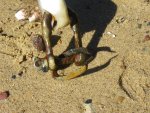
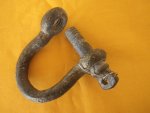
Shackles, good ones and not so good ones look much the same, if not identical. This is, or was, a no brand shackle - the sort you might find in a hardware store. It may have met its strength rating in a straight line pull, I don't know. The owner did some things right - he moused it - but it was side loaded and the shackle pin simply pulled out of the thread - he lost a new Excel anchor. If you buy your own shackles buy rated shackles from respected suppliers. If this shackle had had a nut at the end of the shackle pin - secured with a split pin...... .....I'd have had no lesson to show

IMGP2663 3.jpeg

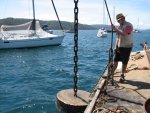
This is our old mooring, a 1t block with ground chain. The rope used to lift it is the mooring strop, being held by the operator, and runs from a swivel and shackle on the seabed 10m to the surface. We have a bridle spliced to this rope - all the splices are simply protected with hose pipe.


40wandeen yachts mooring screen 027 2.jpeg

This is typical of a rope to shackle connection which would be located on the seabed. This arrangement has no swivel, to might have been on the mooring block. The mooring had not been serviced - hence the failure.

Note that thought hose pipe reinforcing on the splice has worn through the eye seems still intact - but the chain has failed and the shackle pin look decidedly worn. The seabed is silica sand

IMGP1634.jpeg

Jonathan
 
Apologies for the delay, I only managed to visit the boat yesterday.

Jonathan, thank you for that horrifying pic of the failed shackle. All moorings will be replaced this year as there were a number of failures. I'll suggest that they use shackles with nuts but it's ultimately beyond my control. Going forward I'll feel uneasy with anything than three mooring lines holding my bow in place.

A number of people have suggested I go down the insurance road. This is the prudent thing to do, that's what insurance is for. But I'm on very friendly terms with the owners of the mooring and really don't want the insurance company chasing them down. If this were some random marina somewhere there's no doubt I'd involve insurance.

I managed to get down to the boat to inspect the situation. I lightly sanded the hull-skeg joint and was pleasantly surprised to find the crack disappeared. I'm not sure what the gray stuff is but only the top layer had cracks. After not much sanding I couldn't see the crack and it feels absolutely smooth to the touch. I can't get the skeg to budge by abusing the rudder, and the inside of the boat shows no signs of cracking. So I feel quite confident that the skeg is OK. For what it's worth, the skeg really does seem to be part of the mould of the hull, there are no bolts holding it in place.

The rudder is obviously damaged -- a superficial inspections shows that the inside is dry and hard (that black stuff is hard too). It really seems that it has been repaired in the past, and that my accident cracked that repair open. There's no side-to-side play, but there's a little of back-to-front play. There's some very very slight resistance when moving it to starboard. I don't know to what extent the play and "binding" are new (the binding is so slight that I doubt would be noticeable in the water), or just fair wear for a 30 year old boat. The rudder stock seems straight, the bottom of the rudder doesn't deflect as I move it from end to end, but I'm not sure how I can assess this more scientifically than just eye-balling the rudder.

So I think a reasonable plan is to drop the rubber, repair it, and replace the bearings in the process. Not sure if I should be contacting Jeanneau for the bearings. A number of people on the internet seem to prefer after-market suppliers like Jefa.
 

Other threads that may be of interest

Top