ropes

If that rope is what I am thinking it is ... just looking at the 'sheen' and make-up .... then sorry - its not rope I would use ... I think you have shown that I may not be wrong in avoiding such fancy - what I call 'carnival rope' .....
Unfortunately reasonably popular because the outer braid is easier to open up to splice. THAT is its weakness.

I'll stick with Marlow type flecked double braid on braid thankyou. It may be hard to splice ... but my choice.

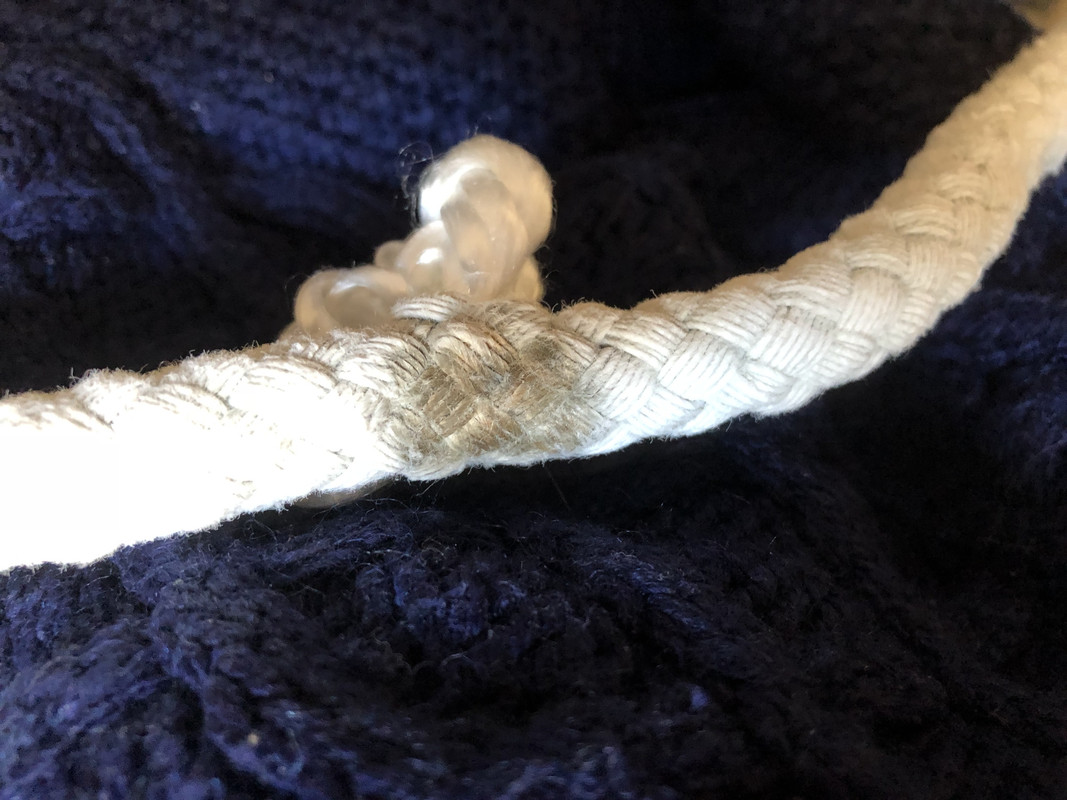
I would like someone to actually explain why a rope does this without any external 'hook or catch' to create ... i speak from my own observations and experience. Decent well made rope should not do this unless an external item causes it to break out. Such as a metal pin, tiewrap sharp end, damaged washing machine etc.

A decent rope has a sufficiently secure outer braid that should not unless weakened - as my genny sheets were - to allow core to come through without being pulled.

Pillowcase ? Yes if you have ... if not then at least THREE secured tapes or tiewraps to control the coils (making sure you do not cut the excess tiewrap !! That cut small piece sticking out of the locking bit is jagged and will create exactly what we are trying to avoid. ONE is not enough as then the rope will be free to tangle and be a mess ... TWO is enough but THREE is the best.

If I have a thimble or fixed end with metal etc. - then I make sure one securing tape or tiewrap is through that to make sure it doesn't flail about.

That is a nylon dockline (major manufacture) but this happends to other ropes too. I'm not the first to notice it. A rigger pointed the problem out to me.

This photo was from this forum about 6 weeks ago. This absolutly happens to all kinds of doublebraid in washing machines. Not all the time. The motion of the machine, weave, and age are all variables. But it happens, just not to you.

index.php
 
Question to 'thinwater' .... ref post #63 ..... were those ropes washed with those snap shackles and split rings as well ?????

No surprise at all ..... and NYLON !! Not exactly best halyard standards !! Confirms my suspicion of 'carnival rope' ... sorry but ..

I have Nylon lines that I bought as its kinder on the 'ladies' hands for moorings plus it STREEEEEETCHES ! .... pity after a few years it just falls apart due to its lack of UV / weather resistance.

Sorry but a decent Polyester Double Braid on Braid if washed carefully by making sure no ends / bits to snag ... will be fine.
 
Question to 'thinwater' .... ref post #63 ..... were those ropes washed with those snap shackles and split rings as well ?????

No surprise at all ..... and NYLON !! Not exactly best halyard standards !! Confirms my suspicion of 'carnival rope' ... sorry but ..

I have Nylon lines that I bought as its kinder on the 'ladies' hands for moorings plus it STREEEEEETCHES ! .... pity after a few years it just falls apart due to its lack of UV / weather resistance.

Sorry but a decent Polyester Double Braid on Braid if washed carefully by making sure no ends / bits to snag ... will be fine.

A. The poster stated the rope was polyester so you are wrong about that. I'm not sure why you are claiming it is nylon. It looks like good quality DB to me. Not carvaval rope and I don't understand why you felt the need to make that baseless attack.

B. I very seriously doubt the shackle had anything to do with it, but it's not my rope or my image. You are grabbing at any straw that might supprt your possition. I consider this argument to be a red herring.

I can post examples all day long. We never said it always happened, but many sailors have posted pictures and I hace seen this in several rope types. It's not common, but it's not rare. It is a risk worth making people aware of.

(this is also polyester)

C687_CC08-1963-4632-_B708-1_CAF2989_F9_B0.jpg
 
Last edited:
"thinwater' ..............

I specifically mentioned Post #63 .............. YOUR POST where you clearly state NYLON and then show photos of the lines.

I am not "grabbing at any straw that might support my possition". In fact I have only shown where your argument is unsupportable.

Again in post #65 .... crappy Nylon rope ....

I suggest 'thinwater' .... find a better rope ..... nylon is 'carnival rope' ..... I would never trust my worst enemy with it !!

As I have said many times in posts years before this thread in fact ... sort out the rope and secure properly ... remove any items that could damage the rope ... then wash. I am not only one who has washed ropes many times and not had any problems. If there are problems - then I suggest to you that it is most likely USER fault for not being more careful ... as I was with my old worn out genny sheets. BUT I was man enough to admit it !!
 
This nylon rope has been washed a dozen times, in the same machine, coiled in the same manner. No damamge. Obviously, nylon is not the key factor. As for stretch, nylon rope will not stretch appreciably under the conditions in a washing machine--that would require hundreds of pounds.

4. tighter covers, such as tis climbing rope, are not vulnerable to herniation.jpg

The motion is between the cover and the core, and is not related to the stretch of the material, it is related to the weave. This rope does, obviously, have a much finer cover.
 
Oh Boy Oh Boy ... let me put this down to cross atlantic language problems ....

Nylon rope is unsuitable as a yottie rope as it stretches ... it is a softer and less tight braid lay-up ... its great for cosmetic work - but not for serious use. In larger sizes it might be useful as a mooring line to avoid sharp stress due to its 'elasticity'.

As for stretch, nylon rope will not stretch appreciably under the conditions in a washing machine

YOUR words not mine - I never said it will stretch in a wash machine !!

Back to nylon and unsuitable ... I have lots of pieces of nylon rope that are from ONE rope that has basically fallen apart due to UV / weather ... I keep them to show others not to make mistake of using it ...
 
Having been responsible for the demise of our domestic washing machine while washing halyard lines, I have resorted to using the local commercial machines at a nearby BP garage. You can get a lot of ropes in the larger machine - and some interesting looks from others when loading in the ropes..........


1588530183048.png
 
Having been responsible for the demise of our domestic washing machine while washing halyard lines, I have resorted to using the local commercial machines at a nearby BP garage. You can get a lot of ropes in the larger machine - and some interesting looks from others when loading in the ropes..........


View attachment 89632

Any damaged ropes ?
 
Been washing mine for years on hot wash with plenty of powder (Tesco basic for us with a water softener). But do make sure the ends are either well sealed or whipped first Never had any wrecked, or in such a tight knot they won't undo. If they have any green in them I chuck in some bleach to get rid.

Awaiting incoming.
Green? Treat with Patio Magic.
 
each to their own - it reduces water retention by the interior of the rope making the rope lighter on a wet day
Some ropes need to be able to soak up water rapidly. For instance, if you want to lassoo a a mooring buoy, (controversial:) ), or more importantly, an MOB, it is recommended that you drop tne bight of rope into the water for a few moments so that it soaks up some water and thereby has more momentum when thrown.
 
I would suggest next time - you can save yourself all that time .... just a simple wash cycle in the machine with a small amount of powder only .... no softeners or overnight soaks etc.

My running gear is well over 20years old and still in good condition ... except for genny sheets that suffer from the cap shrouds ... so they get reversed each year to even out the wear and tear.
I am only replacing this year because I want to reduce the size of ropes used - they are maximum size for the halyard sheaves in mast ... and way oversized at 12mm - so will replace with 10mm . The old will be used as mooring and general purpose lines .....
It's not advised to use old halyards for mooring, as they do not stretch under load and therefore have no shock-absorbing qualities.
 
Re guarding water repellent treatments, there seems to be a great deal of misunderstanding from people who have not used them:

a. They do not waterproof ropes to the extent that they float or anything like that. They do reduce water hold up to the extent that they won't freeze into a useless stick in the mountains or winter sailing. They reduce weight very slightly for light air sheets. But not like using polyolifin sheets or anything like that. If I handed you a treated rope I doubt you could tell the difference. I can't.
b. They replace internal lubricants that have washed out, increasing flexibility and eliminating squeaking and softening the rope, even more than just washing. They reduce internal rope wear. Something like fabric softener, but MUCH more durable and never sticky.
c. It is a lot cheaper than the instructions say if you just treat the rope by soaking in a bucket, and then treat the next rope in the dregs with some booster. Just a few dollars per rope. One bottle will probably do the whole boat twice. That kills the expense argument.

Waste of money? Odd words if you've never tried it and don't understand the value proposition. You're reading a thread on washing ropes, so clearly you are a little OCD in spots. I treat ice climbing ropes (vital--they always are), furler lines (I sail below freezing), and other lines only if I have a very specific reason (squeaking or not running well). Treatment always helps by replacing internal lubricants. I honestly can't see a down side, other than that I am too lazy to wash ropes in general. Treatment always helps by replacing internal lubricants.

Or you can ignor this thread and just buy new rope every 5 years or so. It's not that expensive and new is very nice. Less work and a better result. I can see either path.
 
These were new ropes, daisy chained on gentle. A failure every 6-8 inches. I was washing them just to break them in a little before testing began. I'm not naming names, because I have seen this in most brands, but it was a major.

I had to get the manufacture to send new rope, which I washed in pillow cases. Other ropes gave different results, depending on the weave, coiling practice (or none), and age. It happened a number of times. The only method that always gave clean ropes and never resulted in a damamged rope was presoaking followed by washing in a pillow case. Reach any conclusion you chose, but this is real life and I'm just sharing information. Your results will almost certainly differ.
This, and you comment "loose ropes can wrap around the agitator" in post #45 make me wonder whether the differences in domestic washing machines between USA and Europe (including UK) are relevant. US ones are typically bigger and are top-loaders with a central agitator, while we Europeans tend to have smaller front-loaders where the agitation is done by fins inside the rotating drum.
 
This, and you comment "loose ropes can wrap around the agitator" in post #45 make me wonder whether the differences in domestic washing machines between USA and Europe (including UK) are relevant. US ones are typically bigger and are top-loaders with a central agitator, while we Europeans tend to have smaller front-loaders where the agitation is done by fins inside the rotating drum.

I have to say that my Mother had a 'Twin Tub' with vertical agitator ... I would NEVER put a rope in one of those .....

The machine I use is the typical front loader in EU .. with as Alan says .. a rotating drum and no separate agitator ... in fact its a gentle machine compared to a Twin Tub !!
 
Top