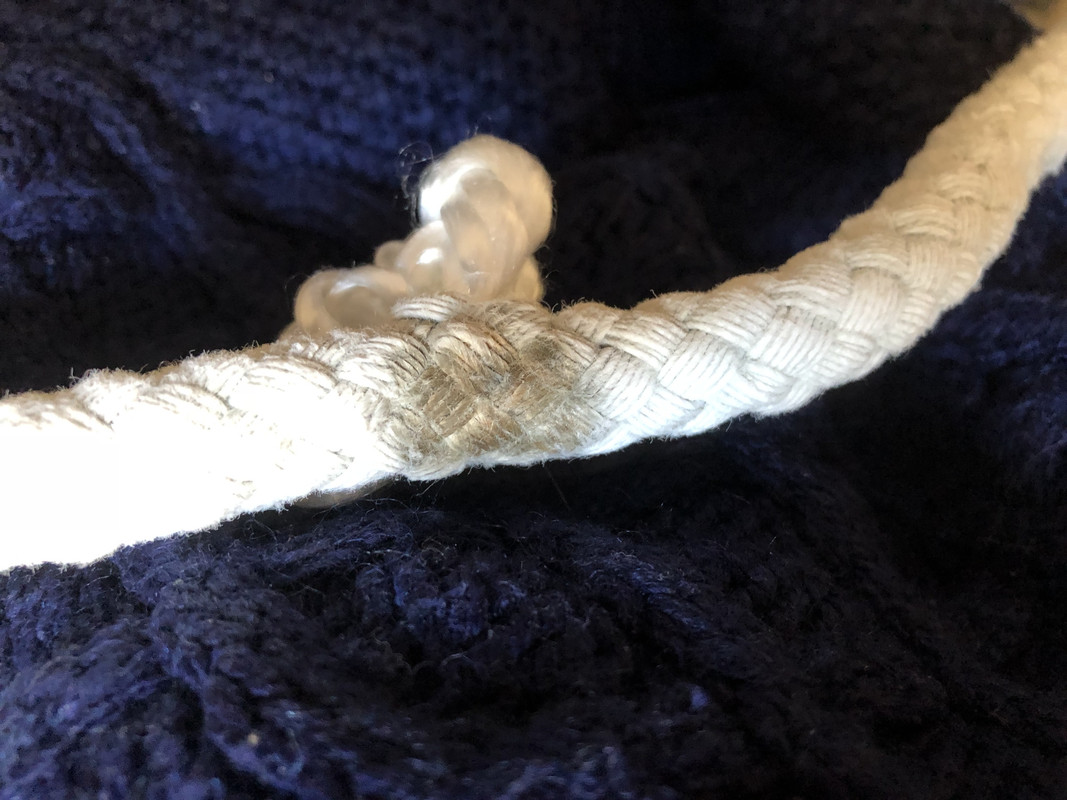
If that rope is what I am thinking it is ... just looking at the 'sheen' and make-up .... then sorry - its not rope I would use ... I think you have shown that I may not be wrong in avoiding such fancy - what I call 'carnival rope' .....
Unfortunately reasonably popular because the outer braid is easier to open up to splice. THAT is its weakness.
I'll stick with Marlow type flecked double braid on braid thankyou. It may be hard to splice ... but my choice.
I would like someone to actually explain why a rope does this without any external 'hook or catch' to create ... i speak from my own observations and experience. Decent well made rope should not do this unless an external item causes it to break out. Such as a metal pin, tiewrap sharp end, damaged washing machine etc.
A decent rope has a sufficiently secure outer braid that should not unless weakened - as my genny sheets were - to allow core to come through without being pulled.
Pillowcase ? Yes if you have ... if not then at least THREE secured tapes or tiewraps to control the coils (making sure you do not cut the excess tiewrap !! That cut small piece sticking out of the locking bit is jagged and will create exactly what we are trying to avoid. ONE is not enough as then the rope will be free to tangle and be a mess ... TWO is enough but THREE is the best.
If I have a thimble or fixed end with metal etc. - then I make sure one securing tape or tiewrap is through that to make sure it doesn't flail about.
Question to 'thinwater' .... ref post #63 ..... were those ropes washed with those snap shackles and split rings as well ?????
No surprise at all ..... and NYLON !! Not exactly best halyard standards !! Confirms my suspicion of 'carnival rope' ... sorry but ..
I have Nylon lines that I bought as its kinder on the 'ladies' hands for moorings plus it STREEEEEETCHES ! .... pity after a few years it just falls apart due to its lack of UV / weather resistance.
Sorry but a decent Polyester Double Braid on Braid if washed carefully by making sure no ends / bits to snag ... will be fine.

As for stretch, nylon rope will not stretch appreciably under the conditions in a washing machine
My worry about Dyneema ropes in a washing machine relate to both the cover issue and to the temperature.

Having been responsible for the demise of our domestic washing machine while washing halyard lines, I have resorted to using the local commercial machines at a nearby BP garage. You can get a lot of ropes in the larger machine - and some interesting looks from others when loading in the ropes..........
View attachment 89632
Any damaged ropes ?
Green? Treat with Patio Magic.Been washing mine for years on hot wash with plenty of powder (Tesco basic for us with a water softener). But do make sure the ends are either well sealed or whipped first Never had any wrecked, or in such a tight knot they won't undo. If they have any green in them I chuck in some bleach to get rid.
Awaiting incoming.
Some ropes need to be able to soak up water rapidly. For instance, if you want to lassoo a a mooring buoy, (controversialeach to their own - it reduces water retention by the interior of the rope making the rope lighter on a wet day
It's not advised to use old halyards for mooring, as they do not stretch under load and therefore have no shock-absorbing qualities.I would suggest next time - you can save yourself all that time .... just a simple wash cycle in the machine with a small amount of powder only .... no softeners or overnight soaks etc.
My running gear is well over 20years old and still in good condition ... except for genny sheets that suffer from the cap shrouds ... so they get reversed each year to even out the wear and tear.
I am only replacing this year because I want to reduce the size of ropes used - they are maximum size for the halyard sheaves in mast ... and way oversized at 12mm - so will replace with 10mm . The old will be used as mooring and general purpose lines .....
This, and you comment "loose ropes can wrap around the agitator" in post #45 make me wonder whether the differences in domestic washing machines between USA and Europe (including UK) are relevant. US ones are typically bigger and are top-loaders with a central agitator, while we Europeans tend to have smaller front-loaders where the agitation is done by fins inside the rotating drum.These were new ropes, daisy chained on gentle. A failure every 6-8 inches. I was washing them just to break them in a little before testing began. I'm not naming names, because I have seen this in most brands, but it was a major.
I had to get the manufacture to send new rope, which I washed in pillow cases. Other ropes gave different results, depending on the weave, coiling practice (or none), and age. It happened a number of times. The only method that always gave clean ropes and never resulted in a damamged rope was presoaking followed by washing in a pillow case. Reach any conclusion you chose, but this is real life and I'm just sharing information. Your results will almost certainly differ.
This, and you comment "loose ropes can wrap around the agitator" in post #45 make me wonder whether the differences in domestic washing machines between USA and Europe (including UK) are relevant. US ones are typically bigger and are top-loaders with a central agitator, while we Europeans tend to have smaller front-loaders where the agitation is done by fins inside the rotating drum.