Rookie question

We went there with a copy of Delmar Morgan on board, in 1978. TBH, I don't think that pilots are much use, being expensive and full of unnecessary pretty colour photos and information that soon goes out of date. I think that you would be better off with Reeds, which gives you the important stuff, and a copy of something like the Michelin guide, which can be really useful.
I agree strongly with Johnalison that Reeds will give you all the detailed pilotage you need for this coast and be up to date, provided you take the current year's copy. I enjoy reading pilot books but don't find they add much of practical help beyond the data in Reeds, which ckvers a vast area.

Peter.
 
I annotate my pilot books with notes like where the supermarkets are, restaurants, notes on the approaches etc. It makes the pilot book more of a personal rutter.

What I find utterly useless are aerial photographs. I'm at sea level not 500m up in the air! Another one is photographs looking out to sea. Only use is for advance reconnaissance by hire car.
 
Interesting. I find the aerial photos (first introduced, I believe by Jack Coote of East Coast Rivers fame) one of the few useful fearures of Pilot books. However, I find the drone videos, such as those published here by John Ranson (Johnah) even better and regularly updated.

In fact, for our ever changing coast, I find the websites of Tillergirl (CTTE) and Cantata, with copious free chartlets to download, the most useful adjunct to up to date charts, for which Tillergirl's weekly updates are a fantastic aid. In fact, I find the websites more useful than the books, but do carry the books on board. I would prefer a link to a local website offering the same service for a foreign coast I was visiting to any Pilot Book.

Thank you again, Roger & Dick.

Peter.
 
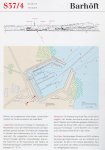
I have no use for aerial photos and think that navigating by harbour charts is an important skill, since you have to imagine what it will look like when you get there. My favourite pilots were German ones that went with the charts and cross-referenced to them. Something similar is still available there but mine have been superceded long ago. All they have is a harbour chart, often a drawing of the approach, and written information about the place. With a G/E dictionary to hand even I can get the gist of it. Here is a page about a charming little place.
IMG_20220711_0001.jpg
 
In the last couple of weeks the UKHO weekly notices include this:

PHOTOGRAPHY
ADMIRALTY publications utilise imagery from a wide variety of sources, mariners, port authorities and
other users. The UK Hydrographic Office (UKHO) welcomes new imagery of navigational aids,
landmarks, coastline, approaches to and from ports and berths. Imagery from the mariner's point of view
is especially helpful. Images can be sent to the UKHO using the email publications.queries@ukho.gov.uk.
Please include the name and location of the feature in the image and how the image should be accredited
within ADMIRALTY publications.
 
In the last couple of weeks the UKHO weekly notices include this:

PHOTOGRAPHY
ADMIRALTY publications utilise imagery from a wide variety of sources, mariners, port authorities and
other users. The UK Hydrographic Office (UKHO) welcomes new imagery of navigational aids,
landmarks, coastline, approaches to and from ports and berths. Imagery from the mariner's point of view
is especially helpful. Images can be sent to the UKHO using the email publications.queries@ukho.gov.uk.
Please include the name and location of the feature in the image and how the image should be accredited
within ADMIRALTY publications.
I think I’m too old for all this. Photos in colour have great appeal but they can be misleading if the weather or light are different from that experienced. Mariners’ drawings have been used for centuries of course, but that doesn’t mean that their time has passed. I can get what is important from drawings like my example above far more easily, and cheaply for that matter. I know I’m on a hiding to nothing in making this point but it would be lovely if just one person agreed with me.
 
I think you are spot on that things can be misleading. I have no idea why you think you are on a hiding to nuffin. I think you are making a good point. Note the Admiralty said 'Imagery from the mariner's point of view is especially helpful'. The Admiralty will want to collect as much information as possible so they can compare and contrast; not to produce a series of images.
 
I think I’m too old for all this. Photos in colour have great appeal but they can be misleading if the weather or light are different from that experienced. Mariners’ drawings have been used for centuries of course, but that doesn’t mean that their time has passed. I can get what is important from drawings like my example above far more easily, and cheaply for that matter. I know I’m on a hiding to nothing in making this point but it would be lovely if just one person agreed with me.
You make a good point. The whole art of cartography is to present essential information without being swamped by extraneous information; the process is called abstraction. Charts are an excellent example of how that should be done; they present the information you need and suppress much else. There is a case for non-essential information being available to provide context for essential information, but information used for that should be very much in the background. Geological maps of the UK are a good example - they use a grayscale version of the OS map as background, but the geological information is in bright colours. Your point about seasonal changes is very good, too; of course in our latitudes, a wood may have a very different profile in winter and summer! Colour choice is also important, but much harder to get right.

Images are an excellent resource - much of my work in Antarctica depended on it! But equally, much of my work was to abstract essential information from an image, removing the effects of (say) shade and presenting a uniform and harmonized view of the terrain. Skill in interpreting images was essential; even in an essentially monochrome world like Antarctica, it isn't straightforward! But the maps we created from images provided a view of the terrain that was independent of sun direction or shading.

We did provide some photo-maps to support fieldwork where the existing data and resources were inadequate, but we (and most of the users) regarded these as a stop-gap measure. Unfortunately, improving on them might require man-years of work, and we were a group of 6!
 
My longest coastal passage as Skipper is eleven hours so not confident enough to go from the Needles I just know it is the most common crossing point.

Solent/Poole/Weymouth are indeed popular and easy crossing points. Popular because there are lots of boats and relatively easy because as pointed out they are 2 cross tide passages - 12-15 hours with very clear start and finish points. However, they are a long way from the Medway and if you intend going further west you are better off crossing in the east and coasting down the French side.
 
Solent/Poole/Weymouth are indeed popular and easy crossing points. Popular because there are lots of boats and relatively easy because as pointed out they are 2 cross tide passages - 12-15 hours with very clear start and finish points. However, they are a long way from the Medway and if you intend going further west you are better off crossing in the east and coasting down the French side.
The Normandy coast is an excellent place to start coastal cruising, with many treasures such as St Valery en Caux, and excellent cheese. The longest hop is Boulogne to Dieppe, missing out the dull Le Tréport, at 55 miles, but this is a quiet area without shipping.

Another passage worth thinking about, perhaps not for a first, is Brighton to Cherbourg. We used to do this to get to the Channel Isles. Although it is 90 miles, you can get two tides with you and one against, making it seem much shorter.
 
Ramsgate to Calais with a favourable tide time is sounding realistic for my first channel crossing and exploring the Normandy coast is very appealing. Thanks for all the input.
 
Ramsgate to Calais with a favourable tide time is sounding realistic for my first channel crossing and exploring the Normandy coast is very appealing. Thanks for all the input.
The Normandy coast doesn't usually appear on lists of great cruising areas, but these lists are made by experienced sailors who want lots of rocks and racing tides to hold their attention and challenge them. The Normandy coast is attractive all the way from Picardy to Cherbourg and spectacular in places and there is plenty to see and do on land. I won't give too much away and spoil your fun, but you'll enjoy it.
 
I am surprised no-one has mentioned Ramsgate to Graveline. If the tides are right it's a lovely place and certainly shorter than Ramsgate to Boulogne. But again it isn't a passenger port and therefore have to take a taxi or bus to Calais ( or possibly Dunkirk) to get passports stamped. Also don't forget you need to do the same again when you leave so you either have to make Calais your last point of call in France or get a taxi or train from Boulogne to Calais, and of course once in Calais get to the port itself. TBH it's all this faffing around that has caused me to stay in the UK this year. Only two years ago it was so much easier.
 
As it stands Boulogne is not a port of entry, Calais or Dunkirk are so you would have to book in there. Next year might see some sense restored but I wont hold my breath.
Boulogne is listed as a port of entry on both CA and admiralty websites. do you know something they dont?
 
Seconded for Ramsgate Calais.. Ised to do it all the time.

The trip from the Mudway to Ramsgit is a decent passage of itself. Leave at HW near Sheerness. Take the falling tide to Ramsgate. You get to Ramsgate at about LW and can carry on or stop over and explore.

Ramsgate is actually a magical place unlike any other in the UK. You are in the centre of the town with all the shops and pubs right next to you. Leave on LW as the tide turns south. Follow the deep water chanel due east (crossing the tide) till Goodwin Knoll buoy. Point at Dunkirk (130 degrees) and the tide takes you to Calais in time for the bridge to open into the marina near HW. As you will be arriving newr HW, you can go straight across the sandbanks outside the harbour.

Keep a sharp eye out for shipping as you get newr the TSS. Ships that come into view at about ten O'clock in the SW lane and two O'clock in the NE lane are the ones that will get close. Contaier ships and small white ones go very fast.
 
Interesting comments re aerial pics. We certainly introduced more of them in the current edition of ECP, but we do understand and did continue (I hope, in most cases) the sea level views on approach for most places. We felt that the aerials were/are useful to give a broad layout of what is where, especially when annotated with arrows and identifiers. If everyone thinks they are a waste of space, perhaps we should think about reducing them again next time round!
 
Boulogne is listed as a port of entry on both CA and admiralty websites. do you know something they dont?
My understanding is that if you arrive at Boulogne you are required to go to Calais to get your passport stamped and vice versa on departure. Unless that has changed in the last month or two?
 
Interesting comments re aerial pics. We certainly introduced more of them in the current edition of ECP, but we do understand and did continue (I hope, in most cases) the sea level views on approach for most places. We felt that the aerials were/are useful to give a broad layout of what is where, especially when annotated with arrows and identifiers. If everyone thinks they are a waste of space, perhaps we should think about reducing them again next time round!
Not a waste of space, but perhaps to be used in addition to interpreted drawings?
 
It's a matter of style. At the age of 82 I think that I am entitled to be a bit old-fashioned when it suits me. I have visited mumerous places over the years, from Kinsale to Gdansk, mostly with the minimum information needed for safe navigation, and I can't think of any that I visited for the first time with more than the vaguest idea of what I was going to see when I got there. I have always treasured this sense of discovery, and the serendipitous adventures that it has brought me. Pilots have followed the style of guide books generally, and for me personally they spoil the fun of going somewhere new. For a city, all I need is something like a Rough Guide or the old Michelin guides. I can see that there is a commercial need to sell publications and that in today's market this means making books look sexy. In my quest to help fellow sailors enjoy some of the things that have pleased me I generally try to avoid giving too much away because I can still remember the fun we had finding things out for ourselves. I hope that at least some of todays new cruisers can see it this way, in today's age when the whole world can be seen on infinite Street Views (which I adore).
 
Top