Rocna Style Anchor or Delta?

Just to stir the pot a bit, now that I've had a lot more info on anchors I found that the delta style 12kg anchor I currently have is actually the kobra 12kg anchor which technically is within the size range for my yacht. But 12kg does seem pretty low and the surveyor commented he thought it seemed underweight.

My next option is to ask a chandlers if I can buy a Rocna to try out on the roller to see if it works. If it doesn't I'm thinking keep the Kobra for now or change to a 20kg Delta.

I don't know where you are based but this could save a lot of money, probably get it for £150:

Pardon our interruption...

Extra weight is only an issue for those with racing/light displacement boats or those without a windlass......as long as it fits your bow.

.
 
Thanks, based near Plymouth. Definitely interested in cruising not racing,

I'd sit tight for a bit longer - people buy another anchor for a variety of reasons and then put their 'old' anchor for sale on eBay, or equivalent. This forum has a 'For Sale' section.

This thread will run for some time and your ideas can change with further information.

I think we all assume you have a windlass - but one should never assume.

It has been mentioned but not emphasised - for the sailing (or anchoring) you intend doing you should be carrying a cross section of anchors. Fortress is an obvious choice, very different to all the anchors you are considering and mentioned on this thread - but if you need to deploy from a dinghy then their light weight is a godsend. Again - keep watching eBay. If you lean toward Epsioln I'd ring Lewmar and ask the obvious questions, is the anchor with drawn, why can you not buy one - when, if ever, will new stock arrive (and report back here).

I found the folding mechanism of Kobra a liability, and had mine welded up. I also found the shank weak (and I bought ours in Preston marina and there was a bent shank on a Kobra on the bow of a boat in the marina). Its a great anchor, apart from the mechanism and shank - but I know why its cheap. I test anchors - but I would not use a Kobra, for the reasons stated. I would not buy a Delta either - virtually everyone posting on this thread has replaced their Delta with whatever is their choice and for most they would never consider going back to a Delta - modern anchors are so predictable and reliable. Perfectly acceptable, but superseded - if you could get one would you buy a new Ford Cortina? - does the job, sort of, but replaced by factorially better, and safer, vehicles.

The list of anchors and their prices - keep the anchor for a year and it works out at about Stg1.50 per day - people pay that daily for cups of coffee, they could make themselves -

Jonathan
 
Another way of looking at this dilemma is to consider the cost of one night at say MDL compared to differences in prices on basis you want a new anchor . Based on prices quoted the difference seems about 2 nights berthing at say Brixham ,Torquay or wherever you cruise. I would bit the bullet and get down to a local chandlers to test out that rocna on your roller. I haven’t ever felt the need to change our Lewmar delta but our anchoring would be for lunch stops or in the sludge of Chi harbour . I suspect most makes supplied nowadays hold fine in south coast harbours unless you winter cruise in f8 weather .it seems the amount of chain deployed has a bearing on situation -I have tended to think the rya taught scope under estimates the need but just my impression.
 
The Kobra II does not have a folding mechanism, least not above 10 kg. There are plenty of reasons why an anchor shaft becomes bent.

We seem to consistently sail and anchor in areas where there are few ports and the weather has a reputation of being frequently rough and unpleasant. Last year alone we anchored three times in winds up to and above 45 kts. At twenty knots we barely pay attention. Thank you, but our shaft still looks perfectly fine.

The nominal wind load on our boat in a F10, which has a the aerodynamic efficiency of a brick, is about 3090 N or roughly 300kg. Peanuts!
The nominal load in a 5kt current is 1980 N or about 195 kg. Also peanuts.
Our 16 kg Kobra seems to manage fine with this.
 
In addition

Spade was the first of the new gen anchors but the 2006 YM anchor test put new gen anchors on the map - and there have been a number of good anchors since (and a number of tests). We have had 20 years of new gen anchors, though some new anchors have only been available much more recently. I don't recall anyone ever saying:

'I wish I had kept my Delta or CQR - this new gen anchor is rubbish'

Nor anyone saying - 'I'm retiring my Rocna, Supreme, etc - and replacing it with a Delta'.

Most people who have changed, upgraded? seem more than happy with their choice. (I accept having spent the monies defined earlier - few are going to admit they bought a lemon.)

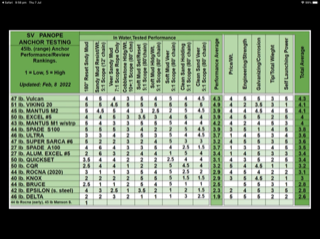
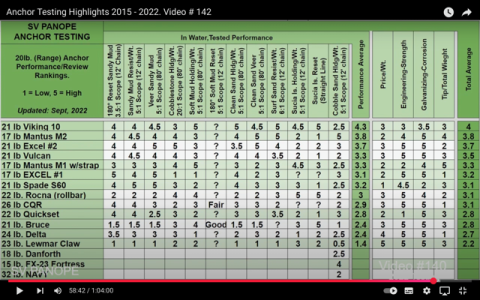
Yachting Monthly published the 2006 test and published some of the tests conducted later by Voile et Voilears (my spelling may be incorrect). These tests all included hold data. The Panope/Steve Godwin videos and spreadsheets also provide some background (and no hold data) - but take the tests in total, all test regimes have their faults.

Jonathan

IMG_9522 2.PNGScreen Shot 2024-12-17 at 9.03.32 pm 2.png
 
The list of anchors and their prices - keep the anchor for a year and it works out at about Stg1.50 per day - people pay that daily for cups of coffee, they could make themselves -

Jonathan
That really is a daft argument. Just about all anchors do the job for most people and very few boats are lost never mind lives because of anchor failure. The OP is a UK sailor, and unless he spends most of his time living on his boat he is unlikely to spend more than 50 or 60 days at anchor a year, and then mostly in the more benign summer months in good anchorages. Anchoring even with the dreaded CQR really is not an issue. Sure some anchors are difficult to set and it can be annoying; some anchorages can be congested and dragging can be a nuisance, but by and large anchoring is a non event once you get the hang of how to do it with your boat and gear.

On the other hand as Pete Smith says when talking about what prompted him to look for improvements is that when you move away from this pattern of usage and become a voyager visiting a wide variety of anchorages maybe in poor weather you quickly encounter a wide range of situations that show up the weaknesses of older designs. Of course newer designs are on the whole "better" - they have to be otherwise why bother? That does not mean that everybody needs them at up to 3 times the cost for benefits they may never need.

Keep a sense of proportion. It is nothing to do with the daily cost nor what that is compared to a daily cup of coffee. It is based on your assessment about what is most appropriate for your type of use and with the budget available. Of course having a £600 anchor on your bow roller might give bragging rights and you might be able to claim "hold me comfortably in a F10 off a lee shore", but it is not a sound rational decision .
 
To the OP, consider a 13kg Knox, at a shade over £300

Tranona is being somewhat glib, boats drag all the time. Often without physical damage, but the psychological damage to your inability to get a good nights sleep after dragging should not be underestimated.

— W
 
The Kobra II does not have a folding mechanism, least not above 10 kg. There are plenty of reasons why an anchor shaft becomes bent.

We seem to consistently sail and anchor in areas where there are few ports and the weather has a reputation of being frequently rough and unpleasant. Last year alone we anchored three times in winds up to and above 45 kts. At twenty knots we barely pay attention. Thank you, but our shaft still looks perfectly fine.

The nominal wind load on our boat in a F10, which has a the aerodynamic efficiency of a brick, is about 3090 N or roughly 300kg. Peanuts!
The nominal load in a 5kt current is 1980 N or about 195 kg. Also peanuts.
Our 16 kg Kobra seems to manage fine with this.
I suggest you read this article:

Bends and Breaks: Anchor Shank Strength - Practical Sailor

And then tell me what steel is used in your anchor.

Jonathan
 
I suggest you read this article:
Thank you for that and I'll cross that bendy bridge when I get there. Fortunately, I carry two extra anchors on board, both of which have an equal holding capacity to my current main anchor. At least I'll be in good company when it finally does get all bent out of shape: with Rocna, Spade and Ultra. I'll let you know how it all shapes up, until then, I'll carry on anchoring all over Norther Europe and Scandinavia with what I got, be that in high winds or a calm.
 
Thank you for that and I'll cross that bendy bridge when I get there. Fortunately, I carry two extra anchors on board, both of which have an equal holding capacity to my current main anchor. At least I'll be in good company when it finally does get all bent out of shape: with Rocna, Spade and Ultra. I'll let you know how it all shapes up, until then, I'll carry on anchoring all over Norther Europe and Scandinavia with what I got, be that in high winds or a calm.
As Tranona said most of us anchor somewhere that'll be benign - so I'm sure you will be fine. You are still here so your practice is honed which underlines your confidence.

But do you really carry a Kobra and the other 3 you mention?

The strength, or lack of, is not in a straight line pull but the tension when applied to the shank at 90 degrees.

You mention the nominal load on your yacht in F10 is 300kg - I've never measured the windage of a yacht that was the shape of a brick. I measured snatch loads, it was a moving yacht at anchor, of 650kg in 35 knots. The yacht had the windage, approx, of a 45' AWB. Its not the steady wind of F10, or whatever, (and F10 is much higher than my 35 knots) but the tension induced when the yacht sails at anchor or the gusts are coming from a variety of directions.

300kg is 'about' the tension in your rode imposed when you power set your anchor with a 30hp engine running at cruising revs (and when power setting under a sustained tension). I checked this with our 2 x 20hp engines and a load cell - crudely its 'about' 100kg of tension for every 10hp.

Confession - I had to look up F10 to confirm - we don't use the Beaufort scale here, we work in knots or km/hr - Oddly we still call F10 a 'Storm'. We have not totally abandoned Beaufort as I associate 'Storm' with F10.
 
Last edited:
I anchor over 300 days a year and have done so for the last 17 years, so you can perhaps understand my emphasis on selecting the best rather than the least expensive anchoring equipment.

If you plan to anchor overnight or leave the boat unattended during the day, I would encourage you to avoid poorly performing anchors or copies of better performing anchors.

Rather than a Rocna copy or even a genuine Rocna, I would suggest a Mantus M1. Having owned and trialed both a genuine Rocna and the Mantus M1 over many nights at anchor, the Mantus is the better performing option (I have not seen the latest Mk2 Rocna).

One caution is: Mantus is a physically large anchor; check the fit on your bow roller before ordering.
 
I don't know where you are based but this could save a lot of money, probably get it for £150:

Pardon our interruption...

Extra weight is only an issue for those with racing/light displacement boats or those without a windlass......as long as it fits your bow.

.
I forget the detail but Simpson Lawrence was a fundamental part of Lewmar (when Lewmar was established). SL offered ground tackle and windlass to add to the Lewmar portfolio. SL conducted all the research and initial production of Delta. Delta was designed to counter the introduction of the Bruce anchor which was taking sales away from the CQR. Providing the anchors is a genuine SL anchor it should be fine, but may need re-galvanising. Seems expensive.

The current Delta maybe different from the original SL Delta - and anchors sometimes enjoy updating, like the current Rocna.

Jonathan
 
Our boat, see avatar, is just under 32' and displaces 8.5 t in full cruising trim. Our engine delivers 58 hp and we use a substantial portion of it to back in the hook, always.

F10 equates to 52 kts. The calculation by which I arrived at the projected load of 300kg includes a sufficient margin to cover additional loading due to the boat swinging at anchor.

Yes, we do carry a total of three anchors: a 35 lbs CQR, which lives in the bilge, a 16 kg FOB, ready to deploy on the stern rail (the shaft, you will be happy to know, is a massive, rectangular section of 3x5 cm, made in France) and a 16 kg Kobra II on the bow.

We rode out 40 kts on the CQR in the Dutch Waddenzee (no shelter from the wind) together with a 4 kt tidal current. Total calculated load for wind and current: 1960 N or 190kg. Compared to the CQR, which works fine once set, the Kobra is much more aggressive, has a much larger surface area and a considerably better tip to shaft weight ratio due to a ballasted tip.

I did not buy the Kobra because it was reasonably priced or "cheap", but because it came out on top in consecutive tests conducted on a variety of sea beds. Due to it's performance in different sea beds it was judged to be a "true" universal anchor. Works for us.
 
Our boat, see avatar, is just under 32' and displaces 8.5 t in full cruising trim. Our engine delivers 58 hp and we use a substantial portion of it to back in the hook, always.

F10 equates to 52 kts. The calculation by which I arrived at the projected load of 300kg includes a sufficient margin to cover additional loading due to the boat swinging at anchor.

Yes, we do carry a total of three anchors: a 35 lbs CQR, which lives in the bilge, a 16 kg FOB, ready to deploy on the stern rail (the shaft, you will be happy to know, is a massive, rectangular section of 3x5 cm, made in France) and a 16 kg Kobra II on the bow.

We rode out 40 kts on the CQR in the Dutch Waddenzee (no shelter from the wind) together with a 4 kt tidal current. Total calculated load for wind and current: 1960 N or 190kg. Compared to the CQR, which works fine once set, the Kobra is much more aggressive, has a much larger surface area and a considerably better tip to shaft weight ratio due to a ballasted tip.

I did not buy the Kobra because it was reasonably priced or "cheap", but because it came out on top in consecutive tests conducted on a variety of sea beds. Due to it's performance in different sea beds it was judged to be a "true" universal anchor. Works for us.
Of the Kobra I could not agree with you more (and it is cheap). It engages well, it sets well with a bit of engine power or wind, it does not clog with mud - which are characteristics of a good anchor.

Jonathan
 
As Tranona said most of us anchor somewhere that'll be benign - so I'm sure you will be fine. You are still here so your practice is honed which underlines your confidence.

……
Yes if all you are going to do is marina hop and occasionally anchor for lunch.

If the OP really intends to use the boat widely around UK waters, then when gets up to the NW then need to be confident about anchoring to weather a gale, in a location where no harbours / pontoons are nearby - or importantly have space, if everybody else moves to the only pontoon for 100 miles 2 days before a bad forecast.

As the wind blows 40 knots in the dark, few regret paying a bit more for a good anchor and chain.

PS Unlike some on here I did a direct comparison - Rocna on previous boat, then Delta on new boat, which was a major disappointment in terms of setting and grip, so dumped and swapped to Rocna mid cruise. So direct comparison on same boat. No comparison.
 
I suggest you read this article:

Bends and Breaks: Anchor Shank Strength - Practical Sailor

And then tell me what steel is used in your anchor.

Jonathan
I think I would be be quite pleased if I hauled up my anchor one day after a wild night and found the shaft bent!

Because that means it held all night, and the fact that it bent but did not break or drag could be a testament to its holding power :) and £150 for a replacemnt is less than the excess on any insurance claim.

Unless of course it happened in a F5 :)
 
I think I would be be quite pleased if I hauled up my anchor one day after a wild night and found the shaft bent!

Because that means it held all night, and the fact that it bent but did not break or drag could be a testament to its holding power :) and £150 for a replacemnt is less than the excess on any insurance claim.

Unless of course it happened in a F5 :)
That's exactly what happened with Rocna with the bendy shanks. One unlucky owner bent the shank. received a new one as a replacement - it too bent.

The fluke held but the shank bent. An anchor with a bent shank cannot be set and its very difficult to straighten the shank

If you read the PS article the rusty anchor was one of the many with the 350Mpa shanks

I recall people were not happy.

The shank of one of the bent anchors was tested and found to be a 350Mpa quality not the 800Mpa claimed. - all written up in PBO.

I still have the anchor, wondering what to do with it - maybe you would like to buy it? :). You might be quite pleased.

Jonathan
 
Last edited:
PS Unlike some on here I did a direct comparison - Rocna on previous boat, then Delta on new boat, which was a major disappointment in terms of setting and grip, so dumped and swapped to Rocna mid cruise. So direct comparison on same boat. No comparison.

My previous trimaran, a 2 tonne 30 footer, came with a 10kg Delta. It was a sod to get to set sometimes, even in mud or sand. I got fed up with it and replaced it with a Fortress FX-16. That would set straight away in any weed free bottom, and reset fine on wind or tide changes despite the myth that they don't. The only problem was after a blow it could be a booger to get out again, which is a known issue with Fortresses.
 
That's exactly what happened with Rocna with the bendy shanks. One unlucky owner bent the shank. received a new one as a replacement - it too bent.

The fluke held but the shank bent. An anchor with a bent shank cannot be set and its very difficult to straighten the shank

If you read the PS article the rusty anchor was one of the many with the 350Mpa shanks

I recall people were not happy.

The shank of one of the bent anchors was tested and found to be a 350Mpa quality not the 800Mpa claimed. - all written up in PBO.

I still have the anchor, wondering what to do with it - maybe you would like to buy it? :). You might be quite pleased.

Jonathan
I said I might be pleased if it bent, rather than snapped or dragged, vey different from saying I would try and use a bent one.
 
Top