Road diesel and tank deposits

Chris_Robb

Well-Known Member
Joined
15 Jun 2001
Messages
8,075
Location
Haslemere/ Leros
Visit site
I am in Greece and have been now for 3 years. So road diesel with bio (up to 10%) is used in the fuel.

I cleaned out the bottom of the tank using a scavenge pump, taking out about 20 litres or so into clear bottles until the fuel is totally clear. There was some black dirt that settled quickly to the bottom of the bottles, leaving a clear diesel above.

I then filtered the fuel back into the tank using a Racor filter funnel. I had to keep clearing the fine mesh filter - which is normal, but this year the stuff being cleared away was a tarry substance.

Is this the deposits from the Bio in the fuel as it settles over winter? I understood that this was the main reason why Bio should not be used in the marine environment.

If a tank is left un cleaned for only a few years this tarry mess is going to be a real menace, blocking filters in no time. I stress that I have no diesel bug in the tank.

May be this problem needs to be taken seriously now, or it may become a real threat to safety.

There is no additive that can be put in, so there is probably no alternative to an annual tank bottom scavenge.
 
More probably polymerisation than biological infection.
It doesn't help that much of the fuel from a boat engine is recirculated to the tank - just feels yours after 4 hours motoring.
Those who remember the heady smell of Castrol R - do you remember trying to get off the lacquer that glued valvesprings together.

I'm afraid all the veg oils polymerise - sunflower being one of the worst - and most of the bio-additive in diesel is reclaimed frying oil.

The answer is to motor less and sail more.

PS After I steam-cleaned my diesel tank 1857.9 engine hours ago, I fitted a 40mu Racor filter separator - until that shows signs of contaminants I'm leaving well alone. I prefer to use diesel by can from roadside pumps - not only is it invariably cheaper than bowser, you're less likely to get short measure and dirty fuel - though here in Greece it all comes from the same place.
 
Last edited:
More probably polymerisation than biological infection.
It doesn't help that much of the fuel from a boat engine is recirculated to the tank - just feels yours after 4 hours motoring.
Those who remember the heady smell of Castrol R - do you remember trying to get off the lacquer that glued valvesprings together.

I'm afraid all the veg oils polymerise - sunflower being one of the worst - and most of the bio-additive in diesel is reclaimed frying oil.

The answer is to motor less and sail more.

PS After I steam-cleaned my diesel tank 1857.9 engine hours ago, I fitted a 40mu Racor filter separator - until that shows signs of contaminants I'm leaving well alone. I prefer to use diesel by can from roadside pumps - not only is it invariably cheaper than bowser, you're less likely to get short measure and dirty fuel - though here in Greece it all comes from the same place.
Hi Charles
Sail more! You're totally predictable!
But that won't stop the stuff gumming up your tank.

We set off from prevesa to leros this weekend. Judging by the forecasts I won't be doing much motoring.
 
Hi Charles
Sail more! You're totally predictable!
But that won't stop the stuff gumming up your tank.

We set off from prevesa to leros this weekend. Judging by the forecasts I won't be doing much motoring.

Big leap. I'm looking to come back, after the CA Dodecanese Rally from Leros to Kolpos Patrai - trouble is end September, single-handed, in 1 week might be a bit of a challenge.
We had an ENE here overnight -reached F7. Not really forecast on the GRIB which was giving a max of 10-15 knots (though the direction correct). It is, of course the effect of the Rhion gap accelerating the katabatic flow.
 
We had an ENE here overnight -reached F7. Not really forecast on the GRIB which was giving a max of 10-15 knots (though the direction correct). It is, of course the effect of the Rhion gap accelerating the katabatic flow.

Hi Charles. Hot SE 35kts in Finikounda and Methoni last night - with gusts to keep things exciting. Lost 2 trees in the garden . . . all quiet now. One local boat mashed up. Half the shoreside road in Methoni washed away. Sounds like you were better off in the Gulf!

Summer's a bit late . . . good thing it didn't hit us during the CA rally last year! Mind you, it was well forecast - lots of boats scuttled back to Pylos yesterday.
 
Last edited:
You're in the wrong bit of Leros! We're in the anchorage on the north of the island, 20 gusting 30 all day, starting to drop off a bit now.

I took a car up north this morning, it did look a lot better. A few small jobs to do tomorrow and we will be up that way Friday......... famous last words:confused:

Sorry Rob, didn't intend to hijack your tank thread.
 
Last edited:
I am in Greece and have been now for 3 years. So road diesel with bio (up to 10%) is used in the fuel.

I cleaned out the bottom of the tank using a scavenge pump, taking out about 20 litres or so into clear bottles until the fuel is totally clear. There was some black dirt that settled quickly to the bottom of the bottles, leaving a clear diesel above.

I then filtered the fuel back into the tank using a Racor filter funnel. I had to keep clearing the fine mesh filter - which is normal, but this year the stuff being cleared away was a tarry substance.

Is this the deposits from the Bio in the fuel as it settles over winter? I understood that this was the main reason why Bio should not be used in the marine environment.

If a tank is left un cleaned for only a few years this tarry mess is going to be a real menace, blocking filters in no time. I stress that I have no diesel bug in the tank.

May be this problem needs to be taken seriously now, or it may become a real threat to safety.

There is no additive that can be put in, so there is probably no alternative to an annual tank bottom scavenge.

Interesting. We've been in Greece for 8 years, our boat is 18 years old and last year I had an inspection hatch cut into the stainless steel tank so I could clean it. I expected masses of gunge in there but I found only a few isolated areas of black sticky stuff adhering to the tank walls. A good wash with hot water and a tiny bit of detergent, followed by a good rinse and wipe out was all it needed.

One lesson we have learned the hard way is if you order a bowser in a remote location when they ask how much fuel you want double it. So if you need 100 litres tell them you need 200. Otherwise they just put 100 litres in the bowser and you end up sucking the **** out of the bottom as well.
 
Interesting
One lesson we have learned the hard way is if you order a bowser in a remote location when they ask how much fuel you want double it. So if you need 100 litres tell them you need 200. Otherwise they just put 100 litres in the bowser and you end up sucking the **** out of the bottom as well.

We've been to several garages where they expect you to pay for what you have ordered as they don't want dregs of fuel left in the bowser, so beware of asking for more than you can take.
 
I think I have an alternative, I have made up my own fuel polishing system, which runs using a 12v fuel pump, sucking fuel up from the tank and returning 'polished' fuel back to the tank via two filters, one to remove water the other any other contaminates, this is a switchable system, and has another benefit that fuel from the tank can be diverted from the polishing filters,via a three way valve, to pump fuel to the engine primary filter in the event of the engine pump failure.
In normal use the engine pump sucks polished fuel through two filters to the primary one then onto the high pressure system.
It seems to work well, I take precautions when filling up, and use an additive.
All this was prompted by being engine-less following a refuel of dirty diesel, in a channel frequently used by ferries, making the filter changes lengthy and difficult in the swell they created passing me at speed!
If anyone is interested I have the schematic of the system installed, not all my idea I may add but one I modified to suit my requirements.
 
Hi Charles. Hot SE 35kts in Finikounda and Methoni last night - with gusts to keep things exciting. Lost 2 trees in the garden . . . all quiet now. One local boat mashed up. Half the shoreside road in Methoni washed away. Sounds like you were better off in the Gulf!

Summer's a bit late . . . good thing it didn't hit us during the CA rally last year! Mind you, it was well forecast - lots of boats scuttled back to Pylos yesterday.
Jim. Hope to see you when we pass. Would pilos be a more sensible plCe to meet?
Prabably be monday or tuesday. Little of panic today as fresh water pump let go. Was in time to get my crew who come tomorrow to get new one. But have you zeen volvo parts costs..... be on bread and water for a month to pay for it!

I will text you when on the Way.
Chris
 
Hi Charles. Hot SE 35kts in Finikounda and Methoni last night - with gusts to keep things exciting. Lost 2 trees in the garden . . . all quiet now. One local boat mashed up. Half the shoreside road in Methoni washed away. Sounds like you were better off in the Gulf!

Summer's a bit late . . . good thing it didn't hit us during the CA rally last year! Mind you, it was well forecast - lots of boats scuttled back to Pylos yesterday.

I got caught, last September, in a SE in Katakolo and have just had the Navik straightened out, having had a ground-line part. Certainly the Peloponnesus is wide open to a SE.
Sorry about the trees - but it gives an idea of the gusts.
Will try and call in to see you, am struggling with replacing a toilet seacock - the shaft parted and the 23 year-old extension, though DZR, was dezincifing. I'm having to get a 55mm octagonal box wrench made, as no one seems to make such a tool and there's insufficient room for a Stillson of the correct jaw-width.
We're now expecting a W but I suspect it will only get up to about 15 knots in the open Ionian.
 
Charles, Chris,

Look forward to seeing you when you pass by. Looks as though the jet stream is taking another (rather late!) step northwards on Sunday/Monday, so Finikounda quay can welcome you, free elec & water. Rather an informal elec connection though! Tap off a street light, no fusing . . .
 
Charles, Chris,

Look forward to seeing you when you pass by. Looks as though the jet stream is taking another (rather late!) step northwards on Sunday/Monday, so Finikounda quay can welcome you, free elec & water. Rather an informal elec connection though! Tap off a street light, no fusing . . .

Does that mean you only get electricity when it's dark? :eek:
 
Just saw a mini tanker filling up next door's boat and the pipe from the tanker to the gun is at the bottom of the tank, therefore you are getting the dregs of the tank if you take the first fill.

The beauty of the minitankers is that they are filled from the filling station tanks, which have a good turnover rate. In the season minitankers are filled a couple of times per week, so the likelihood of dregs seems pretty low. On many of the islands the ship with the road tankers comes weekly, so again not much time for water to get in or sludge to develop. To my mind far better than many UK marinas with floating bunkers that are rarely topped up.
 
Does that mean you only get electricity when it's dark? :eek:

Errm. Let's see now:

Gr hbr elec 2.jpg

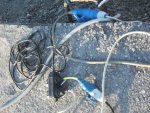
That ribbed tube comes from the base of the quay lamp (the concrete slab I'm standing on with the cat's paw imprint) which only turns on when it's dark. However, each quay lamp turns on when it feels like it. If its bulb is working, that is. Since we're distributing via a four way plug, polarity could be an issue for two of these guys - that's if polarity was checked in the first case.

Well, there's the evidence.
 
Does that mean you only get electricity when it's dark? :eek:

Not when I was last there, though I had to rewire the assembly to get the correct polarity - the local electrician came down (rather late) and checked things out. The light-operated switch appears to be in the unit.
Nice little village, but limited room and the tie-up, on the outside of the breakwater, is only good for settled weather.
 
Top