
Rigging question

purplerobbie

Well-Known Member
Joined
20 Jan 2007
Messages
1,441
Location
ked Away
Visit site
Should the upper and lower spreaders be the same width accross the boat? So the rigging is more or less in column or should the upper ones be a bit shorter so the rigging comes out slightly to the next set of spreaders then come out slightly to the deck?
 
No I don't think it matters or at least we find both designs and you should rig as per the original design.
A wider base ie further out abeam the mast will always give better support than a narrow base. But then a narrow base permits closer sheeting of the jib.
Regarding the spreader tip position in the line of the cap shroud. A longer spreader causing the cap shroud to deviate further will give more end force on the spreader so help to support the middle of the mast. It will also improve the angle of the cap shroud to the top of the mast so supporting it better. However again a longer spreader can foul the jib. If the cap shroud is close to straight ie no deviation at the spreader tip then there will be little end pressure on the spreader ie no point in having a spreader. (given of course that the inner side stay will also support the middle of the mast)
Now all this was assuming one spreader rig and on re reading you have multiple spreaders. It would follow that a lower spreader should be longer than an upper spreader. The added length will deviate the shroud going over it so provide some end pressure on the spreader. A spreader the same length as the one above will provide no or minimal support by way of end pressure on spreader. This is all just from logic.
The rig may be perfectly adequate with equal length spreaders. The line of the shroud is not described as in column being in tension.
In column means the mast must be perfectly straight so that pressure on the top goes straight down not forcing the middle (or any part to buckle outwards) NB some masts on smaller fractional rigs bow middle forward. This bow is then controlled by lower sidestays with chain plate aft of abeam the mast.
Big masts are usually designed much closer to limits so hopefully yours is well designed so stick with original design. olewill

PS the upper spreaders may have been made as long as possible to give the shroud above it the best angle to the mast. It would however look stupid to have it longer than the lower one but equal may be OK. This may give the top of the mast best sideways support at the expense of no or little end pressure on the spreader so support must be from the shroud meeting the mast at that spreader base.
Why are you asking the question?
 
Last edited:
My boat has been re-rigged at some point and the spreaders are wider than the chain plates.
I know the cap shroud shouldn’t come out to the first spreader then back in to the second.
I can shorten the spreaders without too much trouble but i will have to replace the cap shrouds.
If i only had to shorten the lower set of spreaders i could probably get away with it but it would probably make both sets of spreaders the same length
But i think the right answer is whatever i shorten the lower spreaders by i should shorten the upper spreaders the same to keep the same ratio (about 2 or 3 inches a side) I'm just trying to make my life a little easier.

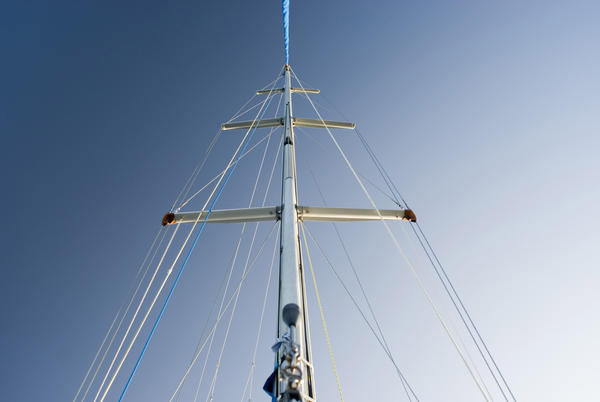
My rig is very like this only 2 sets of spreaders and it narrows back in at the bottom.
boat_rigging_low_angle.jpg
{http://stockarch.com/images/transp...-4117}Image by stockarch - stockarch.com[/url
 
Last edited:
Quote I know the cap shroud shouldn’t come out to the first spreader then back in to the second.
Not to sure which way you are counting spreaders. Certainly the bottom spreaders should not be shorter than the top however equal length is probably OK. Longer bottom than top spreaders is OK.
The top spreader is to improve the angle of the cap shroud to the top of the mast. The 1/3 and 2/3 points of the mast where spreader bases are should be adequately supported by the intermediate stays at those points. So perhaps end pressure on the tips of the bottom spreaders is not so critical. good luck olewill
 
Can you tell us what boat you have, may have detail on the spreader lenth, if we take a Westerly Corsair as an example, double spreader rig, top spreaders are 1mtr long and the lower spreaders are 1.3mtrs long. This I think may help, not your boat but gives you an idea of upper and lower spreader and differences in length, upper ones shorter then lower ones.
 
I would not bother with spreader length, unless there is some other problem with it. Changing shrouds just to make spreaders looking better? :confused:
No rules here, one thing is certain: spreader length should not be less than designed... Rule of thumb: angle at shroud attachment to mast more than 7 deg; this was a minimum, usually. The bigger the better. That is a reason for spreaders, after all.
http://content.answcdn.com/main/content/img/McGrawHill/boating/f0275-02.png
 
I dont think i have explained this very well

if we use you pic ( http://content.answcdn.com/main/cont...g/f0275-02.png ) and if we assume the shroud is A, and the mast is B,
and again if we assume the top spreader is 1 the second spreader is 2 and the gap between A and B at the deck is 3
If we make up a number and say 1, is one meter 2, is two meters and 3, goes back down to 1.5 meters.

It shouldnt do that should it pinch back in at the deck?

Now my thought is if i take 2, off and shorten it so it is the same width as 3, would that be ok?
Or do i need to take off 1, and 2, and whatever i shorten 2, by i need to shorten 1, the same to keep the same ratio between them?

A, comes from the top of the mast in 8mm rigging then over 1, then joins to 2, and then becomes 10mm rigging. If i only shorten 2, it will have no effect on A, but if i shorten 1, and 2, i will have to replace A, as it will then be to long. (well the first half of it would be anyway)

I'm not worried about replacing A, if i have to i would rather it be right.

The boat is a kalik 40 and the original rig was damaged before i got her. The owner managed to find a secondhand rig that was the right length and fitted it
 
I'm not sure I follow you exactly... The pic above is just to show effect of angle (A) shroud makes to mast; this is single spreader situation. You have something this kind, I presume, two-spreader rig: http://www.doylesails.com/onedesign/farr395/images/pic-farr-395-shrouds.jpg - just another handy pic from gogle :).
Spreader length is usually such so to have big enough angle between every shroud and mast. It does not matter whether the fall of shroud (from spreader down) is vertical or not, may be any, it may even go back to mast. Important thing is that it holds mast sideways, so sufficient angle is needed. http://www.woodenboatfittings.com.au/public/shroud-angles.jpg

I understand upper spreader is shorter - so no reason to touch it anyway. Lower spreader is wider than chainplate spread, or even deck. Not convenient, but also nothing wrong with it, really. Usually spreaders were not made wider than deck, or than genoa sheeting angle, as this may be a trouble. But the loads on shrouds were calculated accordingly to the spreaders.

Perhaps this mast comes from wider boat or just one that had chainplates at deckedge. Perhaps it's stronger than you need - but no saying. Shortening spreader will make the whole rig weaker. Kalik had rather high and heavily loaded rig, from looking at it.
Problem is someone has designed the mast you have now in just this way, probably calculating loads on the mast.
When you cut the lower spreader length, forces and loads will change - rig will lose some stiffness up there, while loads on lower shroud will get bigger. Without measuring this rig exactly impossible to say what may happen to it...
So I would not cut anything without a good reason.

I would first make sure what was the original rig design for your boat and compare with what you have. This will give you some idea. IF mast section is not weaker, wires not smaller diameter and so on - compared to original design - then you just may make it similar to original one. Rig specs should be possible to find. Kalik 40 was Gary Mull design, also as Mull 40 and perhaps Olsen 40, later made in far east as Concept 40.
Other than this - it's designing a new rig in fact. Can be done of course, but by someone who knows the boat parameters, not by forum post :o
 
Last edited:
If it's not grossly getting in the way of sheeting in the genoa, I can't see a problem, provided the mast is not bending in an odd or excessive way.
The extra length will be trying to push the mast to leeward at spreader height, but the lower will stop that
Are the spreaders or lowers angled aft?
Is it masthead?
If the mast bends a lot fore and aft, that changes all the shroud tensions more, so you need to be sure the tensions are reasonable to start with.
There is a good little book by Ivar Dedekam (sp?) and I think Kemp and NOrth have good info on their websites.
I would want to know the rig was behaving properly as the yacht is powered up progressively, before going out in big weather.
Whatever the spreader lengths, the shroud tensions need to be about right.
 
I can only agree with all that has been said. My own phobia is regards to the fore and aft bending of the middle of the mast. (or 1/3 and 2/3 height points.) So check and be aware of mast bend. If you really don't like the lower spreaders being longer than seems right then yes shorten them to same (or approaching) length as upper spreaders. A little shortening should not matter much.
yes I think you are right to be concerned about the rig which is not identical to the original. Which apparently failed anyway.
good luck olewill
 
The original mast got damaged when the pin in the forstay worked loose so not a rig failure.

The rig is in mast reefing so i cant put too much pre-bend on it.
If you google Kalik 40 sail plan it gives a forestay length of 53.8 ft and i just ordered a sail and measured the sail as 51.2 so accounting 2.5ft for the roller furling sounds about right.

The problem is in the sheeting angle the sail is rubbing heavily on the lower spreader and the genoa cars are quite far on the deck.
Yes i think the boat the rig came off had the chainplates on the hull. That would make it about right if i moved my chainplates on the hull.

I think i'm looking at shortening them at the most about 4 to 6 inches each side so i'm not cutting a great amount off. I know it dosent sound a lot but it really looks odd when you see it on the boat.
 
The original mast got damaged when the pin in the forstay worked loose so not a rig failure.

The rig is in mast reefing so i cant put too much pre-bend on it.
If you google Kalik 40 sail plan it gives a forestay length of 53.8 ft and i just ordered a sail and measured the sail as 51.2 so accounting 2.5ft for the roller furling sounds about right.


The problem is in the sheeting angle the sail is rubbing heavily on the lower spreader and the genoa cars are quite far on the deck.
Yes i think the boat the rig came off had the chainplates on the hull. That would make it about right if i moved my chainplates on the hull.

I think i'm looking at shortening them at the most about 4 to 6 inches each side so i'm not cutting a great amount off. I know it dosent sound a lot but it really looks odd when you see it on the boat.

You can lessen the chafing of the genoa on the spreader by reducing the height of the tack of the jib. ie reduce that 2.5 ft for the roller reefing. This will then make an ideal sheeting point further forward. It may help at least a bit.. olewill

(Warning I am an anti roller reefing person and I have the jib tack right on the deck on the little boat.)
 
With lower spreaders wider than the chain plates you get an extra outward pull on the chainplates and more compression on the spreaders.

Having spreaders (upper & lower) with same lenght is ok.

But having the upper wider than the lower sound like a bad idea, it will give give outward pull at lower spreaders.

Rememeber that the shrouds should bisect the angle between the shrouds, for the upper spreaders it's easy.
For the lowe it's most common to bisect the angle of the upper shrouds.
 
Top